

Treats for Poilus
Holiday Rations in the French Army, 1914-1918

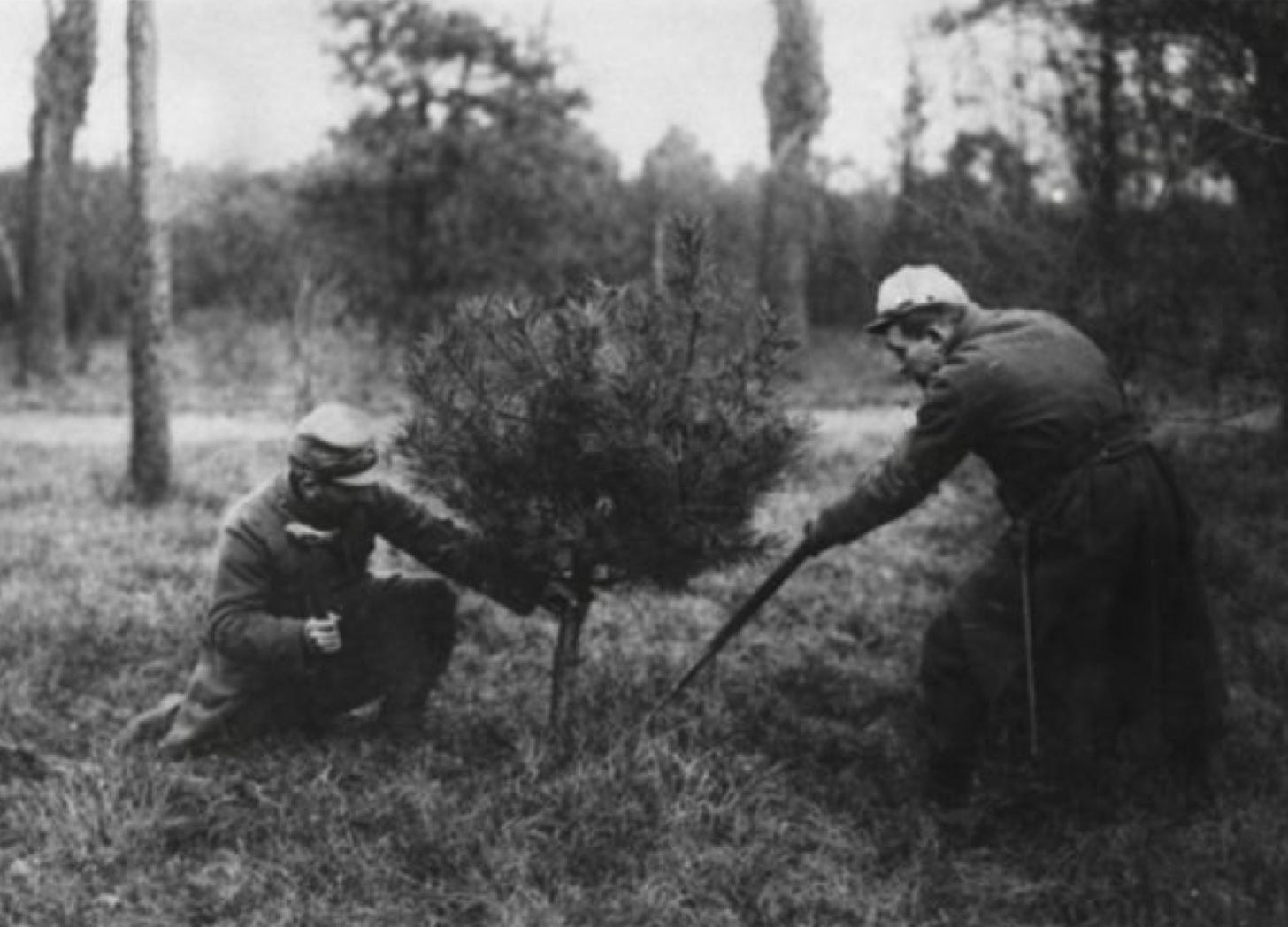
In the section of Paths of Glory devoted to rations issued to French soldiers of the First World War, Anthony Clayton notes that ‘extra food and wine were generally provided on 1 January and 14 July [Bastille Day], but not at Christmas’.1 This observation conforms to the characterization of the Third Republic as a self-consciously (and, at times, aggressively) secular state. At the same time, it runs counter to the my many encounters with descriptions of special meals enjoyed by poilus on the Feast of the Nativity.
My first attempt to shed light on this conundrum took the form of a search for appearances of the French word for Christmas (Noël) in the official history of the French Army of the First World War.2 This turned up many mentions of men who bore the surname of Noël and a few discussions of German statements that used ‘Christmas’ as shorthand for ‘the end of the year’, but nothing about celebrations or the issue of special rations.
I found a handful of relevant anecdotes in the collection of regimental histories stored on Gallica, the digital branch of the French National Library. In the historique of the 45th Chasseurs à Pied, for example, I learned that, on Christmas Day of 1916, the men of the battalion, which was then out of line, were treated to both a suspension of work details and a ‘recreational evening’.3 I also discovered that the dinner enjoyed, on 25 December 1914, by the sappers of a company of the 2nd Engineers owed less to any official act than to the recent liberation of packages from a German trench.4
Speaking of packages … the section of the official history that describes postal services notes that, ‘during the period of Christmas and New Year’s Day’, the folks at home were entitled to send a one-kilo parcel, free of charges for postage, to each a soldier at the front. As a result, towards the end of each year, more than 600,000 gift boxes of that sort, each destined for an individual poilu, passed through the central sorting facility at Reuilly.5
A quick check of the French equivalent of the Congressional Record and Hansard shows that the Parliament of the Third Republic adopted these laws on 23 December 1915, 7 December 1916, and 7 December 1917. In other words, the pattern of the passage of these acts accords with the theory that a benefit that was originally designed to promote a secular holiday may have evolved into a means of helping soldiers celebrate Christmas. Moreover, while the date of the last act in this series – 17 December 1918 – may indicate an attempt to ‘walk back’ from the implicit endorsement of Christmas, it might also reflect nothing more than, in the aftermath of the Armistice of 11 November 1918, parcels would travel more quickly.6
For Further Reading


Anthony Clayton Paths of Glory: The French Army, 1914-1918 (London: Cassell, 2015) page 84
Les Armées Françaises dans la Grand Guerre (Paris: Imprimerie Nationale, 1922-1936)
Alfred Mercier Historique du 45ème Bataillon de Chasseurs à Pied (Nancy: Imprimeries Réunies de Nancy, 1920) page 91 (Gallica)
Historique de la Compagnie 17/1 du 2e Régiment de Génie (Belfort: André Herbelin, 1920) page 7 (Gallica)
Les Armées Françaises dans la Grand Guerre: Tome XI, la Direction de l’Arrière (Paris: Imprimerie Nationale, 1937) page 395 (Mémoire des Hommes)
L. Bocquet Collection Complète des Lois, Décrets, Ordonnances, et Règlements (Paris: Recueil Sirey, annual) (1915) page 414, (1916), page 450, (1917) pages 645-646, and (1918) pages 719-720 (Gallica)