

Sherman on Pontoon Bridges
Imaginary Armies

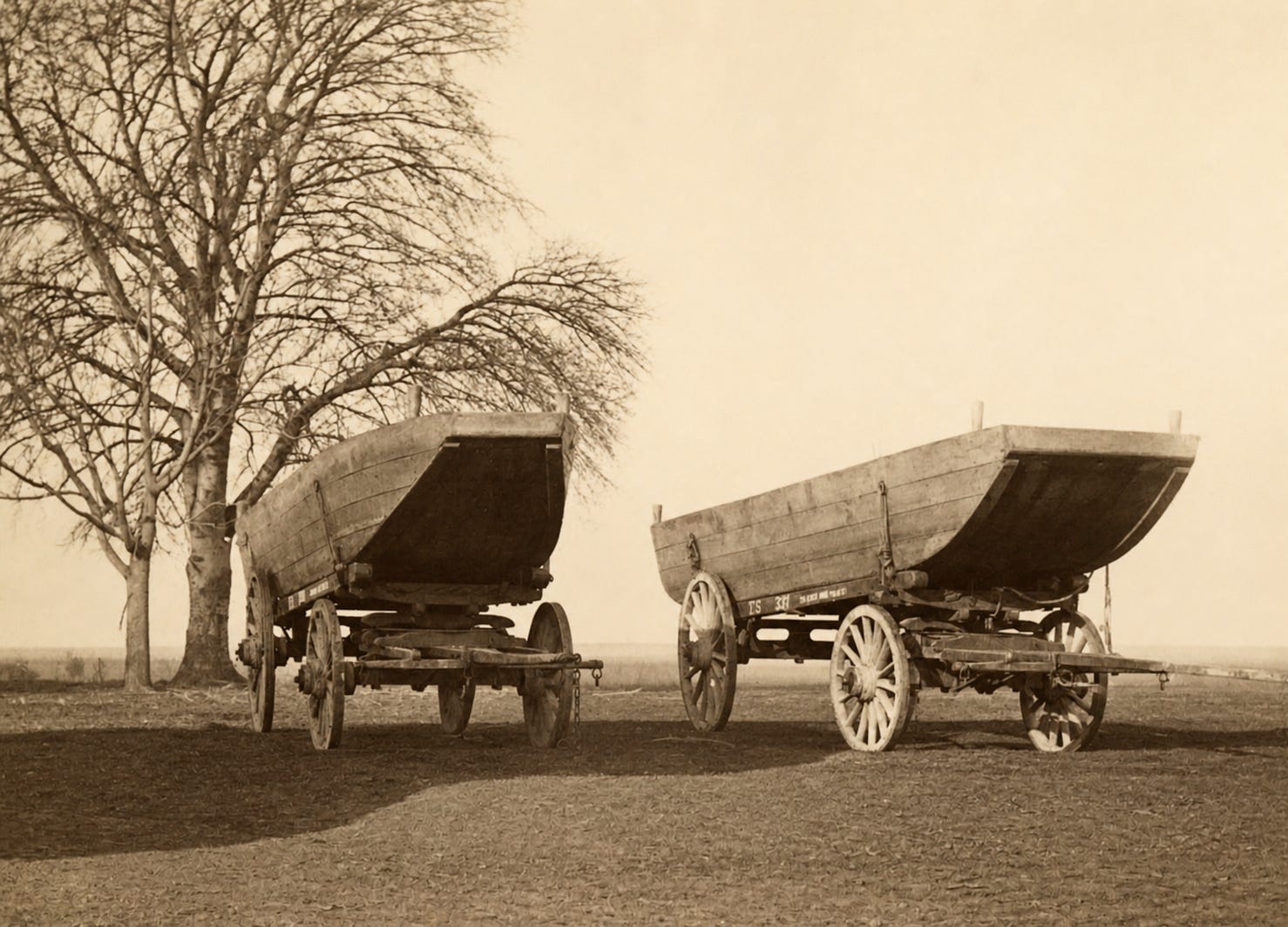
For the passage of rivers, each army corps had a pontoon-train with a detachment of engineers, and, on reaching a river, the leading infantry division was charged with the labor of putting it down. Generally the single pontoon-train could provide for nine hundred feet of bridge, which sufficed; but when the rivers were very wide two such trains would be brought together, or the single train was supplemented by a trestle-bridge, or bridges made on crib-work, out of timber found near the place.
The pontoons in general use were skeleton frames, made with a hinge, so as to fold back and constitute a wagon-body. In this same wagon were carried the cotton canvas cover, the anchor and chains, and a due proportion of the balks, chesses, and lashings. All the troops became very familiar with their mechanism and use, and we were rarely delayed by reason of a river, however broad.
I saw, recently, in Aldershot, England, a very complete pontoon-train; the boats were sheathed with wood and felt, made very light; but I think these were more liable to chafing and damage in rough handling than were our less expensive and rougher boats. On the whole, I would prefer the skeleton frame and canvas cover to any style of pontoon that I have ever seen.
Sources and Notes
Apart from items printed in italic letters, the text of this post comes from: William Tecumseh Sherman Memoirs of William T. Sherman (New York: D. Appleton, 1875) Volume II, Chapter XIV (Internet Archive)
Librivox offers, free of charge, an audio version of the aforementioned chapter. The viva voce version of the paragraphs reprinted in this post can be found in the recording marked ‘Military Lessons of the War - Section 3’. (The Tactical Notebook salutes Librivox reader David Wells for the high quality of this program and thanks him for his support of this remarkable service.)
The term ‘balks and chesses’ describes the pre-cut pieces of wood that were placed on top of pontoons, thereby converting a line of boats into a bridge.
Related Reading


