

Sherman on Signals
Imaginary Armies

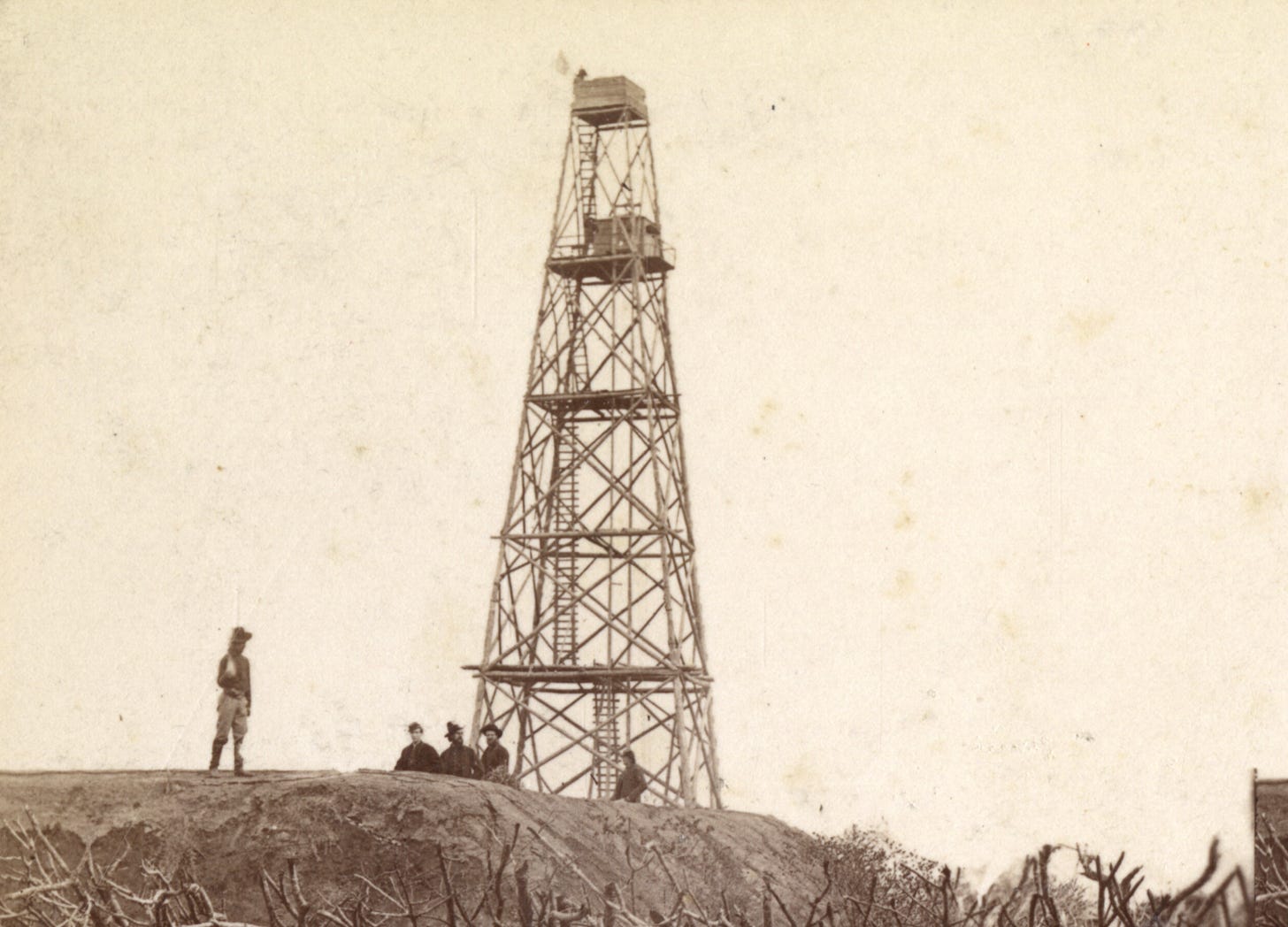
In the last chapter of his memoirs, William Tecumseh Sherman explains both his fondness for the telegraph and his disappointing experience of visual means of communication.
For the rapid transmission of orders in an army covering a large space of ground, the magnetic telegraph is by far the best, though habitually the paper and pencil, with good mounted orderlies, answer every purpose. I have little faith in the signal-service by flags and torches, though we always used them; because, almost invariably when they were most needed, the view was cut off by intervening trees, or by mists and fogs.
There was one notable instance in my experience, when the signal-flags carried a message of vital importance over the heads of Hood’s army, which had interposed between me and Allatoona, and had broken the telegraph-wires (as recorded in Chapter XIX) but the value of the magnetic telegraph in war cannot be exaggerated, as was illustrated by the perfect concert of action between the armies in Virginia and Georgia during 1864. Hardly a day intervened when General Grant did not know the exact state of facts with me, more than fifteen hundred miles away as the wires ran.
So on the field a thin insulated wire may be ran on improvised stakes or from tree to tree for six or more miles in a couple of hours, and I have seen operators so skillful, that by cutting the wire they would receive a message with their tongues from a distant station. As a matter of course, the ordinary commercial wires along the railways form the usual telegraph-lines for an army, and these are easily repaired and extended as the army advances, but each army and wing should have a small party of skilled men to put up the field-wire, and take it down when done. This is far better than the signal-flags and torches. Our commercial telegraph-lines will always supply for war enough skillful operators.
Sources
Apart from items printed in italic letters, the text of this post comes from: William Tecumseh Sherman Memoirs of William T. Sherman (New York: D. Appleton, 1875) Volume II, Chapter XIV (Internet Archive)
Librivox offers, free of charge, an audio version of the aforementioned chapter. The viva voce version of the paragraphs reprinted in this post can be found in the recording marked ‘Military Lessons of the War - Section 3’. (The Tactical Notebook salutes Librivox reader David Wells for the high quality of this program and thanks him for his support of this remarkable service.)
The link in the text will take you to Chapter XIX of Sherman’s Memoirs (Hathi Trust).
Related Reading


