

A Rude Reception
A novelist describes his first day of recruit training
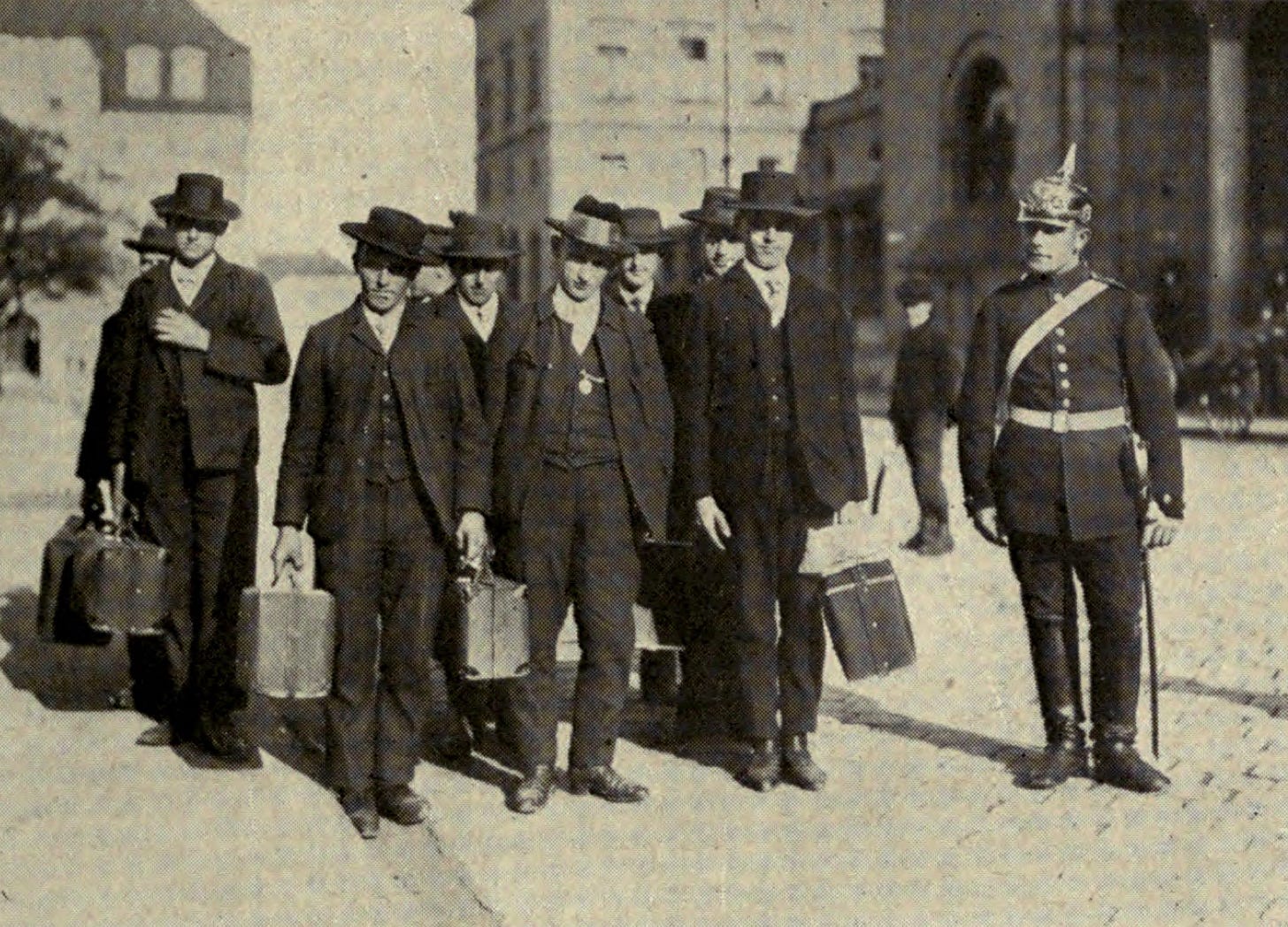
At the start of 2026, The Tactical Notebook will resume its serialization of the diary of Alwin Lydding, thereby synchronizing the seasons described in each post with those experienced by our readers in the Northern Hemisphere. In the meantime, we will publish excerpts from comparable stories, whether true or fictionalized, written by some of Lieutenant Lydding’s contemporaries.
This effort begins with the following description of recruit training during the First World War. It comes from The Fiery Way (Der Feurige Weg), an autobiographical novel written by Franz Schauwecker shortly after the end of the First World War.
The translation of this novel into English, by Thonald Holland, entered the public domain in 2025. You can find the whole book on the website of The Hathi Trust.
The following version of Mr. Holland’s translation includes a small number of changes that I have made, most of which replace British terms of art with their German (or, in a few cases, American) equivalents.
‘Training squad … halt!’
The awkward squad halts.
‘Left turn! Left, man, not right! Ease off a bit, gents. Ease off to the right.’
The clodhoppers press to the right.
‘More! Little more! Right, you ox, you! Spread yourselves out! Get on, get on! Still, back there. . . Right guide!’
Everybody treads on everybody else’s feet, shoves with elbows, curses. Squash. Mutterings.
The Unteroffizier gives some instructions to the escort and enters the building before us. The barrack-square round us is cold, bare, gigantic. It is an October evening; the wind drives fine rain across the dusk, out of which rise the barracks, shadowy blocks with a few glimmering windows breaking the monotony. We shiver with cold and damp.
We have just arrived, herded together from all corners of the province, and we are waiting, wearily, hungrily, for allotment of quarters. Chattering, laughing, cursing.1 One or two dumb louts stand helplessly around, overwhelmed by the newness of everything. A good many are from the country, have hardly been out of their village before.
I strike up acquaintances. ‘Blooming cold.’ ‘Um. I’m thirsty.’ ‘Wish they’d hurry up a bit with these quarters.’ ‘They don’t care about us.’
Half an hour dawdles by. Some go up to the escort and ask questions. There is a flashing of pocket-lamps. Suddenly three men emerge from the building: a Feldwebel, an Unteroffizier, and a clerk.
‘Ease off. Guide right! ‘Hi, you there, have the goodness to come this way!
Order in the swarm at last.
‘Count … off!’
‘One, two, three, four, seven, eight, nine …’
‘Right … As you were! You’ll have to sweat for that, my man. Now, once more. ‘Count … off!’
We stumble through somehow.
Allotment of quarters begins. The room I come to is for fourteen men, and we’re twenty. So twelve have to sleep in six beds. I’m one. Up till now I’ve always had myself. The beds are two-storied here as well, and the blankets are distinctly thin.
Oh! Noise, tobacco-smoke, laughter. Every smell tells a tale. Everything is strongly-built here, and rough-planed. If anyone treads on your foot he doesn’t say ‘Sorry’. The more courteous say ‘Hi!’
The door flies open. A soldier appears in helmet and side-arms. Everyone shuts up and stares at the man, who strides in to the middle of the room, thick-legged, hand on sword-strap, and examines us in silence. One of us ventures a couple of paces towards him.
‘Where’s the canteen here, Unteroffizier?’ The soldier tugs at his sword-strap. ‘Not an Unteroffizier. Want to start with the canteen straight away, do you? That’s right. Over the yard by the guard-room.’
‘Guard-room? Where’s …?’
‘Ask the Feldwebel. Down in the office. He’ll take you there straight, and stand you one.’
The inquirer laughs sheepishly, and shuts his mouth, mistrusting. We others stand awed, helpless, wondering, looking at the man in helmet and uniform. He knows what’s what; we others are only poor boobs. The eagle on his helmet shines, his buttons are sparkling.
‘What’s the work like here, Mister . . . er? um? eh?’ asks another cheerfully. (There are still a few heroes left in the world.)
‘Very nice. If you’re tired, you do a “ground arms.” The Unteroffiziere always keep a bottle of Kümmel handy for refreshment.2 Just make yourselves at home and ask anything you want to know, always ask.’
Suddenly he laughs, good-humoredly.
‘Ah, well! Now get into bed. You’ll see to-morrow for yourselves. I don’t have to drill now, myself. I’m a Gefreiter. Lights out in a quarter of an hour.’
That’s all right for me. I’m nearly undressed already. Mechanically, with a gloomy oppressiveness in my head that suggests fifth-class hotel, a home away from home, an asylum for the roofless ... I take off my boots and put them out on the landing, where vague shapes are floating about in mufti. I’m on the upper story, of course. My bedmate is in already. I look at him, and decide I’d best keep my trousers on.
As I turn over, someone seizes me by the leg. I look round. The Gefreiter is standing there, looking at me.
‘Do you always do that?’
‘Do what?’
‘Do that with your boots?’
‘Boots … yes, I put them out … O Lord!’
‘That’s all right,” says the Gefreiter, “we always do that here. Then the colonel goes round the landings and picks the boots up and cleans them till morning. That’s his job. If there’s too many, his wife helps him. And in the morning he puts out an extra pair for everybody. Have a look now. They may still be there.’
I jump to the door. The boots are gone. Thank God I’ve got another pair in my bag.
To be continued …
Source for the Photo
The photo at the top of this post comes from George Abel Schreiner The Iron Ration: Three Years in Warring Central Europe (New York: Harper Brothers, 1918) page 63 (Internet Archive)
For Further Reading


Though the regiment in which Franz Schauwecker served, Fusilier Regiment Queen Victoria of Sweden (1st Pomeranian), occupied a Kaserne in Bromberg (present-day Bydgoszcz), on the border between the Prussian provinces of Posen and West Prussia, it belonged to a brigade, a division, and an army corps stationed in Stettin, which was located in Pomerania. The 34th Fusiliers also bore a title that linked it to the latter province.
In the days of the German Empire, people in Northern Europe often drank Kümmel, a liquor flavored with herbs, after eating a heavy meal.