

Weapons/27th Marines (III)
The conclusion to a decision-forcing case

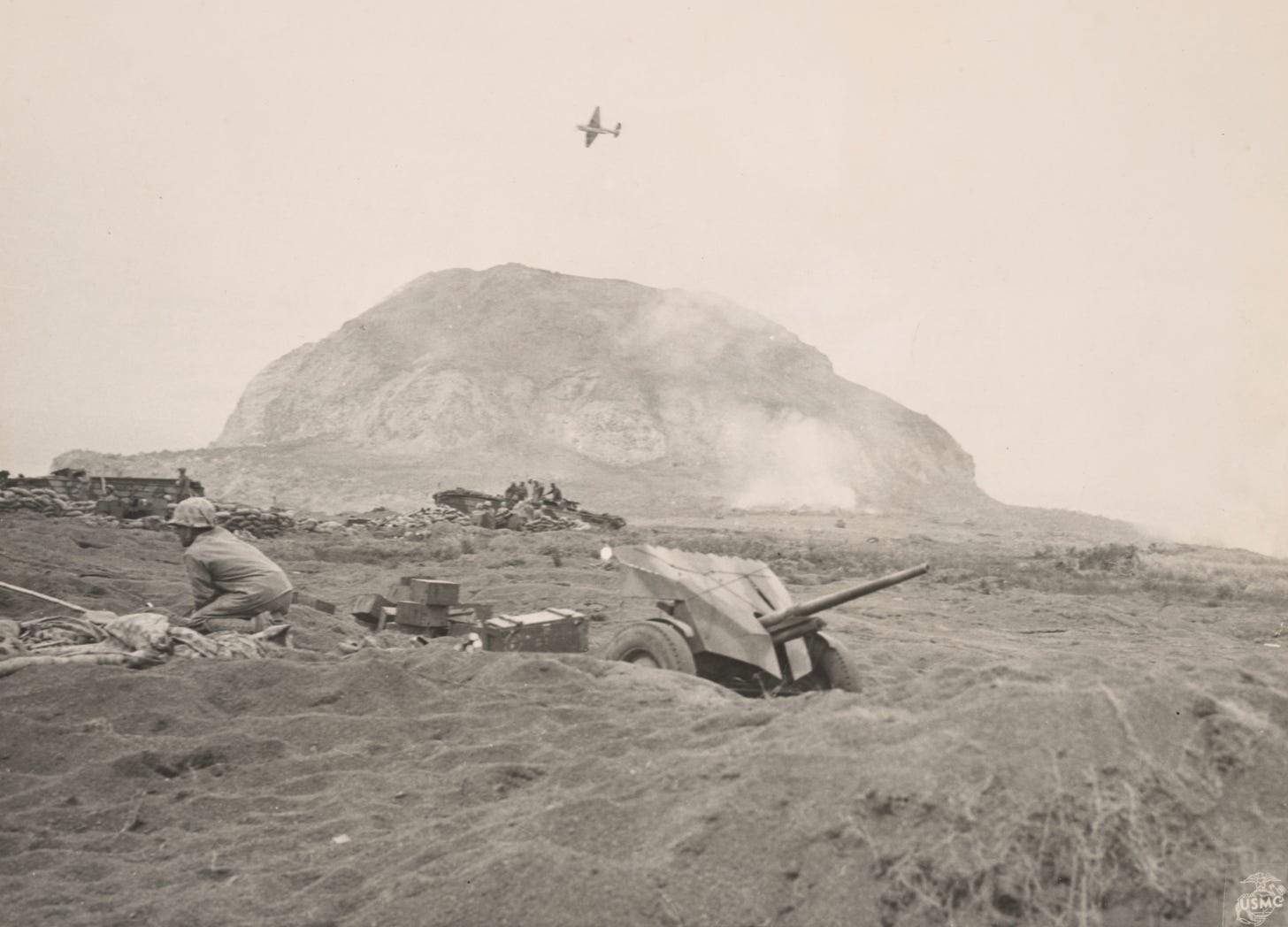
This post concludes a three-part series drawn from the memoirs of its protagonist, Captain Earl J. Stearns, USMC. If you have not done so already, please read (and, better yet, work through) the first two posts in this sequence.


Despite the fact that your three combatant platoons lack the weapons that define them, you distribute them in accordance with the task organization of the 27th Marines drawn up before the landing. Thus, you attach your First Platoon to the 1st Battalion and your Second Platoon to the 2nd Battalion. As your Third Platoon is already serving with the 3rd Battalion, you find yourself at the head of ninety-five or so officers and men of a ‘company minus’, an organization that consists of the three sections of your company headquarters (headquarters, communications, and maintenance section) and the crews of the four disabled self-propelled guns.

The memoir that serves as the source for this exercise contains no description of the way that you employed these Marines. Indeed, from the moment you detach your two anti-tank platoons, you make no mention whatsoever of your company. Rather, the remainder of that narrative deals with the actions of the 27th Marines as a whole.
This suggests the possibility that the regimental commander employed the remnants of Weapons Company as a means of filling small gaps, responding to minor emergencies, and defending his base. In other words, he may have employed the Marines led by Captain Stearns as a Verfügungs unit. (For more on that concept, please see our two posts on the subject of the battalion designed by Franz Uhle-Wettler.)
The regimental commander might also have employed the remaining Marines of Weapons Company to fill the many gaps in the ranks of his battalions that occurred in the course of the battle.
On that subject ..
Captain Stearns concluded his monograph with a critique of the way that Marine formations on Iwo Jima handled matters of rotation, rest, and replacement.
It is my opinion that a maximum of two weeks fighting such as was encountered on Iwo is sufficient for any unit at one time. CT-27 (Combat Team 27, that is, the 27th Marines) was in action for thirty-two days, which seems but a short time, but the fighting had been bitter from the time the waves left the control vessels up to the hour the troops left the island
Casualties were high and by the end of two weeks most platoons were lead by junior NCQs and many of the companies by young lieutenants. While the highest praise and credit should go to these leaders, the fighting efficiency of the unit was reduced below an efficient standard by the end of two weeks.
Much of this could be laid to the poor replacement system that was used. Replacements reached the regiment in dribbles as the shore party on the beachwould finish with them. Due to the nature of the fighting, no time or place presented itself to properly orient these people before they were put in the line, resulting in a great many un necessary casualties. One regiment of the Third Division that could have been put in the line, was never landed. In addition, the 147th Infantry Regiment, fully equipped, was landed on 21 March with the mission of occupying Iwo after it had been secured, and it is my opinion that had both of these units been committed, the campaign would have been over much sooner, with less casualties.
Source
Earl J. Stearns The Operation of the 27th Marine Combat Team (Fifth Marine Division) on Iwo Jima, Volcano Islands, 19 February-23 March 1945 (Western Pacific Campaign) (Fort Benning: Unpublished Manuscript, 1948)
Along with four hundred or so ‘personal experience monographs’ written by other veterans of the Second World War, this paper can be found on the website of the Donovan Library.


Fascinating trip thru a small part of a very nasty campaign. Thank you.
Captain Stearns certainly stated some points I have thought a lot about over the years. I well remember the first time I heard about the individual replacement system both the War and Navy Departments used, and still use, when I saw the movie To Hell and Back. Even as a kid (I was 10 I think), I wondered why you would do that to people. My subsequent readings of history, commentaries and analyses have only confirmed that it is a procedure that only works for personnel managers at HRC and other places far from actual war fighting. I thought the Army’s COHORT program was a great idea, but it wound up in the Too Hard box at HRC and HQ DA way too soon. I am not sure that the new manning system and IPPS-A are any improvement as, as Donald Vandergriff has noted extensively, HRC still operates the same old way.