


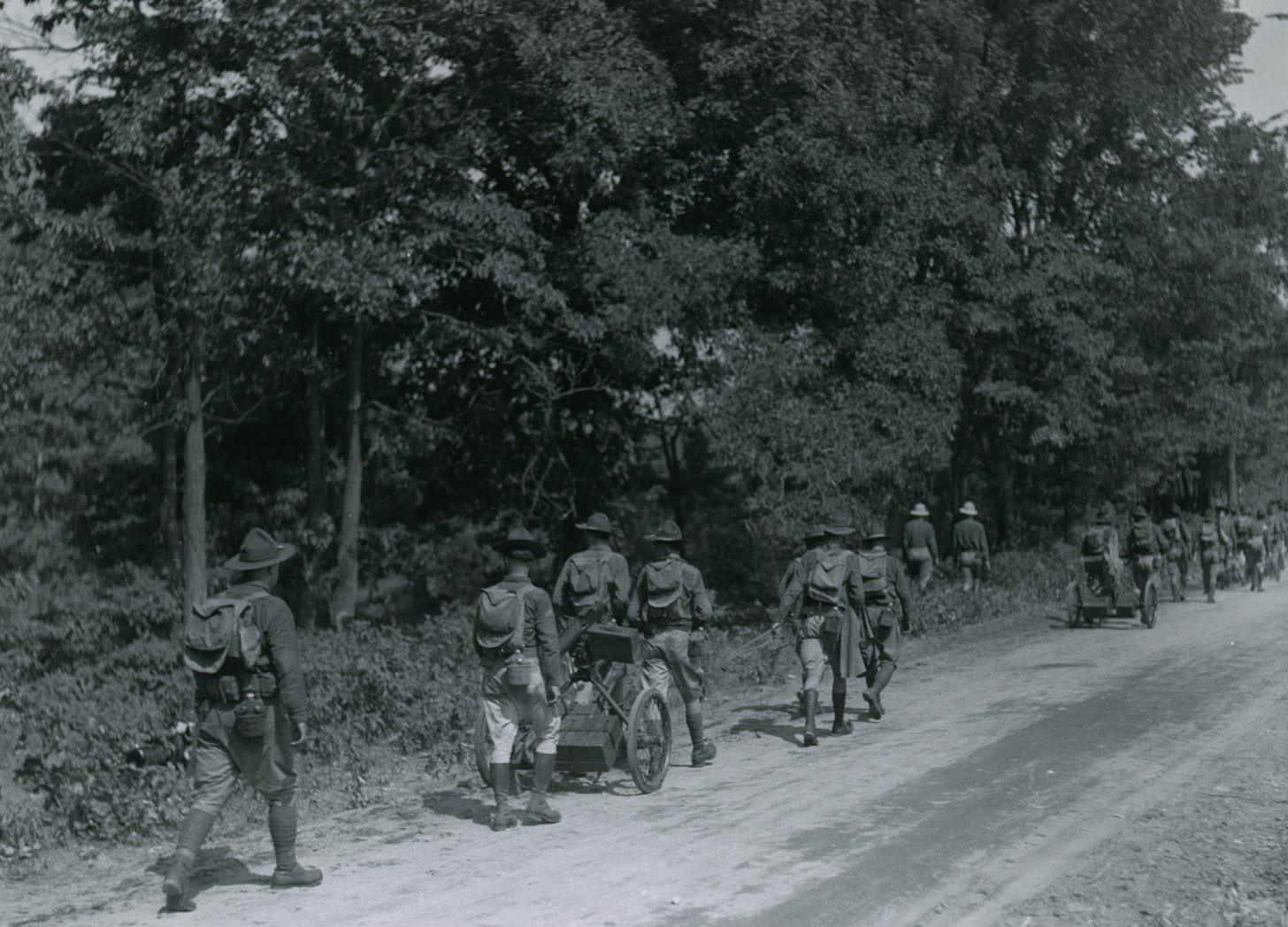
The following problem appeared in the first semi-annual volume of the Infantry School Mailing List, which rolled off the press in 1931. (This periodical, which might well be described as a journal in all but name, replaced the collections of mimeographed instructional materials that the US Army Infantry School sent out to subscribers in the 1920s.)
For the philosophy behind theses problems, please see:

NOTE
This problem places players in the role of a regimental commander who must devise and describe three courses of action.
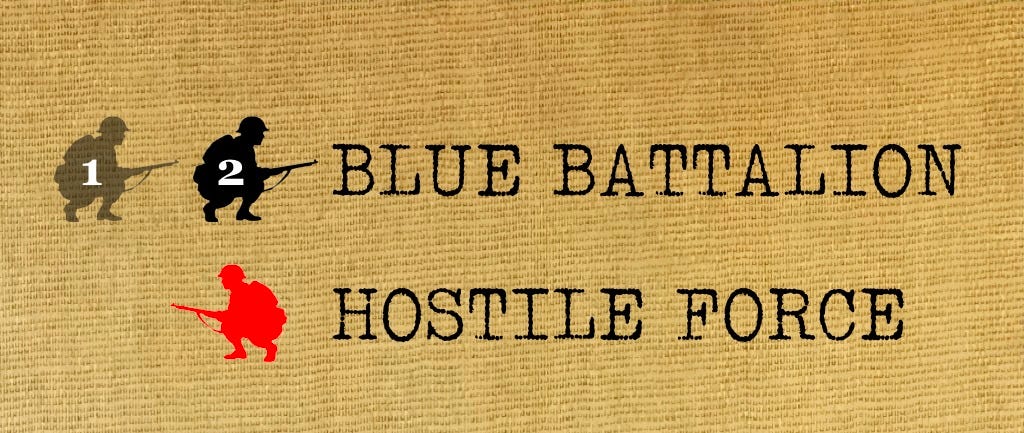
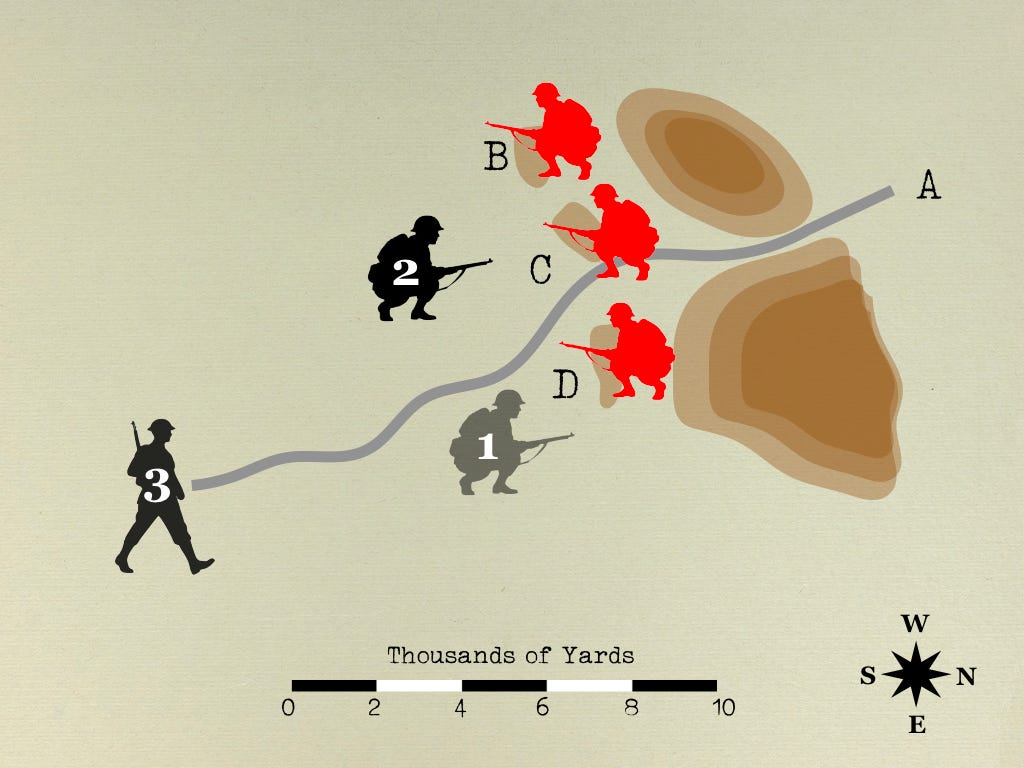
Each black silhouettes represents a full-strength friendly battalion. A gray silhouette depicts a battalion that has suffered heavy losses. Each red silhouette stands an enemy force of comparable size.
PROBLEM NO. 14
And what did ye look they should compass? Warcraft learned in a breath?
Rudyard Kipling The Islanders
SITUATION
A Blue force has the mission of preventing enemy troops from moving southeast through the Pass A.
One Blue battalion on Hills B, C and D was attacked this morning by an enemy force and driven back. An additional Blue battalion arrived this afternoon and the Blues attacked.
At 6:00 PM the attack was slowly progressing. The 1st Battalion, somewhat disorganized and at about 60 per cent effective strength, is generally east of the road. The 2nd Battalion is [located] to the west.
A third [friendly] battalion has arrived at the locality shown. Some officers of this battalion have preceded the battalion and are familiar with the terrain. Darkness falls at 7:00 PM. Additional enemy troops, marching toward A, went into bivouac at 5:00 PM, 17 miles northwest of A.
(1) All Blue battalions are well-trained veterans.
(2) Two Blue battalions are well-trained veterans; the last battalion to arrive is only partly trained.
(3) All of the Blues have had very little training.
REQUIREMENT
What does the Blue commander intend to do in each case?
How to Play
I invite paid subscribers to to use the comments section to share their own answers to the questions posed.
I will post the original (1931) solutions to the problem, as well as my own commentary, on Sunday, 23 August 2026.
Sources
‘Infantry Problems’ Infantry School Mailing List (Fort Benning: US Army Infantry School, 1931) Volume 1 (1930-1931) page 54 (Internet Archive)
The Internet Archive preserves scans of microfilmed copies of all thirty volumes of the Infantry School Mailing List. However, it catalogs them under the heading of the Infantry School Quarterly, which succeeded the Mailing List in 1947. (Internet Archive)
The Hathi Trust provides links to scanned-from-paper copies of some, but far from all, issues of the Infantry School Mailing List (Hathi Trust)
You can find a copy of The Islanders on the webpage of the Kipling Society.
Related Reading


“A Blue force has the mission of preventing enemy troops from moving southeast through the Pass A.”
Given that enemy forces have already moved beyond Pass A, I would say that Blue Forces have already failed in their mission. Moreover, and given the relative equality of forces and time remaining before darkness, the only real option is to shift to the defense unless significant additional Blue Forces are readily available. In all 3 cases I would seek to defeat any attack by enemy forces by constructing prepared positions in the best ground I could find, clearing fields of fire, resupplying my forces, requesting additional forces and supplies, and attacking by fire with organic weapons, artillery and anything else available (odd that combined arms operations are often neglected in these problems). The attrited Battalion would become the Regimental reserve until it could be reconstituted and the other two Battalions would form the defense.