

River Road
The Conclusion of 'Snow'


The following post describes the historical solution to the third problem of a decision-forcing case. For the first five parts of this exercise, please see …


28 February 1942
At 0615, Captain Middeldorf came to the conclusion that the weak point of the Soviet position was the frozen stream that ran between the two sides of Pashoga. He therefore decided to lead the Reserve Company in an attack along that axis.
While waiting for the Reserve Company to arrive, Middeldorf ordered all elements to do what they could to prevent Soviet soldiers from escaping the village and to be on the watch for Soviet reinforcements. To this end, the artillery battery prepared to drop shells on routes that led out of Pashoga.
This attack, which began at 0800, resulted in German victory. By 0830, the Germans had captured, in addition to the village of Pashoga, 29 prisoners, 26 rifles, and an 82mm mortar. They also find the remains of 27 Soviet soldiers who had, presumably, died in the defense of the village.
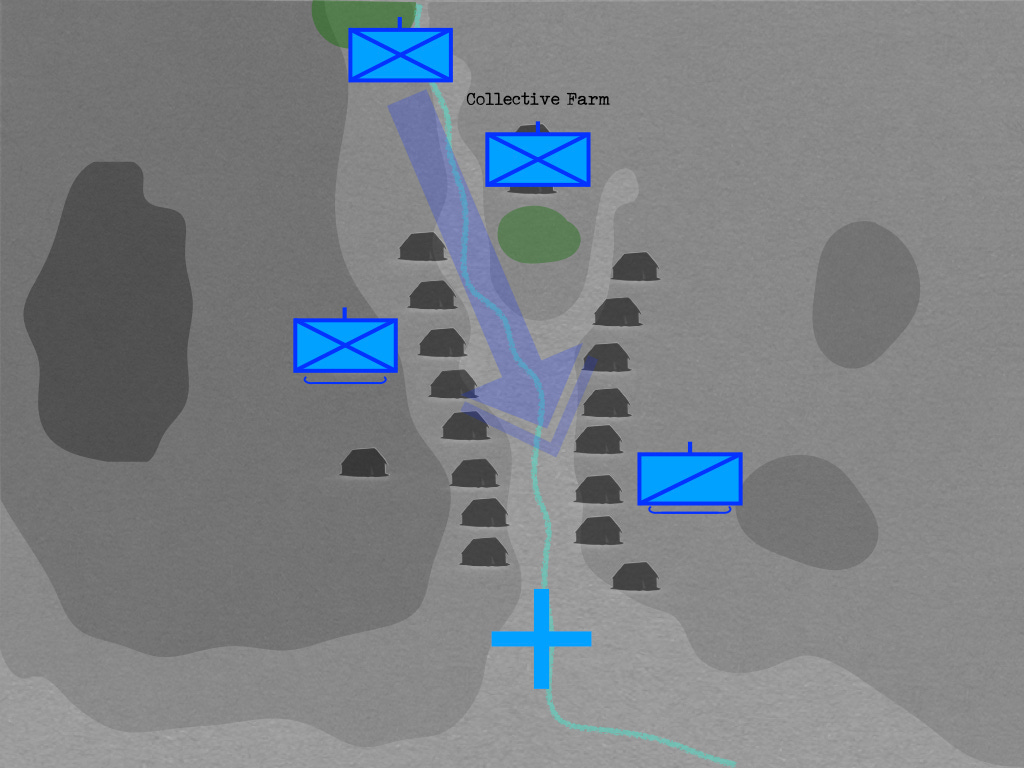
In the course of the attack, five German soldiers suffered light wounds. (At this time, a “light wound” was one that could be treated without evacuation to a hospital in Germany.) In addition to this, frostbite injured several of the attackers.
On the following day (1 March 1942), Soviet forces conducted two attacks against Pashoga, one at 1200 and one at 1530. Both attacks failed. The Soviets also used mortars and a flat trajectory gun to shell the village.
At 2230, Russian aircraft bombed a woods where Soviet soldiers had assembled, presumably for a third attack.
On the same day, Captain Middeldorf falls ill. He therefore relinquished command to First Lieutenant Sauvant-Siegert.
On 2 March 1942, a German patrols in the vicinity of Pashoga found the remains of 20 Soviet soldiers.
Sources
Most of the information used to create this decision-forcing case comes from the war diary of Battle Group Mollenhauer (Kampfverband Mollenauer) for the period 22 January 1942 through 28 April 1942. I found this on the website of the Russian-German Project for the Digitization of German Documents found in Russian Archives.
For Further Reading


Much more direct approach, I like it.