

The Walrus and the Penguin (VI)
The Mobilization of the British Army (1914-1916)

This post concludes a series. To read the earlier installments, please see:


The first Military Service Act of 1916, which came into force on 27 January 1916, both ended direct enlistment into the Territorial Force and preserved its status as a separate body. The act replaced voluntary enlistment of all types with the compulsory call up of all single men of military age. Thus, rather than joining either the Territorial Force or the Regular Army, a man subject to the act registered with the authorities and waited to be called. At the same time, the act called for the discharge and subsequent conscription into the Regular Army of unmarried members of the Territorial Force who had declined to volunteer for Imperial Service.1
The second Military Service Act of 1916, which was implemented on 25 May 1916, included married men in the list of those liable to conscription into the Regular Army. At the same time, it made all members of the Territorial Force available for service outside of the borders of the United Kingdom and, at the same time, subject to involuntary transfer to a unit of the Regular Army.2
It took some time for the effects of conscription to erode the particular identities of those parts of the Territorial Force that were serving overseas. While field artillery units serving on the Western Front lost their traditional designations in the course of the great reorganization of 1916, those serving elsewhere, as well as all infantry battalions and Yeomanry regiments, held on to their old names until the end of the war. Moreover, while overseas units received reinforcements from a variety of sources, all concerned with the personnel replacement system seem to have placed a high value on the maintenance of the traditional relationship between units at the front and their affiliated reserve units.3
During the first week of May of 1916, the overall strength of the Territorial Force stood at 1,017,763. Of these million or so officers and men, about a quarter had been members of the Territorial Force at the start of the war. (On 4 August 1914, some 270,859 soldiers were serving in drilling units of the Territorial Force or the Territorial Force Reserve.) Thus, in the first twenty-two months of the war, the Territorial Force had enjoyed a net increase of some three-quarters of a million men. These figures compare favorably with the figure of 900,000 mentioned by Haldane in the early public discussions of the Territorial Force. Moreover, as more than nine-tenths of the officers and men of the Territorial Force had volunteered for overseas service before the onset of conscription made such declarations obsolete, Haldane’s prediction in that regard proved to be accurate as well.4
Haldane, however, proved less than perfectly prescient when it came to the overall size of the land forces that the United Kingdom would put into the field. The one million members of the Territorial Force represented about a third of the nearly three million officers and men serving in the British Army in May of 1916 and a little more than a quarter of the almost four million soldiers of all ranks who were with the colours when, in March of 1918, the British Army was as large as it would ever be.5
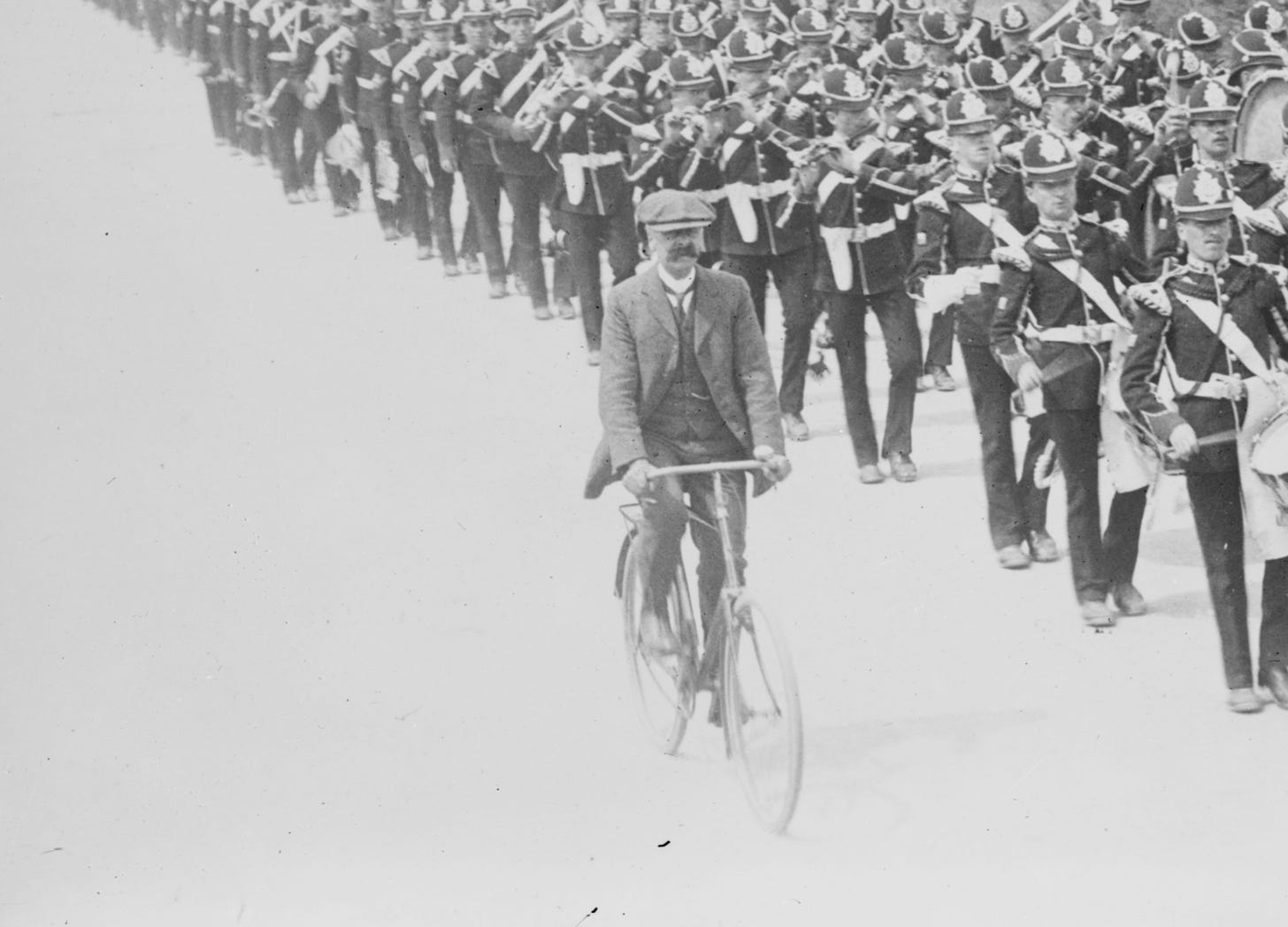
Viewed from the point of view of individual arms, the Territorial Force provided both the lion’s share of the horse cavalry regiments (57 out of 91) and a substantial proportion of the front-line infantry battalions (486 out of 1,051).6 It did not, however, contribute nearly as much to the new arms that played such a large role in the First World War. Thus, the while many men who had entered the British Army through the Territorial Force served with the units that employed siege artillery, tanks, aircraft, poison gas, and tunneling techniques, nearly all of those units belonged to the Regular Army. The exception that proves this general rule is provided by the many cyclist battalions and bicycle-mounted Yeomanry regiments of the Territorial Force, most of which spent the war on coast defence duties.
In the recent popular literature on the First World War, the Territorial Force gets much less attention than the New Armies and Haldane is all but eclipsed by the figure of Kitchener. However, there is much evidence that the contemporaries of both men realized that Kitchener’s failure to make better use of the framework for expansion provided by the Territorial Force was a mistake.
One of these was Winston Churchill, who, while serving as Secretary of State for War in the months after the Armistice, took the first steps towards the reconstitution of the Territorial Force, rechristened it the ‘Territorial Army’, and made it the chief means of expanding the land forces of the United Kingdom in the event of another major war.
For Further Reading

An earlier incarnation of this essay appeared, under the title of ‘The Expansion of the British Army During World War I’, in The World War I Companion. Edited by Matthias Strohn and published by Osprey, that book rolled off the presses in 2013.
The link will take you to the Internet Archive.
Hansard House of Commons (8 March 1916) Volume 80, columns 516
Hansard House of Commons (11 May 1916) Volume 82, columns 985-999
For a brief overview of this system, E.A. James, British Regiments, 1914-1918 (Dallington: Naval and Military Press, 1998) page 130
At the start of December of 1915, all but 101,359 of the 913,108 officers and men serving in the Territorial Force had volunteered for service overseas. War Office Statistics of the Military Effort of the British Empire During the Great War (London: HMSO, 1922) page 139
In May of 1916, a total of 2,965,776 officers and men were serving in the British Army. In March of 1918, the figure was 3,889,990. These figures include both the Territorial Force and the Regular Army, but exclude the Indian Army, the contingents of the self-governing Dominions, and small colonial corps of various kinds. War Office Statistics pages 229-231
The total figure for cavalry regiments includes the three Special Reserve regiments and the composite regiments of Household Cavalry, but no second-line Yeomanry regiments. The figure for infantry regiments only includes units intended for service with armies in the field and thus excludes garrison and training units. James, British Regiments pages 15, 33, 24, and 126
Transfer to regular army from CONUS. Er Regular from Territorial.
site:linkedin.com/in "Support the Warfighter " "US Army"
Already prepared.
Google awaits. As did others.