

The Locket (January 1918)
Diary of a Stosstrupp Leader (Part 30)

This post continues the translation of the diary of a German soldier who fought in the First World War. Readers can find links to other posts in this series in the following guide.

15 January 1918
We marched to Vervins in pouring rain. I was able to ride (a horse).
When I was already in the saddle, the younger daughter (of the house where I was quartered), Fernande Lefébre, probably only 17 years old, who had fallen in love with me, gave me an object wrapped in paper and told me to unwrap it at the next rest stop.
I did as she asked. The wrapping held a small gold chain with a locket bearing Fernande’s picture.
She wrote: ‘This should be your talisman, to protect you from the bullets of my countrymen.’ My sweet Fernande! She added, ‘After the war, I want you to come back to me.’
The rugged warriors are much more romantic than many believe. Often, however, this romanticism takes a melancholy turn. Thus we sing songs with lines like ‘I sleep in the field on a bed of stone’ and ‘Argonne Woods, you soon will become a quiet graveyard’.
Postscript: This talisman protected me against the French despite my the many trench raids I took part in and all the close combat I experienced. Indeed, it only lost its protective power when the Americans arrived in force, and a bullet from an American rifle gave me a grazing, but serious, head wound.
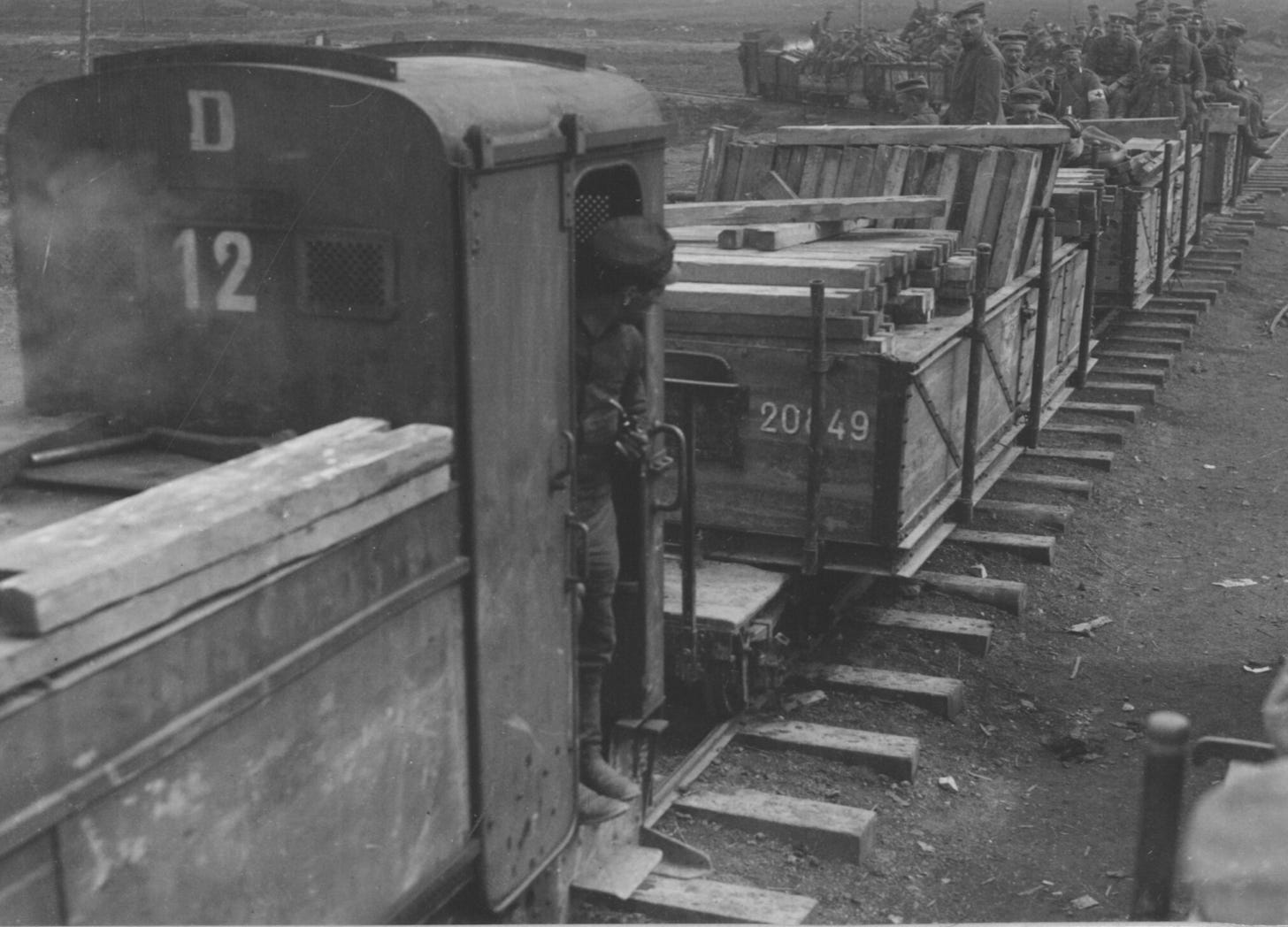
The transport train went from Vervins via Marle to Eppes, where the cargo was unloaded. Terrible mud everywhere!
At the head of the battalion, I rode with Captain Kittel to Montaigu to the Twelfth Camp (a forest camp). In the evening, I went with Lieutenant Riger from II/12 to the K.T.K. (Kampf-Truppen-Kommandeur) in pouring rain to the gravel pit near Corbeny. A magnificent facility, a tunnel built into the hillside with electric light powered by a dynamo powered by a gasoline engine.
Notes
The places mentioned in the previous paragraph adjoin the Plateau de California, a piece of high ground that the Germans called the Winterberg. Located near the town of Craonne, this hill saw much fighting in both the Nivelle Offensive of 1917 and Napoleon’s winter campaign of 1814.
A Kampf-Truppen-Kommandeur, who usually ranked as a captain, enjoyed the power to command all forces in a given sector of a defensive position. For more on this institution, see Timothy Lupfer The Dynamics of Doctrine (Internet Archive) or Graham Chamley Wynne (Robert Foley, editor) If Germany Attacks (King’s College London).
16 January 1918
I inspected the positions (to be occupied by my battalion). At four thirty in the morning, Kittel and Spengler (the battalion commander and his adjutant) arrived at my place. A surprise concentration French artillery shells greeted us. I/97 completed its relief at ten pm.
17 January 1918
I slept well in the deep shelters. Early the next morning at eight, I went with the captain and Lieutenant Kappel, of the advance party, who took up a position on the right flank. I spent the afternoon with Bergner and the evening with Captain Spengler, who was celebrating his 25th birthday.
18 January 1918
I went with the Captain into the trenches. We received artillery fire.
Distribution of positions:
A. Imig 3/97
B. Oppermann 1/97
C. Drape
E. Peters 6/97
The last named received electric light from I/97.
20 January 1918
Heavy air activity. Complete enemy squadrons few over us. Eight German anti-aircraft guns shot at them.
Mild weather. In the evening, I inspected sentries.
to be continued …
Sources
The text comes from Alwin Lydding Meine Kriegstagbuch (My War Diary), an unpublished manuscript that I found at the Bundesarchiv (German Federal Archive) (Folder N 382/1).
For the lyrics to the second song mentioned, see John Meier Das Deutsche Soldatenlied im Felde (German Soldier Songs in the Field) (Strassburg: Trübener, 1916) pages 37-38 (Hathi)
Related Reading

This is particularly poignant.