This post concludes a multi-part case. So, if you haven’t done so already, please read the first three articles in the series.
You soldiered on.
Between 1900 and 1903, you built, and improved, prototypes of the ‘recycled barrel’ howitzer you had agreed to develop. At the same time, you provided the new weapon with all of the accessories, such as limbers and sights, that would be needed to employ the new weapon in the field.
Notwithstanding his earlier misgivings, you seem to have felt a degree of optimism about the prospects for the hybrid weapon you had designed. At the very least, you felt sufficiently confident in the practicality of the approach to propose, sometime in 1902, a program to mount the barrels of three other obsolete artillery pieces - all of which had been adopted between 1877 and 1881 - on quick-firing carriages.
In the same year, the German Army adopted a quick-firing heavy field howitzer of its own. Made with the lighter types of steel that had become available in the late 1890s, this new 150mm piece weighed a little less than its predecessor and a lot less than your prototype.

In 1904, the Chamber of Deputies voted a substantial credit for the acquisition of mobile heavy artillery pieces. While the appropriation made no specific mention of particular models, your hybrid howitzer was the only weapon of that category that was ready to go into production. Thus, early in 1905, the ordnance authorities of the French Army adopted it, with the designation of Canon Court de 155 (Modèle 1904) Tir Rapide [155mm Howitzer (Model 1904) Rapid Fire], as a standard weapon.
In the decade that followed, French state arsenals built a little more than a hundred weapons of this type. In the same period, the great armaments firms of Europe produced a number of heavy field howitzers, all of which equaled (or exceeded) the performance of your invention while weighing a great deal less.
In 1906, you took command of one of the first field artillery battalions to be equipped with your howitzer. After two years in that position, you continued to serve, in various capacities, until February of 1913. After your retirement, you went to work for the private armaments firm of St. Chamond.
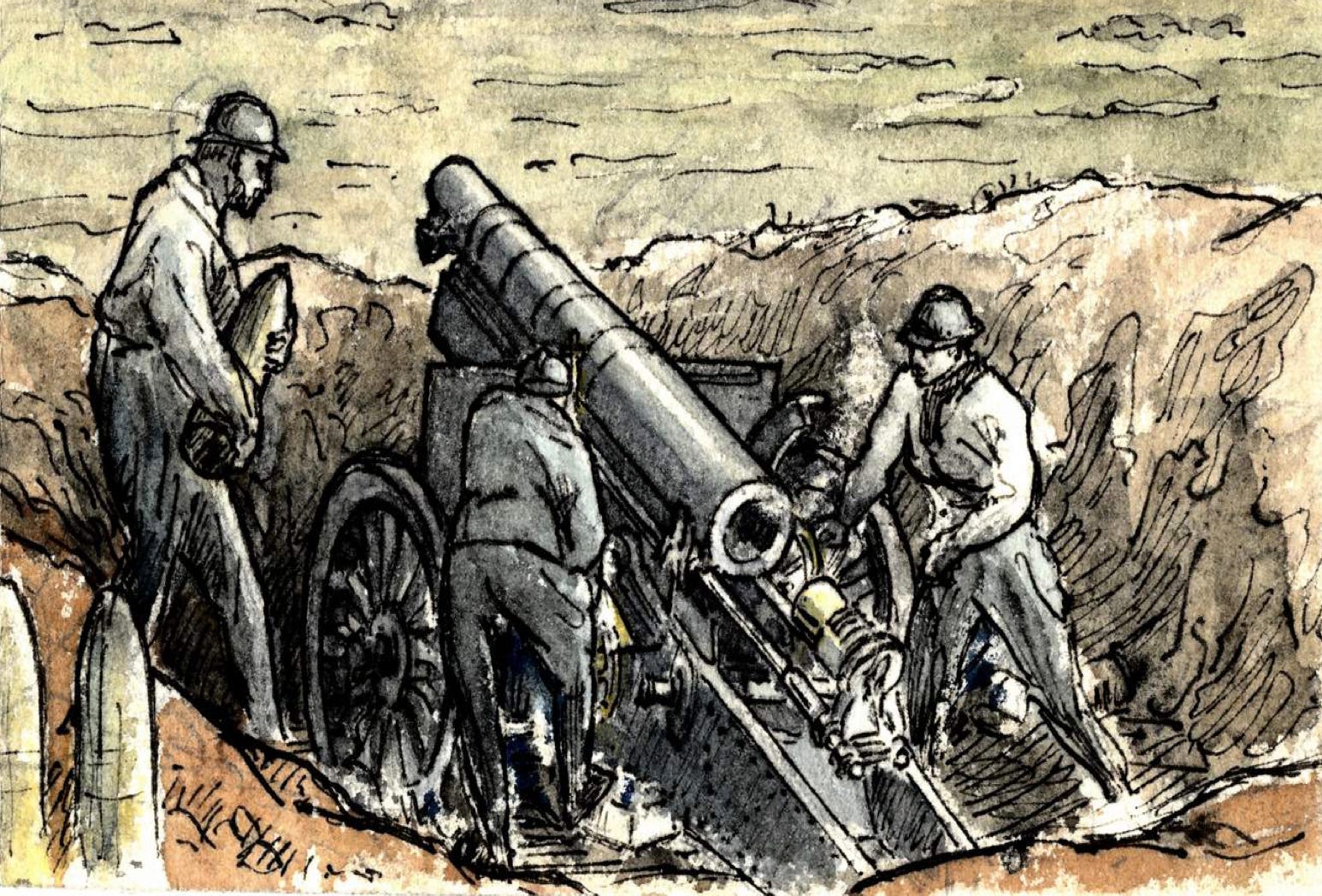
In August of 1914, your howitzer went to war.
Unfortunately, the strains of active service soon revealed a number of mechanical defects, the worst of which caused the recoil mechanism to separate itself from the carriage.) While none of these defects proved fatal to any particular howitzer, they did require the evacuation of many pieces to repair shops. Thus, for much of the first year of the war, batteries that had originally been armed with your howitzer were obliged to make do with obsolete field pieces, all of which dated from the same era as the obsolete barrels you had been obliged to use.
Sources
Jules Challéat L'artillerie de terre en France pendant un siècle : histoire technique (1816-1919), Volume II [Land Artillery in France over the course of a Century: Technical History (1816-1919), Volume II] (Paris: Charles-Lavauzelle, 1935) pages 487-493 (Gallica)
Yannick Lemarchand ‘Le lieutenant-colonel Rimailho, portrait pluriel pour un itinéraire singulier’ (‘Lieutenant Colonel Rimailho, Complex Portrait of a Singular Career’) Entreprises et Histoire (Businesses and History) (1998) pages 9-32 (Research Gate)
Émile Rimailho Artillerie de Campagne (Paris: Gauthier Villars, 1924)
For Further Reading


There is no truer testing ground than the field of battle.