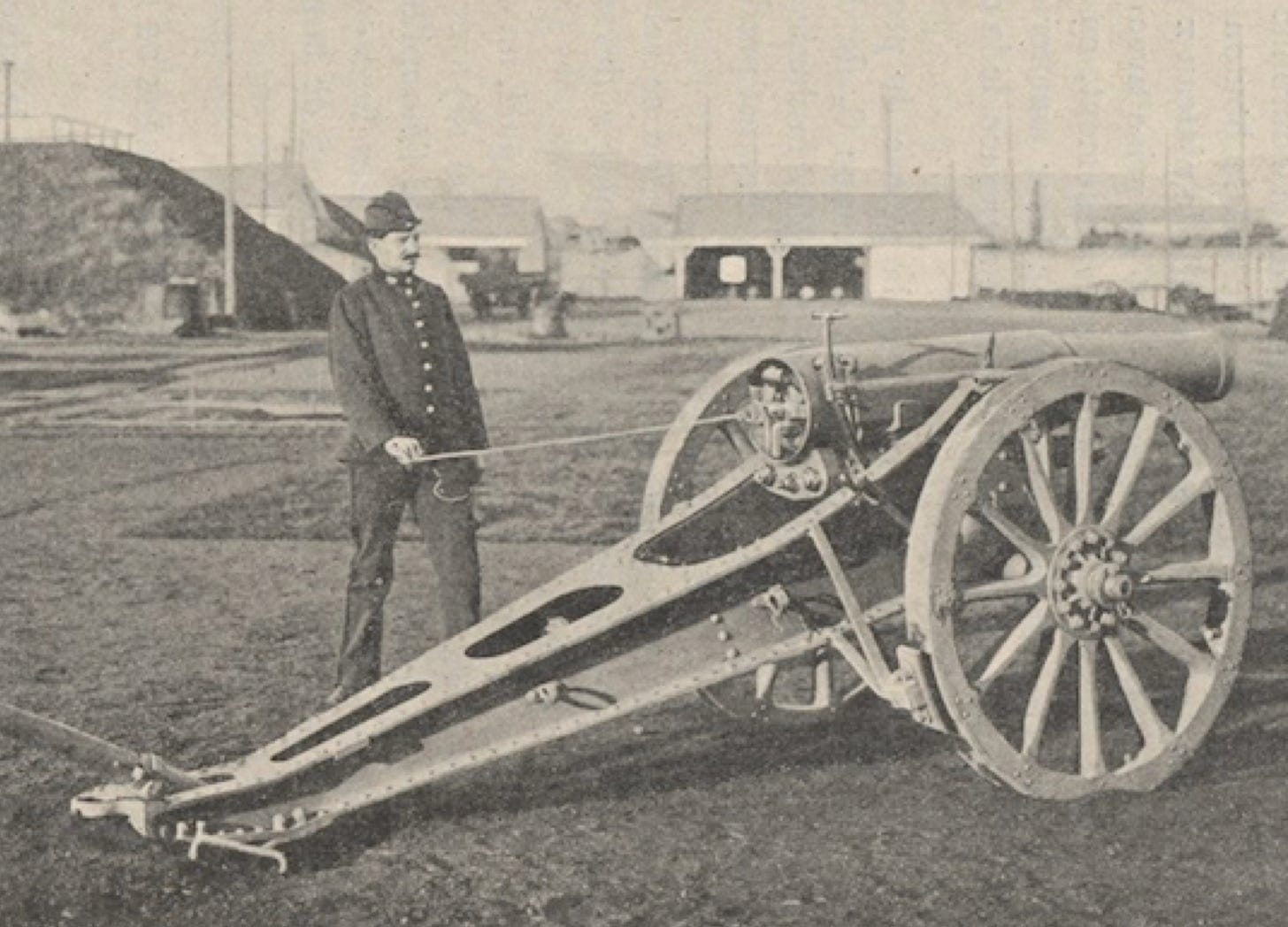
This post begins with the historical solution to the second problem of a multi-part case. So, if you haven’t done so already, please read the first two articles in the series.
The stipulation laid down by the Artillery Technical Committee, which obliges you to use obsolete barrels in your new howitzer, worries you greatly. These old barrels, after all, would both increase the weight of the piece and limit its range. Nonetheless, you decide to go forward with the project. Thus, after a short tour of duty with a battery in North Africa, you return to the arsenal at Puteaux.
The prototype that results from your efforts turns out to be much heavier than you had anticipated. When ready to fire, it weighed 600 kilograms more than the estimate that you made in 1899 (which presumed the use of old barrels) and a full metric ton (1,000 kilograms) more than your design of 1898 (which presumed up-to-date barrels.) When broken down for transport, the each load exceeded your estimate by 300 kilograms, and your original design by half of a ton.
In 1900, while you are working on your prototype, you take a break to attend the International Exposition held in Paris that year. There you see a howitzer offered for sale by the French armaments firm of Schneider and Company. With a caliber of 150mm, the Schneider piece fires 40 kilogram projectiles similar to the ones used with your prototype. It also benefits from an on-carriage recoil-absorbing mechanism. Nonetheless, when configured for firing, it weighs in at a mere 1,800 kilograms.
Indeed, the only advantage enjoyed by your prototype lies in the realm of range. While the brochures published by Schneider claim that its 150mm howitzer can reach out to 5,500 meters, the old barrels that you are obliged to use have, when mounted on other carriages, achieved 6,280 meters.
So, Captain Rimailho, how do you respond to this discovery?
Please use the comments section to propose solutions to the problem faced by Captain Rimailho. I will post the historical solution on Wednesday, 2 July 2025.


I would talk to my immediate supervisor to gain his concurrence for a paper pointing out all of this for the Artillery Technical Committee. While the range (and caliber? We were talking 155mm before and not 150mm) is not as good on the new Schneider weapon, the increase in mobility makes it a superior weapon. The committee can adopt one of 3 Courses of Action (in order of recommendation): (1) Let me complete the design with a new 155mm cannon that will offer superior range and at least equal mobility to the newer systems now appearing. (2) Buy the new Schneider weapon and perhaps change calibers to 155mm. (3) Forge ahead with the current idea. That is, heavier weapon with superior range, but deficit mobility. After all, you can indulge in false economies by reusing old materials, only to get left behind by your adversaries. The world is not standing still.
(Somehow, I think the committee went with COA 3, but you have to try)