


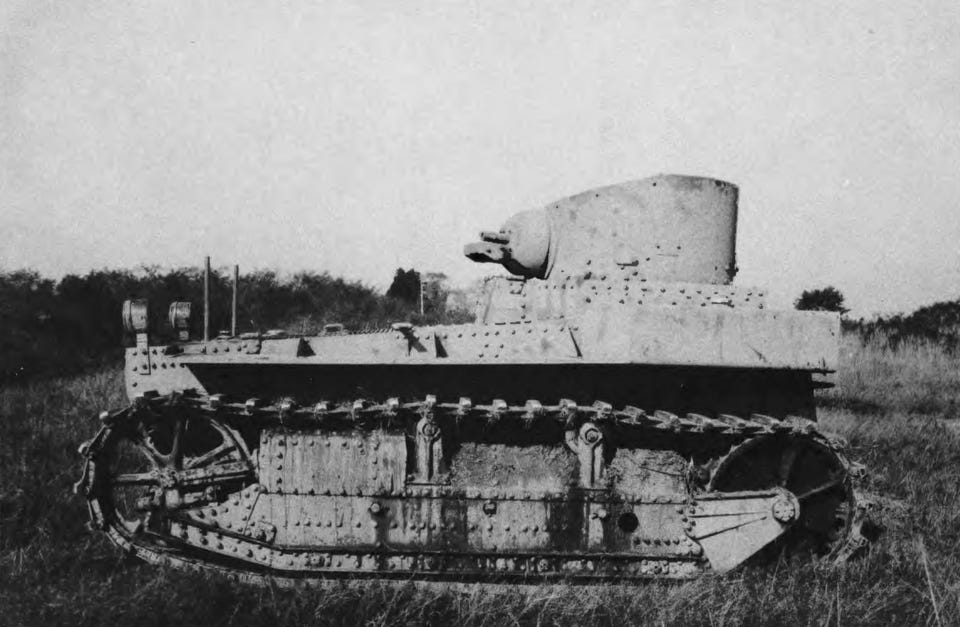
The following post provides the author’s solutions to one of the sixteen short problems published in the very first (1930-1931) issue of the Infantry School Mailing List.
If you have yet to read, or, better yet, work through this problem, please do so before looking at the solutions.

SOLUTIONS TO PROBLEM NO. 10
(1) (Fully-Trained Troops) The company commander moves his Ist Platoon around the quarry to the woods to take the counterattack in flank. He moves the support platoon (2nd) by the shortest route to Hill C to fire on the counterattack. He uses the 3rd Platoon for protection to the front, advancing it abreast of the woods.
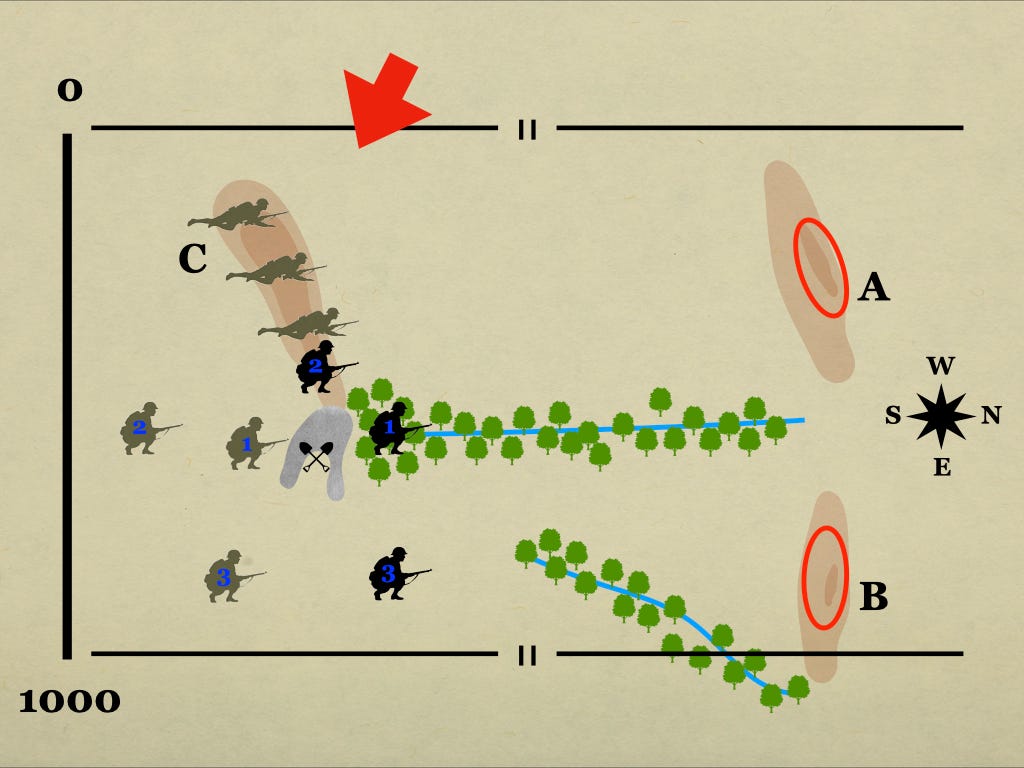
(2) (Green Troops) The left platoon (1st) and support (2nd) platoon are both moved by the shortest route to Hill C to fire on the counterattack. The 3rd Platoon advances abreast of the quarry for protection to the front and flank. This maneuver is simpler and easier of execution than that made by veterans. Moving under some fire first to the right, changing direction to the left, entry into the small woods, and taking security measures toward the north would require more time than with veterans, and greatly increase chances of confusion and disorganization. A simpler movement would be better even if it promises less decisive results.
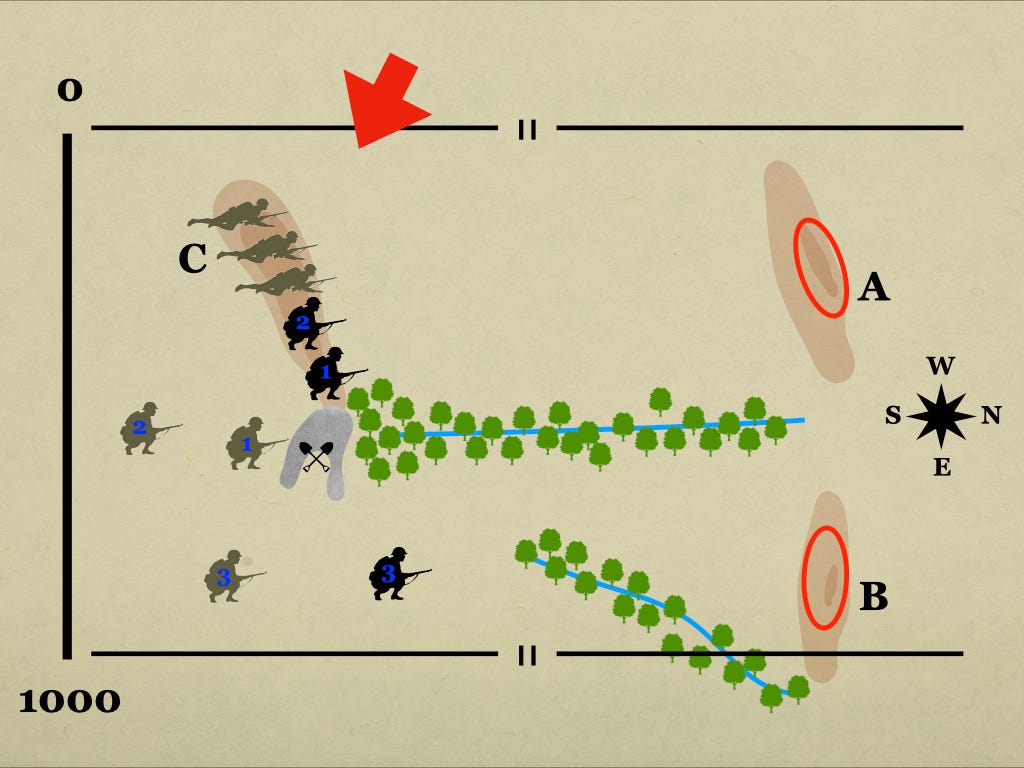
(3) (Green Troops) The company commander resumes the attack toward B, being hidden from view of tanks. He thus moves out of the path of the tanks, which he has no weapons to combat, and he attempts to parry the very strong danger of a tank panic by giving his men something to do, by occupying their minds with the attack toward B. The tanks will have to be dealt with by some other agency.
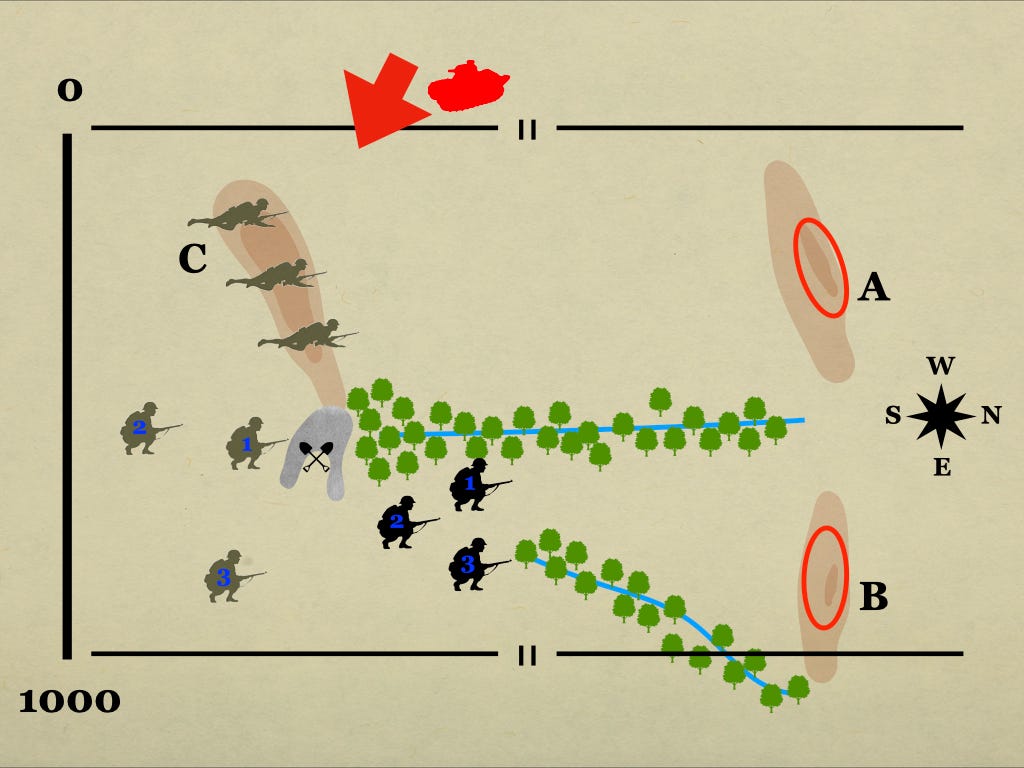
(4) (Fully Trained Troops) The company commander moves his company rapidly into the woods W, where it has some protection against tanks, with a view of allowing the tanks to pass, and firing on the infantry following. Such a maneuver by partly trained troops would tend to result in great confusion; likewise it would be difficult to keep them from opening fire on the tanks, thereby leading the tanks to attack the wood. A small wood should not be considered a tank proof locality.
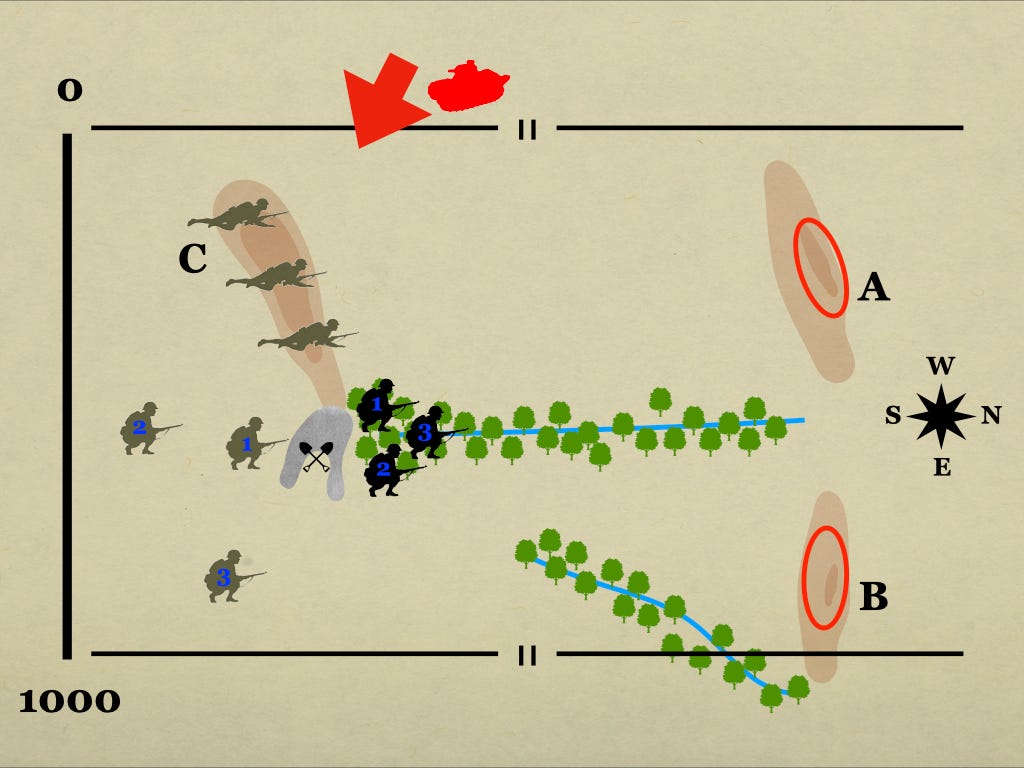
In either case (3) or (4) the essential thing is to give the men a definite task at once, which requires action by them and asserts control of the commander.
Sources
‘Infantry Problems’ Infantry School Mailing List (Fort Benning: US Army Infantry School, 1931) Volume 1 (1930-1931) page 44 (Internet Archive)
The Internet Archive preserves scans of microfilmed copies of all thirty volumes of the Infantry School Mailing List. However, it catalogs them under the heading of the Infantry School Quarterly, which succeeded the Mailing List in 1947. (Internet Archive)
The Hathi Trust provides links to scanned-from-paper copies of some, but far from all, issues of the Infantry School Mailing List (Hathi Trust)
Related Reading


Wow did I misunderstand this one! I think my solution, where I assumed I had tanks, would have received an Unsatisfactory grade for certain. ☹️
Is it correct that most of the US Army were not well trained prior to WWI, other than expeditionary forces such as Blackjack Pershing's and the Philippine troops, so that the sudden draft necessity meant new draftees also got little to no training?