


The first volume of the Infantry School Mailing List, which rolled off the press in 1931, offered readers a set of sixteen short tactical problems. On 24 June 2026, The Tactical Notebook published the sixth of these.

This article provides both of the author’s solution published with the problem. So, if you would like to play your way through the series, please engage the exercise before reading this post.
PUBLISHED SOLUTION TO PROBLEM NO. 6
[While the author of the published solution does not say so explicitly, he seems to presume that the battalion will keep one of its three rifle companies in reserve.]
(1) The riflemen will advance where there is cover. They will move forward in small groups and clusters, and by individuals at times, but retaining the tactical integrity of units. The skirmish line will be avoided. It is conspicuous and gives the enemy excellent targets.
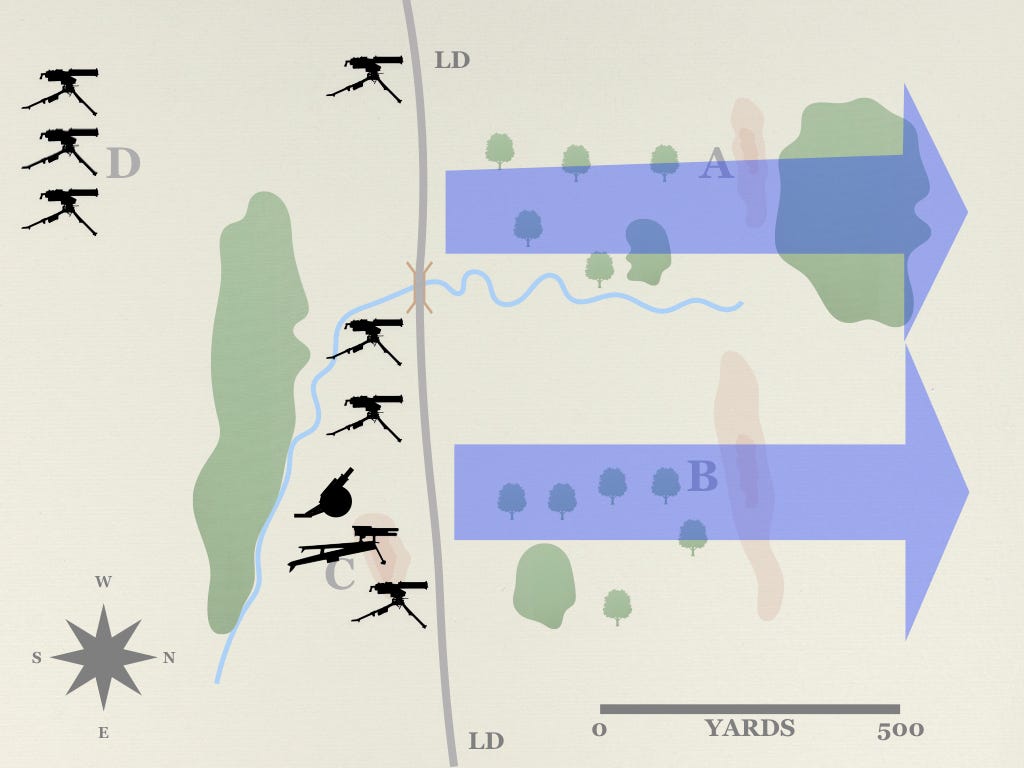
(2) The [battalion] machine-gun company will support the attack from positions on C and from gaps left on purpose between the rifle companies and on the left flank. The cannon-company platoon will support the attack from positions in the vicinity of C.
(3) As the attack starts, supporting machine guns [from the regimental machine gun company deliver indirect] fire on the enemy on Hills A and B. The 37-mm gun fires on any located machine guns. The 75-mm mortars fire on enemy combat posts and machine guns whose position is only generally known. Artillery fire also is placed on the enemy position.
In the attack, riflemen and auto riflemen do not fire. Dependance for gaining fire superiority at the outset is placed on the base of fire (the supporting machine guns and cannon company weapons in this case), and the artillery. In the attack, riflemen and auto riflemen usually will not do much firing at ranges over 400 yards. They endeavor to advance as far as possible under cover without firing, and engage in the fire fight only when forced to do so.
(4) When the Hills A and B are taken, one platoon of machine guns will be attached to the left assault company which has to go through the woods.
(5) With partly trained troops the machine-gun company would support from C and the gap left in the center. This gap would be larger and have more guns in it. Thus control of the machine-gun company would be simplified. The left assault company would not have guns firing past both its flanks, the moral effect of which might prevent a determined advance. A machine-gun platoon would be attached to the left assault company as before.
(6) Whether indirect fire would be delivered by the regimental machine-gun company would depend on its state of training.
Sources
‘Infantry Problems’ Infantry School Mailing List (Fort Benning: US Army Infantry School, 1931) Volume 1 (1930-1931) page 39 (Internet Archive)
The Internet Archive preserves scans of microfilmed copies of all thirty volumes of the Infantry School Mailing List. However, it catalogs them under the heading of the Infantry School Quarterly, which succeeded the Mailing List in 1947. (Internet Archive)
The Hathi Trust provides links to scanned-from-paper copies of some, but far from all, issues of the Infantry School Mailing List (Hathi Trust)
The quotation from Kipling appeared in the original version of the problem. The complete poem can be found on the website of the Kipling Society.
Related Reading

