

Short Problem 6
From the 'Infantry School Mailing List'

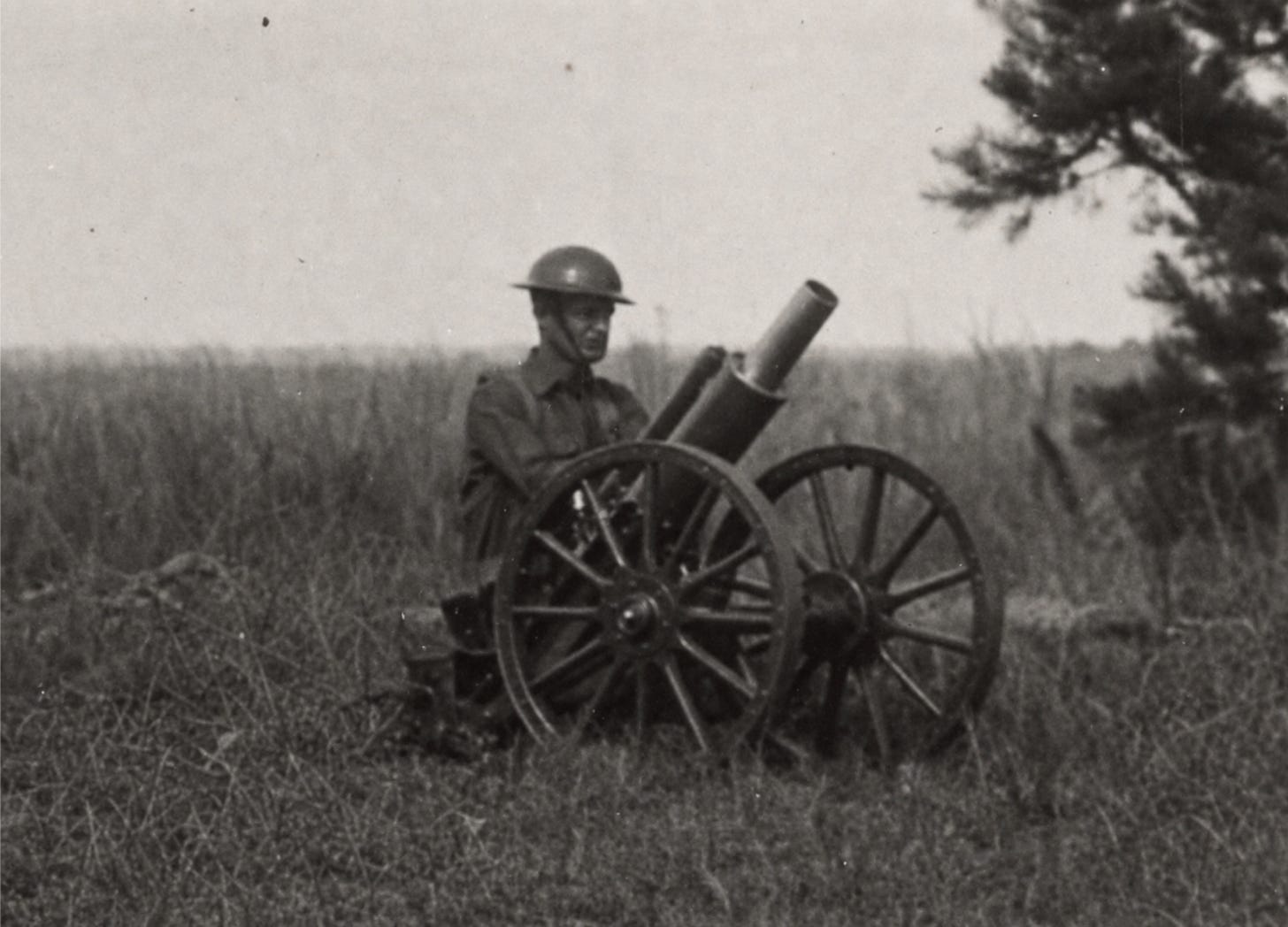
The following problem appeared in the first semi-annual volume of the Infantry School Mailing List, which rolled off the press in 1931. (This periodical, which might well be described as a journal in all but name, replaced the collections of mimeographed instructional materials that the US Army Infantry School sent out to subscribers in the 1920s.)
For the philosophy behind theses problems, please see:

The problem calls for players to step into the shoes of the commanding officer of a battalion reinforced with a platoon from the regimental cannon company and supported by the regimental machine gun company.
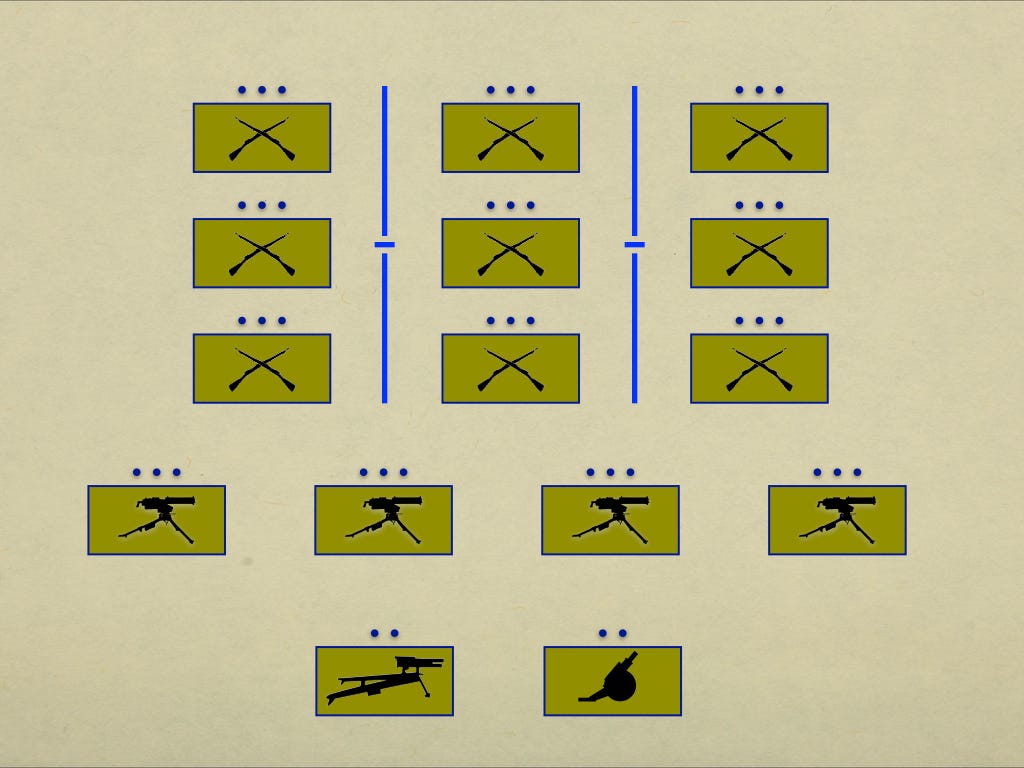
Your battalion consists of three rifle companies (each of three large platoons) and a machine gun company (of four four-piece platoons). The cannon platoon attached to your battalion consists of a section of two 75mm mortars and a section of two 37mm infantry guns.
The 37mm infantry guns send a one-pound (half-kilo) shell out to ranges of 1,600 yards. The 75mm mortars can deliver eleven-pound (5.5 kilo) bombs as far as 1,800 yards.
For more about these units, please see:


PROBLEM NO. 6
‘If you want to win your battles,
take an’ work your bloomin’ guns.’
Rudyard Kipling
Snarleyow
SITUATION
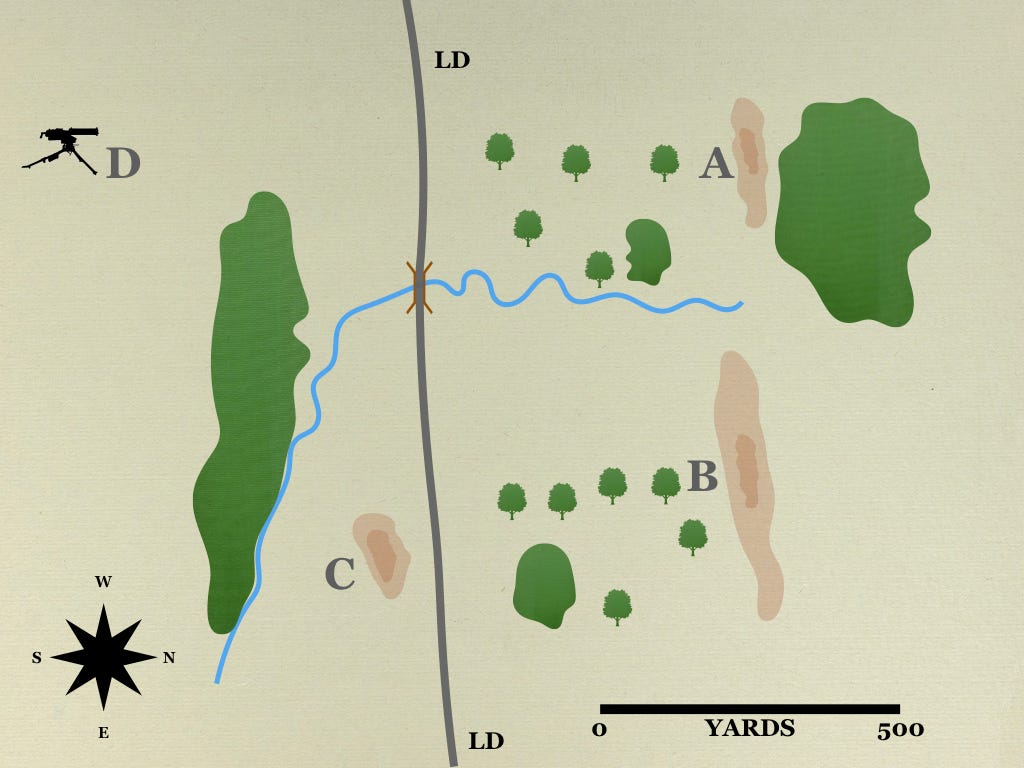
An interior battalion, with a cannon platoon attached, and supported by artillery, is attacking northward. The road is the line of departure. The enemy holds Hills A and B. There is cover in some parts of the battalion zone of action, but not in others. The hill at C affords machine-gun positions more than sufficient for one platoon, but scarcely sufficient for two platoons. The troops are well-trained veterans.
The regimental machine gun company from near D assists by long-range indirect fire at the start of the attack.
REQUIREMENT
(1) Where will the riflemen advance, and in what general formation?
(2) What is the initial employment of the [battalion] machine-gun company and the cannon platoon?
(3) What weapons are firing in the zone of the battalion in the early stages of the attack?
(4) What changes will be made, if any, in the method of fire support when the ridge A-B is captured?
(5) How would the answers to the above be affected if the troops were only partly trained?
(6) Would the employment of the [three platoons of the] regimental machine-gun company be the same?
How to Play
I invite paid subscribers to to use the comments section to share their own answers to the questions posed.
I will post the original (1931) solutions to the problem, as well as my own commentary, on Sunday, 28 June 2026.
Sources
‘Infantry Problems’ Infantry School Mailing List (Fort Benning: US Army Infantry School, 1931) Volume 1 (1930-1931) page 38 (Internet Archive)
The Internet Archive preserves scans of microfilmed copies of all thirty volumes of the Infantry School Mailing List. However, it catalogs them under the heading of the Infantry School Quarterly, which succeeded the Mailing List in 1947. (Internet Archive)
The Hathi Trust provides links to scanned-from-paper copies of some, but far from all, issues of the Infantry School Mailing List (Hathi Trust)
The quotation from Kipling appeared in the original version of the problem. The complete poem can be found on the website of the Kipling Society.
Related Reading

