

Short Problem Number 1
From the Infantry School Mailing List of 1931

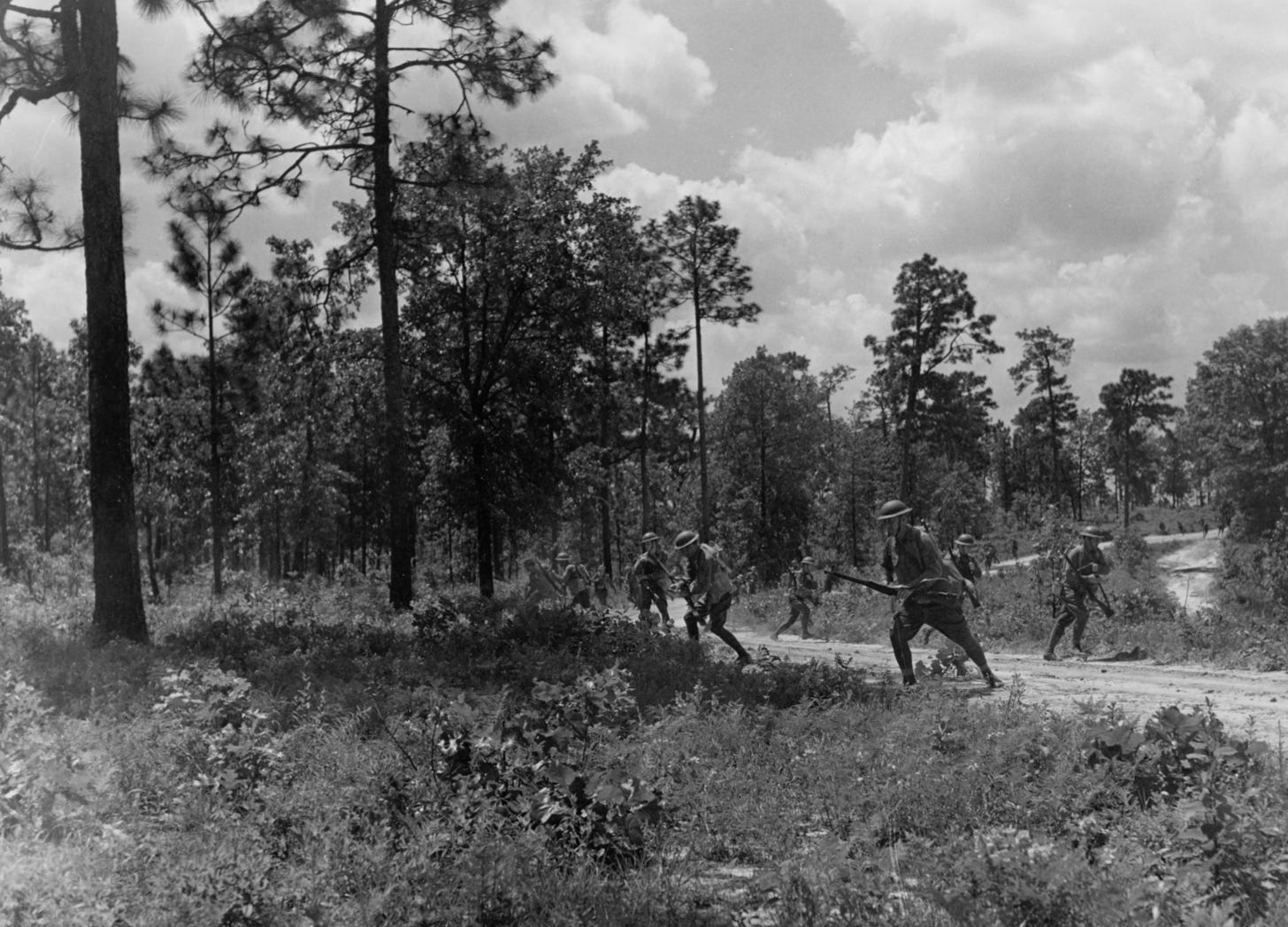
The following problem appeared in the first semi-annual volume of the Infantry School Mailing List, which rolled off the press in 1931. (This periodical, which might well be described as a journal in all but name, replaced the collections of instructional materials that the US Army Infantry School sent out to subscribers in the 1920s.)
For the philosophy behind this problem (and the fifteen that followed), please see:

PROBLEM NO. 1
‘The Lacedaemonians are not wont to ask how many, but where the enemy are.’
Plutarch, King Agis
SITUATION
An infantry battalion advancing northwest encounters a small hostile force on the hill at A. The advance guard, one rifle company, has been stopped at the little stream west of hill B. The rest of the battalion is under cover behind (to the east of) hill B. At 9:00 AM the battalion commander decided to attack. His troops are well-trained veterans.

REQUIREMENT
(1) What is each company, in the attack order, ordered to do?
(2) How is the attack coordinated?
(3) If the troops have had little training, what is each company ordered to do?
(4) How (then) is the attack coordinated?
Weighing in at 852 officers and men, a war-strength infantry battalion of the US Army of 1931, consisted of a tiny headquarters (6 mounted officers), a small headquarters company (1 officer and 62 men), a twelve-gun machine gun company (6 officers and 182 men), and three rifle companies (each with 5 officers and 193 men.)
Most of the men carry M1903 Springfield rifles, bolt-action weapons of the type carried by most riflemen in the world in 1931. Each rifle company, however, rates eighteen Browning Automatic Rifles and eighteen grenade launcher cups. The latter allow the aforementioned rifles to fire three-pound rifle grenades out to a range of two hundred yards.
The machine gun company employs M1917 Browning machine guns: tripod-mounted, water-cooled, rifle caliber weapons of a type adopted towards the end of the Great War.
How to Play
I invite full-bore subscribers to use the comments section to share their own answers to the questions posed.
Please note that the problem asks players to provide two distinct solutions: one that presumes well-trained, experienced units and one that presumes units with little training.
I will post the original (1931) solution to the problem, as well as my own commentary, on Sunday, 17 May 2026.
Source
‘Infantry Problems’ Infantry School Mailing List (Fort Benning: US Army Infantry School, 1931) Volume 1 (1930-1931) page 27 (Internet Archive)
The Internet Archive preserves scans of microfilmed copies of all thirty volumes of the Infantry School Mailing List. However, it catalogs them under the heading of the Infantry School Quarterly, which succeeded the Mailing List in 1947. (Internet Archive)
The Hathi Trust provides links to scanned-from-paper copies of some, but far from all, issues of the Infantry School Mailing List (Hathi Trust)
Related Reading
