


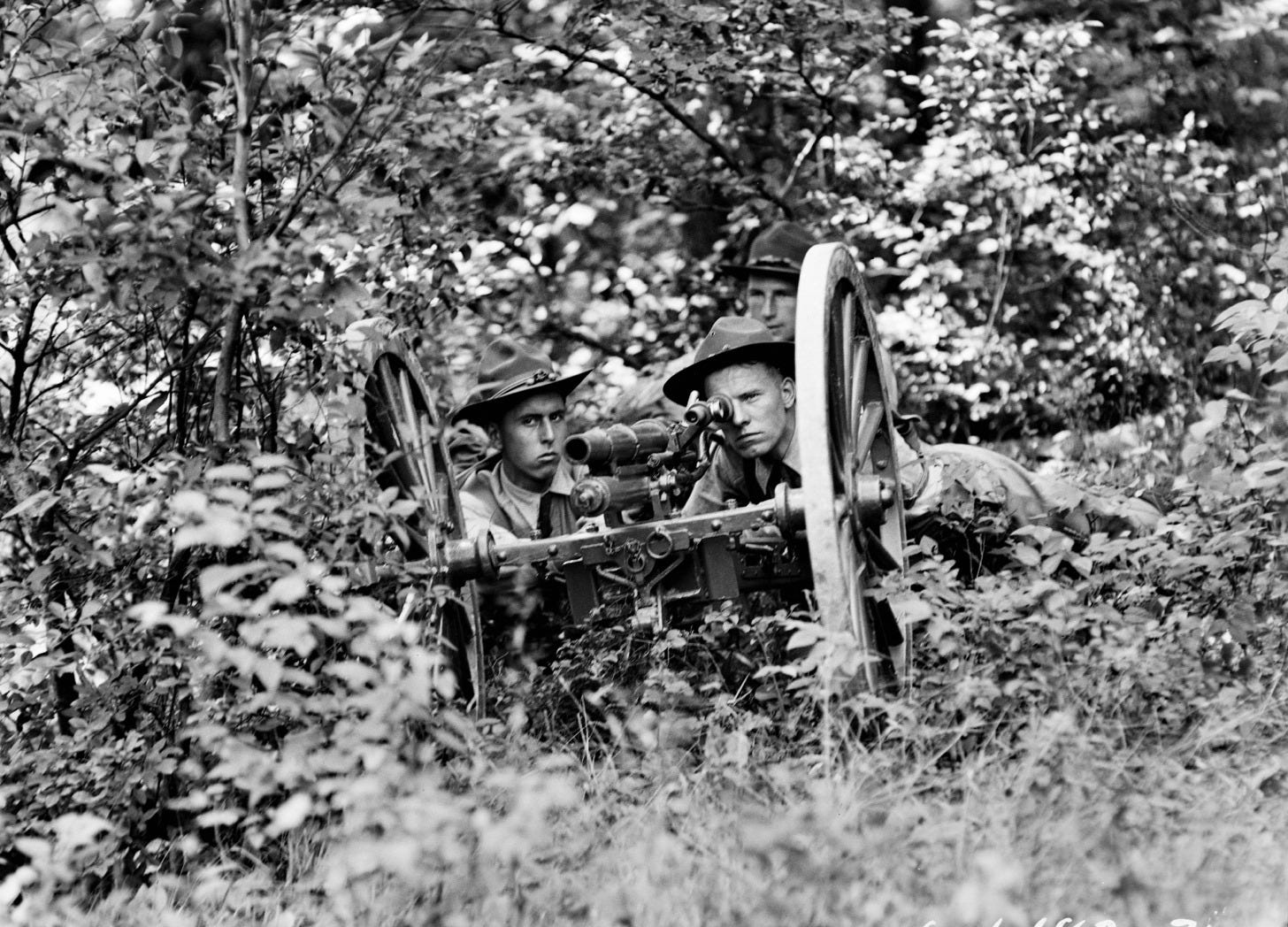
The following problem appeared in the first semi-annual volume of the Infantry School Mailing List, which rolled off the press in 1931. (This periodical, which might well be described as a journal in all but name, replaced the collections of mimeographed instructional materials that the US Army Infantry School sent out to subscribers in the 1920s.)
For the philosophy behind theses problems, please see:

NOTE ON ORGANIZATION
The scale of Problem Number 11 differs greatly from that of its predecessors. Where previous decision games in the series asked students to take on the roles of sergeants, lieutenants, and captains, this exercise puts participants in the role of a brigadier general who, true to his title, commands a reinforced brigade: a two-fisted collection composed of six battalions of infantry and six batteries of field artillery.
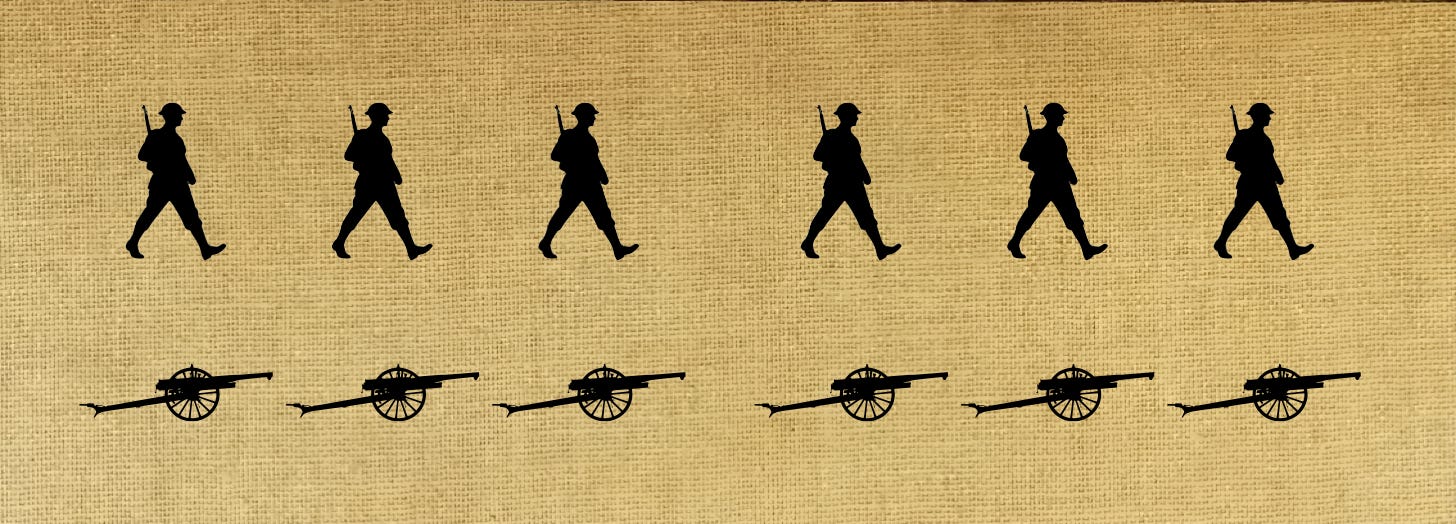
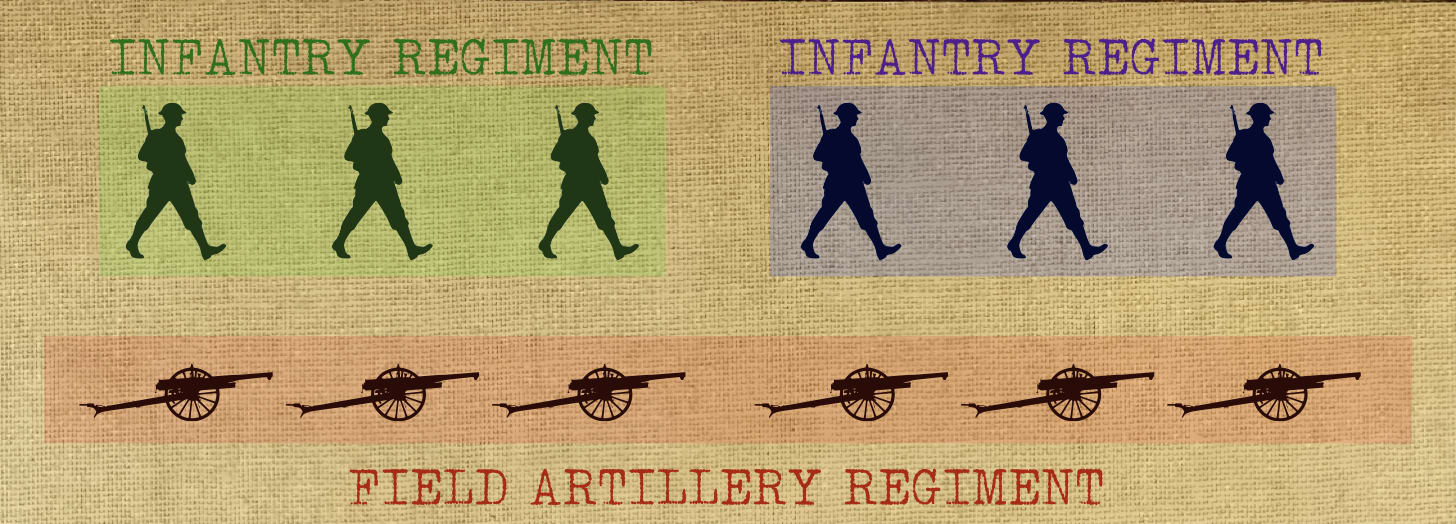
The clean correspondence between these basic building blocks (the units of account of their respective arms) points to features frequently found in armies of the twentieth century. First, the reliable ratio of field batteries to infantry battalions made it possible to pair one of the former with one of the latter, thereby creating marriages that, if not entirely monogamous, promoted close cooperation. Second, the way that these building blocks fit together with others of the same type made it possible for larger units to create parallel pairings of their own.
Thus, a trio of infantry battalions could enjoy a long-term relationship with a troika of field artillery batteries. Likewise, an outfit made from two trios of infantry battalions could form a relationship with an organization composed of two troikas of field batteries.
The chief complication of this arrangement lay in the realm of nomenclature. The US Army of 1930 used the term battalion to describe both the unit of account of infantry and a troika of field batteries. To make matters worse, while three infantry battalions formed an infantry regiment, only two battalions of field artillery were needed to make a regiment of the latter arm.
Things got better at the next rung of the organizational ladder. In both of the ‘royal’ arms (the Queen of Battle and the King of Battle), a pair of the same sort of regiment was called a ‘brigade’.
PROBLEM NO. 11
‘The bigger they come, the harder they fall.’
Bob Fitzsimmons
SITUATION
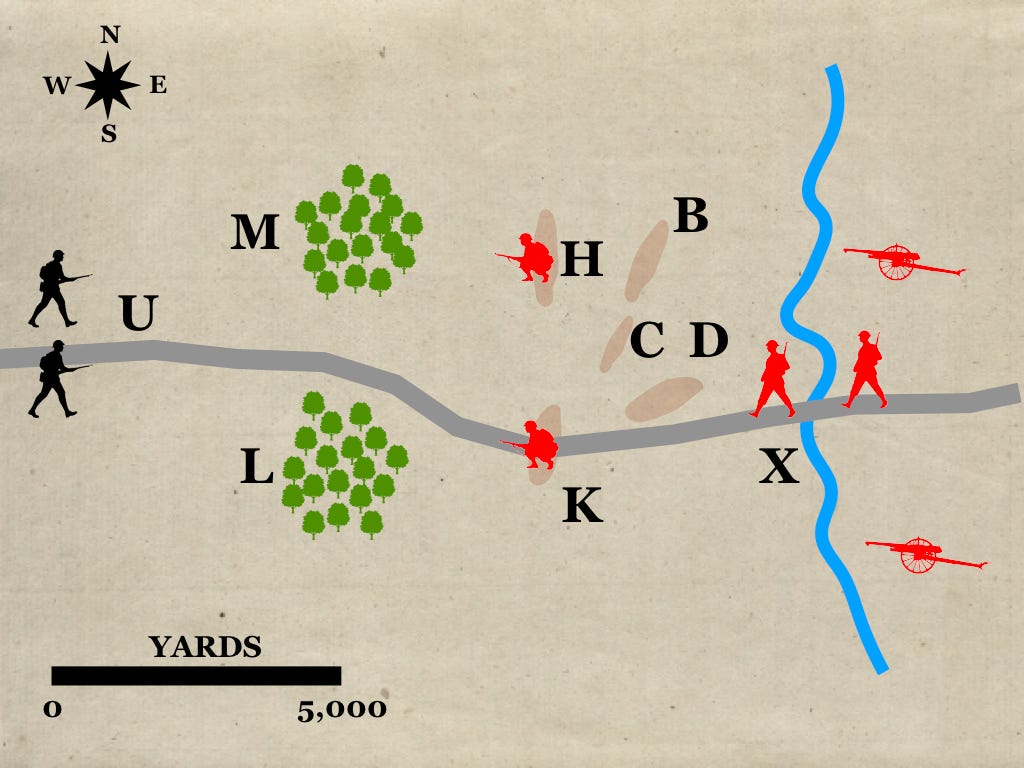
A brigade of infantry with a regiment of field artillery attached is marching eastward to secure the crossings at X.
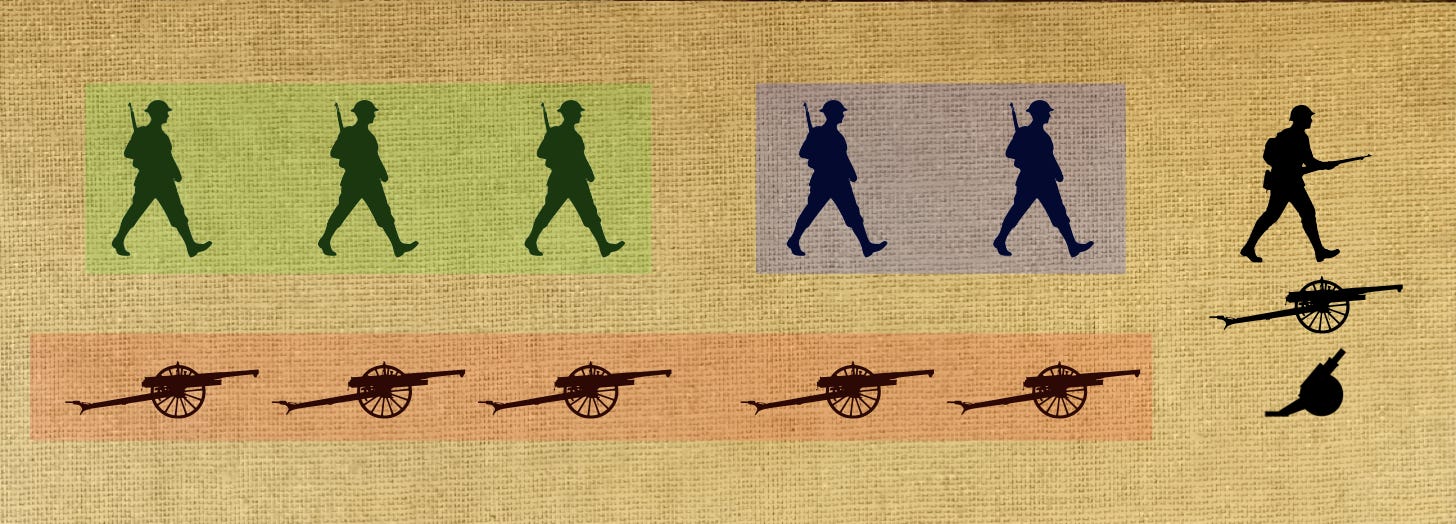
It has one battalion of infantry with a cannon-company platoon and a battery of artillery as advance guard.
As the advance guard reaches U the brigade commander unexpectedly learns that an enemy force, strength unknown, has crossed at X and is deploying on the hills west thereof. It has artillery. The enemy apparently has advanced troops on Hills H and K but there is more activity on the hills east thereof.
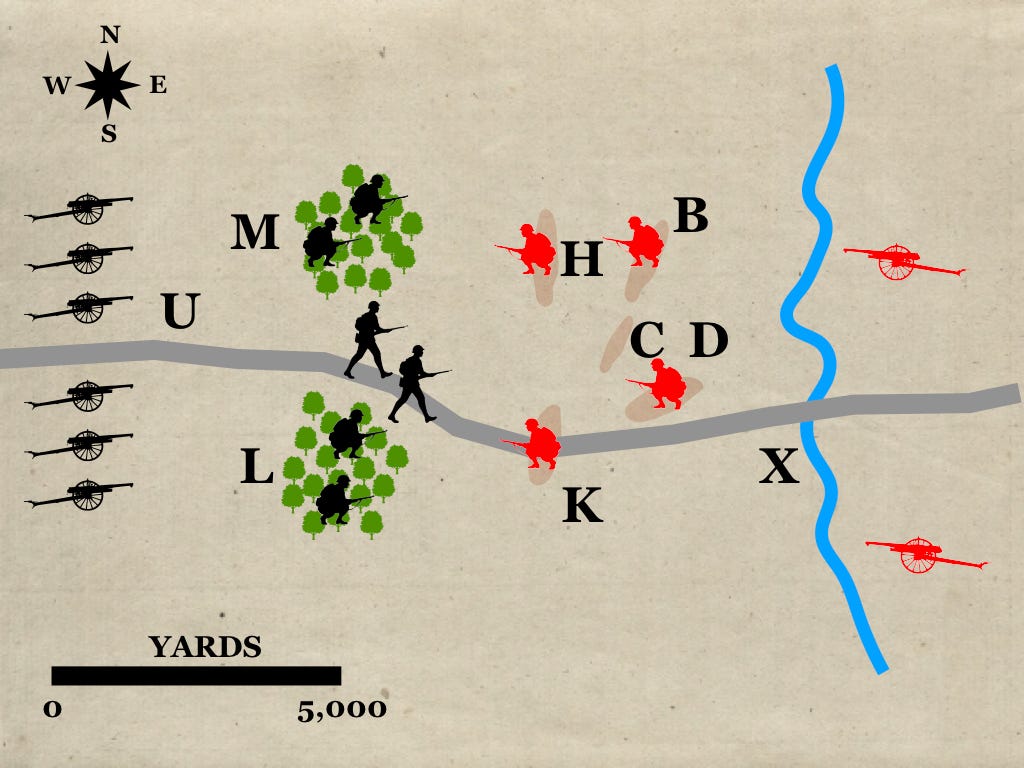
Our hero firmly intends to attack. He instructs the advance guard (reinforced) to secure Hills H and K and to locate hostile flanks. He reinforces the advance guard to a strength of a regiment (less a battalion) and moves the artillery forward so it can support the advance-guard action. He moves the rest of his force into assembly areas in woods L and M.
The mission can only be carried out by aggressive action. True he does not know the exact strength of the enemy or where each hostile company is located. But the enemy does not seem superior; in fact the defensive attitude and the area occupied indicate inferiority. Our leader has the offensive spirit and unless there is a lot of bad news he is going to attack. He is not particularly good at mathematics (numbers don’t mean so much to him) but he does know that small forces have frequently beaten larger ones. Maybe he is a lineal descendant of Old Man Gideon. (See Judges, Chapter 7).
Now the advance guard is about to secure Hills H and K. The main body is moving into assembly areas. The enemy has completed deployment. No other enemy is reported near.
The troops are veterans. Combat orders are no mystery to them. The commander estimates that his troops can be up, and all necessary orders issued, so that with these veterans he can, if he desires, make a coordinated attack by 4:30 PM. Darkness will be at 6:45 PM. There are no good maps available.
REQUIREMENT.
When does he attack?
Is the attack order written or oral?
Does it contain detailed instructions or is it in rather general terms?
If the troops are only partly trained, most of the officers have had little field service, and there are lots of good maps; what now is the answer to the above three questions?
How to Play
I invite paid subscribers to to use the comments section to share their own answers to the questions posed.
I will post the original (1931) solutions to the problem, as well as my own commentary, on Sunday, 2 August 2026.
Sources
‘Infantry Problems’ Infantry School Mailing List (Fort Benning: US Army Infantry School, 1931) Volume 1 (1930-1931) page 44 (Internet Archive)
The Internet Archive preserves scans of microfilmed copies of all thirty volumes of the Infantry School Mailing List. However, it catalogs them under the heading of the Infantry School Quarterly, which succeeded the Mailing List in 1947. (Internet Archive)
The Hathi Trust provides links to scanned-from-paper copies of some, but far from all, issues of the Infantry School Mailing List (Hathi Trust)
In 1897, Robert James Fitzsimmons (1863 – 1917) won a place of honor in the annals of American boxing by beating James John ‘Gentleman Jim’ Corbett (1866-1933) in a fight that lasted for more than ninety minutes.
Related Reading


1. When does he attack? As soon as possible, maximizing the amount of available sunlight.
2. Is the attack order written or oral? Oral.
3. Does it contain detailed instructions or is it in rather general terms? General as the troops are veterans, time is not abundant and securing the crossing is paramount.
4. If the troops are only partly trained, most of the officers have had little field service, and there are lots of good maps; what now is the answer to the above three questions?
As soon as is practical using written orders and slightly more detailed (a FRAGORD and an overlay).