

Sherman on Tactics
Imaginary Armies

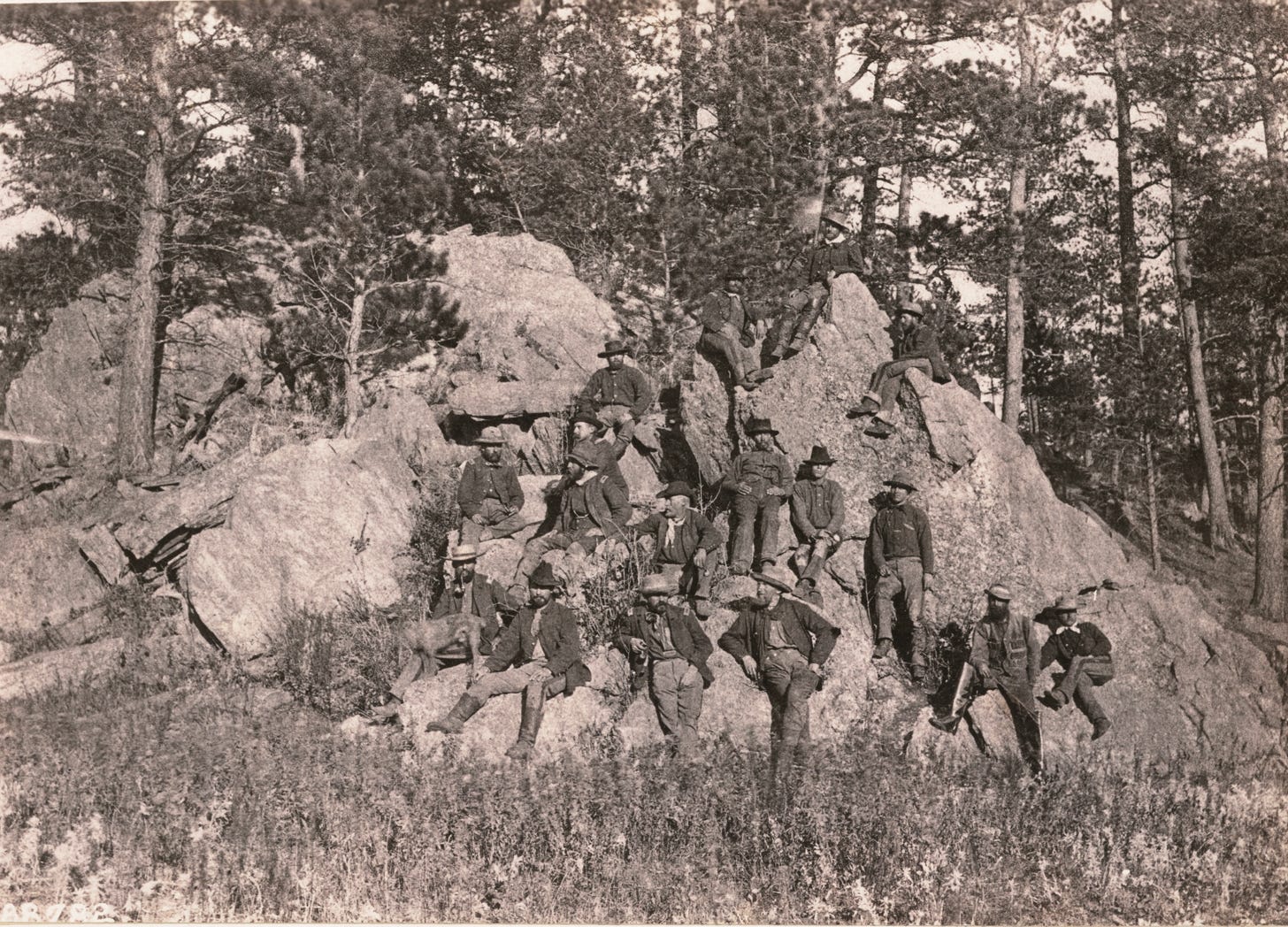
In the last chapter of his memoirs, William Tecumseh Sherman considers, among other things, the effect of trees, breech-loading firearms, and awareness of the ‘big picture’ has on infantry tactics.
Very few of the battles in which I have participated were fought as described in European text-books, viz., in great masses, in perfect order, manœuvring by corps, divisions, and brigades. We were generally in a wooded country, and, though our lines were deployed according to tactics, the men generally fought in strong skirmish-lines, taking advantage of the shape of ground, and of every cover. We were generally the assailants, and in wooded and broken countries the ‘defensive’ had a positive advantage over us, for they were always ready, had cover, and always knew the ground to their immediate front; whereas we, their assailants, had to grope our way over unknown ground, and generally found a cleared field or prepared entanglements that held us for a time under a close and withering fire.
Rarely did the opposing lines in compact order come into actual contact, but when, as at Peach-Tree Creek and Atlanta, the lines did become commingled, the men fought individually in every possible style, more frequently with the musket clubbed than with the bayonet, and in some instances the men clinched like wrestlers, and went to the ground together. Europeans frequently criticized our war, because we did not always take full advantage of a victory; the true reason was, that habitually the woods served as a screen, and we often did not realize the fact that our enemy had retreated till he was already miles away and was again intrenched, having left a mere shirmish-line to cover the movement, in turn to fall back to the new position.
Our war was fought with the muzzle-loading rifle. Toward the close I had one brigade (Walcutt’s) armed with breech-loading ‘Spencer’s’. The cavalry generally had breach-loading carbines: ‘Spencer’s’ and ‘Sharp’s’, both of which were good arms.
The only change that breech-loading arms will probably make in the art and practice of war will be to increase the amount of ammunition to be expended, and necessarily to be carried along; to still further ‘thin out’ the lines of attack, and to reduce battles to short, quick, decisive conflicts. It does not in the least affect the grand strategy, or the necessity for perfect organization, drill, and discipline. The companies and battalions will be more dispersed, and the men will be less under the immediate eye of their officers, and therefore a higher order of intelligence and courage on the part of the individual soldier will be an element of strength.
When a regiment is deployed as skirmishers, and crosses an open field or woods, under heavy fire, if each man runs forward from tree to tree, or stump to stump, and yet preserves a good general alignment, it gives great confidence to the men themselves, for they always keep their eyes well to the right and left, and watch their comrades; but when some few hold back, stick too close or too long to a comfortable log, it often stops the line and defeats the whole object. Therefore, the more we improve the fire-arm the more will be the necessity for good organization, good discipline and intelligence on the part of the individual soldier and officer.
There is, of course, such a thing as individual courage, which has a value in war, but familiarity with danger, experience in war and its common attendants, and personal habit, are equally valuable traits, and these are the qualities with which we usually have to deal in war. All men naturally shrink from pain and danger, and only incur their risk from some higher motive, or from habit; so that I would define true courage to be a perfect sensibility of the measure of danger, and a mental willingness to incur it, rather than that insensibility to danger of which I have heard far more than I have seen.
The most courageous men are generally unconscious of possessing the quality; therefore, when one professes it too openly, by words or bearing, there is reason to mistrust it. I would further illustrate my meaning by describing a man of true courage to be one who possesses all his faculties and senses perfectly when serious danger is actually present.
Modern wars have not materially changed the relative values or proportions of the several arms of service : infantry, artillery, cavalry, and engineers. If any thing, the infantry has been increased in value. The danger of cavalry attempting to charge infantry armed with breech-loading rifles was fully illustrated at Sedan, and with us very frequently.
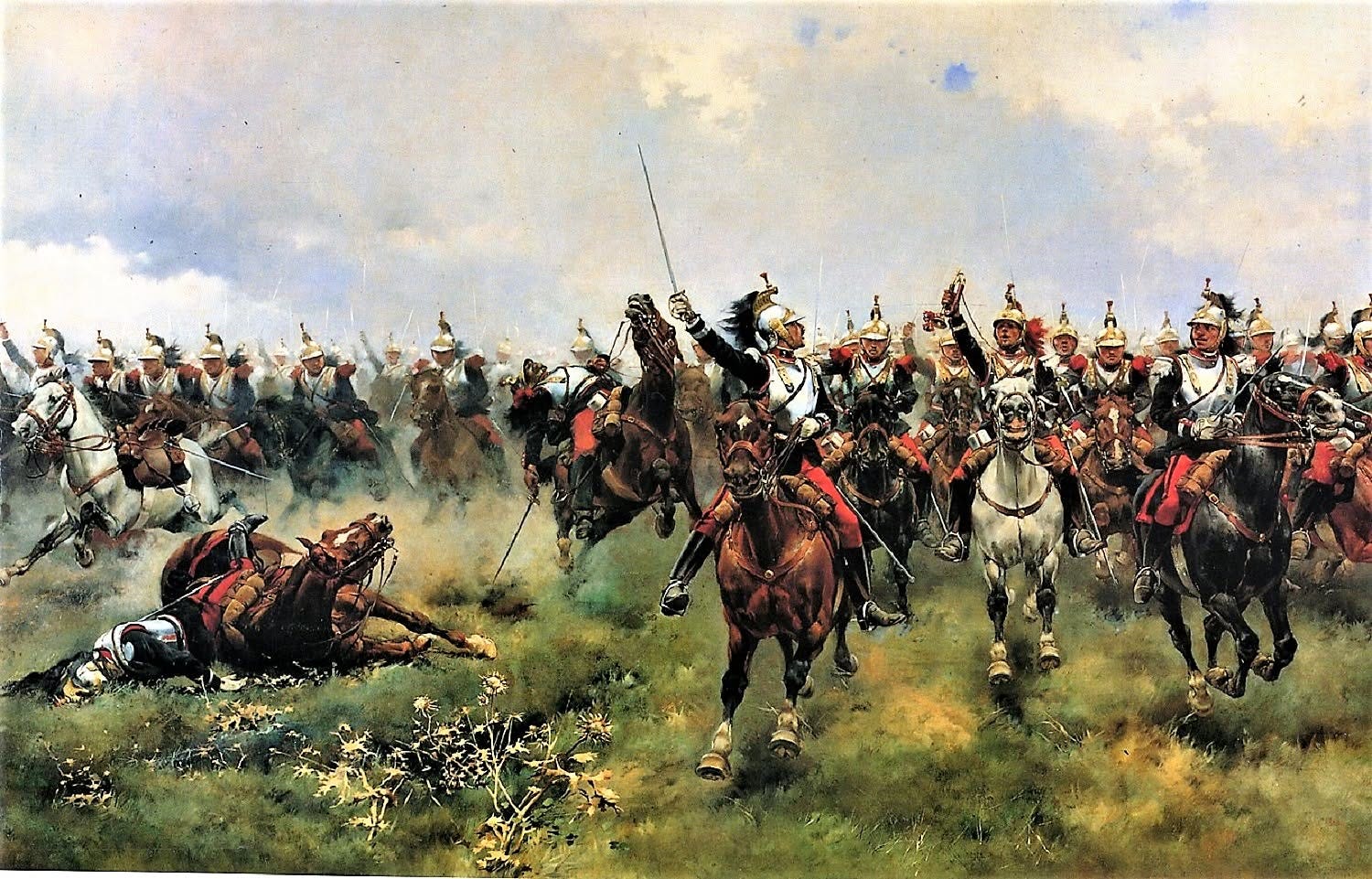
The painting depicts an attempt made by French heavy cavalry at the battle of Sedan (1 September 1870) to charge German infantry armed with breech-loading rifles.
So improbable has such a thing become that we have omitted the infantry-square from our recent tactics. Still, cavalry against cavalry, and as auxiliary to infantry, will always be valuable, while all great wars will, as heretofore, depend chiefly on the infantry. Artillery is more valuable with new and inexperienced troops than with veterans. In the early stages of the war the field-guns often bore the proportion of six to a thousand men; but toward the close of the war one gun, or at most two, to a thousand men, was deemed enough.
Sieges, such as characterized the wars of the last century, are too slow for this period of the world, and the Prussians recently almost ignored them altogether, penetrated France between the forts, and left a superior force ‘in observation,’ to watch the garrison and accept its surrender when the greater events of the war ahead made further resistance useless; but earth-forts, and especially field-works, will hereafter play an important part in wars, because they enable a minor force to hold a superior one in check for a time, and time is a most valuable element in all wars.
It was one of Professor (Dennis Hart) Mahan’s maxims that the spade was as useful in war as the musket, and to this I will add the axe. The habit of intrenching certainly does have the effect of making new troops timid. When a line of battle is once covered by a good parapet, made by the engineers or by the labor of the men themselves, it does require an effort to make them leave it in the face of danger; but when the enemy is intrenched, it becomes absolutely necessary to permit each brigade and division of the troops immediately opposed to throw up a corresponding trench for their own protection in case of a sudden sally. We invariably did this in all our recent campaigns, and it had no ill effect, though sometimes our troops were a little too slow in leaving their well-covered lines to assail the enemy in position or on retreat.
Even our skirmishers were in the habit of rolling logs together, or of making a lunette of rails, with dirt in front, to cover their bodies; and, though it revealed their position, I cannot say that it worked a bad effect; so that, as a rule, it may safely be left to the men themselves. On the ‘defensive,’ there is no doubt of the propriety of fortifying; but in the assailing army the general must watch closely to see that his men do not neglect an opportunity to drop his precautionary defenses, and act promptly on the ‘offensive’ at every chance.
I have many a time crept forward to the skirmish line to avail myself of the cover of the pickets’ ‘little fort’, to observe more closely some expected result; and always talked familiarly with the men, and was astonished to see how well they comprehended the general object, and how accurately they were informed of the state of facts existing miles away from their particular corps. Soldiers are very quick to catch the general drift and purpose of a campaign, and are always sensible when they are well commanded or well cared for. Once impressed with this fact, and that they are making progress, they bear cheerfully any amount of labor and privation.
Sources
Apart from items printed in italic letters, the text of this post comes from: William Tecumseh Sherman Memoirs of William T. Sherman (New York: D. Appleton, 1875) Volume II, Chapter XIV (Internet Archive)
Librivox offers, free of charge, an audio version of the aforementioned chapter. The viva voce version of the paragraphs reprinted in this post can be found in the recording marked ‘Military Lessons of the War - Section 2’. (The Tactical Notebook salutes Librivox reader David Wells for the high quality of this program and thanks him for his support of this remarkable service.)
For a detailed description of the German system of recruitment of the early 1870s, see Gerald F. Talbot Analysis of the Organization of the Prussian Army (Berlin: W. Moeser, 1871) (Hathi Trust)
Related Reading


“Soldiers are very quick to catch the general drift and purpose of a campaign, and are always sensible when they are well commanded or well cared for.” I would absolutely change that last or to an and as both are very necessary to the success of any force.