

This post follows three previously published portions of ‘The Art of Command’


Situation II
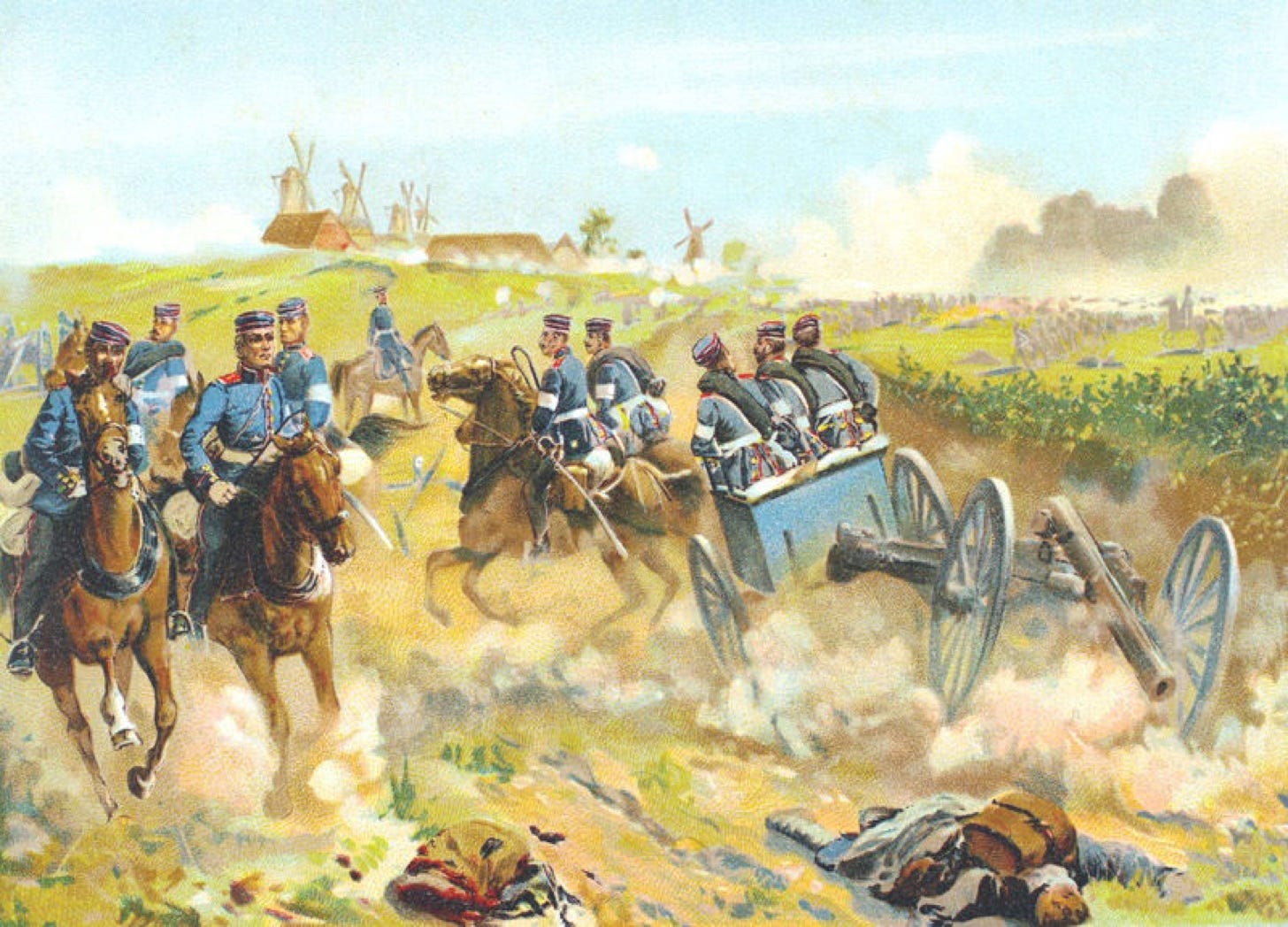
A battery attached to the regiment comes into action on the Windmill Heights. The leading battalion in the main body has been ordered to protect the artillery. What should the battalion commander say?
‘The 10th Company will cover the battery deployed on the Windmill Heights.’
As a rule, infantry that covers artillery deploys somewhat forward and to the flank, usually on the outer wing. It would be wrong, however, for the battalion commander to assign a specific spot, even when features of the terrain seem to invite it. The company commander will find the right place, a position that lets him fulfill his mission.
Assume, for example, that a piece of woodland lies 400 meters to the right and 300 meters forward, and that the battalion commander considers it ideal for the covering company. If he orders, ‘The 10th Company will occupy the grove to the right front of the Windmill Hill and cover the battery,’ he overshoots the mark. He has taken the choice of means out of the company commander’s hands. What if the grove proves so dense that no one can enter it? What if, for compelling reasons, the artillery has not deployed on that hill at all, but farther forward, or on some other spur? In both cases the detailed order becomes unsound.
Situation III
The regimental commander decides to attack. He commits the second battalion entirely and instructs the third battalion to keep two companies in reserve behind the left flank. What order should the third‑battalion commander give?
‘The 11th and 12th Companies will remain behind the left flank at the colonel’s disposal.’
An order in any other form, for instance, specifying the exact point on the ground, prescribing the formation, or fixing a distance to be maintained, would be fundamentally wrong. Such detail would bind the company commander’s hands.
Suppose that at the assigned spot the companies suddenly come under artillery fire and suffer heavy losses. A slight change of formation or a modest advance, withdrawal, or sidestep might easily remedy the situation. Yet the company commander would still be bound by his initial order and, strictly speaking, lapses into disobedience the moment he alters it.
Of course, no sensible company commander will cling to the literal wording of an order that brings only slaughter and ruin to his men. No superior, in turn, will condemn such disobedience. He will condemn only blind obedience to a lethal instruction. That raises the question: why place the company commander in such a predicament in the first place?
In real war, where shells alone decide questions of right and wrong, such issues seldom admit doubt. In peace, however, matters look different. A company commander may deviate from a precise order because he lacks cover or because other circumstances force his hand. His superior may refuse to accept these reasons, may not even ask after them, and may simply take offense. What then?
Situation IV
The regiment intends to carry the attack forward but has not yet to achieve fire superiority. The battalion commander therefore decides to commit one more company. What does he order?
‘The 11th Company will deploy on the left of the 10th.’
He must not prescribe how the company deploys or how strong a firing line it forms. The captain knows that well enough. Nor should he order the new company to attach itself to the end of the existing firing line. There may be an excellent firing position a little farther off which the captain has already spotted.
To leave such a position unused would be folly. Under its cover the regiment might gain ground, while the position itself stands empty. The captain knows that the regiment seeks fire superiority. He will know how many rifles to bring forward and which sort of firing line best serves his purpose.
If the regiment plans to attack and wishes to commit this extra company before the assault, the battalion commander may add: ‘The regiment will attack.’
That is all he needs to say.
A different addition (for example, ‘Drive the skirmish line forward!’) would seize control from the company commander and might even demand the impossible.
At the moment the order is given, such an advance might be possible. Indeed, the captain would probably have pushed forward on his own initiative. However, if the enemy strengthens his fire while the advance takes place, the captain might not be able to push any farther. Thus, he would be obliged to stop moving until friendly forces regained fire superiority.
To be continued …
For All Six Posts in this Series

Related Reading


Sources and Notes
Clemens Spohn ‘Die Kunst des Befehlens’ (‘The Art of Command’) Jahrbücher für die Deutsche Armee und Marine (Annuals for the German Army and Navy) (October 1907) pages 337-340 (Hathi Trust)
‘The Art of Command’ (unpublished typescript prepared by the British War Office, 1907) (Military Learning Library)
Prussia (War Ministry) Felddienst Ordnung (Field Service Regulations) (Berlin: E.S. Mittler, 1900)
Prussia (War Ministry) Exerzier Reglement für die Infanterie (Infantry Training Regulations) (Berlin: E.S. Mittler, 1906)
Readers can find a copy of the Bavarian printing of the Infantry Training Regulations at the Internet Archive.
“In real war, shells alone decide questions of right and wrong.”
This saying, accompanied by suitable illustration, justifies its own line of merch.
What do orders look like in the Armed Forces of Ukraine? Do they follow NATO standard, Soviet, or a different form? The outputs companies need to produce as inputs for battalion-scale battlefield effects are more varied and technical now than twelve decades ago.