

This post follows two previously published portions of ‘The Art of Command’


We must always remember that fruitful cooperation among companies in a battalion, among battalions in a regiment, and so on, becomes nearly impossible when the units receive orders that have not been thought through from A to Z. In peacetime one can still imagine canceling, or revising, an order five minutes after issuing it. Even then, the old maxim ordre … contreordre … désordre (‘order … counter-order … disorder’) will often proves true. In war, however, we should issue orders as if the messenger carrying a revision will not be able to reach his destination.
For that reason, orders sent to subordinate commanders at the outset of battle must be framed so that they remain valid, at least in spirit, as the fight develops.
A few examples will show how I imagine well-issued orders.
Situation I
A regiment on the march runs into the enemy. What order should the regimental commander give the leader of the advance guard?
The Infantry Training Regulations, in paragraphs 356 and 357, state:
‘The advance guard has the task of securing time and space for the main body to deploy. The commander issues the necessary orders to the leader of the advance‑guard. The latter must quickly seize important pieces of ground to his front and flanks, especially commanding heights, even if this requires combat and, above all, secure positions that will permit the artillery to go into action.’
‘The commander of the advance guard must not hesitate to occupy a wider front than his strength would otherwise warrant. The artillery, coming up swiftly, will soon relieve the advance guard.’
These rules make it clear that, if he tried to cover every possibility [that the leader of the advanced guard might face] the regimental commander would sow the seeds of a great deal of misunderstanding. Thus, rather than trying to do that, he expresses his intent and leaves the choice of means to his subordinate. He therefore orders:
‘The advance guard will delay the enemy.’
In accordance with paragraphs 417–420 of the Infantry Training Regulations and the passages just cited, that brief order leaves the leader of the advance guard free to choose his methods. It contains all that the regimental commander must order and, at the same time, all that he can be ordered. It also makes plain the intent of the regimental commander: the advance guard must keep the enemy busy, attract the latter’s full attention, and, at the same time, avoid launching a full-scale attack. In other words, the leader of the advance guard should help the regimental commander to keep his options open.
The leader of the advance guard moves his troops forward, close enough to open fire and convince the enemy that an attack will soon begin, but never so close that he loses control of his own actions or, should his enemy prove bold, provoke an overwhelming counter-attack.
In addition to precluding misunderstanding, the wording of the order provides the subordinate with both a framework for his own decisions and full freedom of action.
Let us suppose that the order reads:
‘The advance guard occupies Hill X and from there will engage the enemy.’
If he does this, the regimental commander would violate the Infantry Training Regulations.
Now, what should the leader of the advance guard do if Hill X, which, from the perspective of the regimental commander, had appeared to lie but 1,000 meters away from the enemy, turned out to be separated from the foe by 1,500 meters or within the effective range of hostile rifles? [In 1907, that would be 500 meters.]
In the first case, the advance guard could not open fire without wasting a lot of ammunition. In the second case, it would not be able to endure the effects of enemy fire and, as a result, would have to choose between attack and retreat, either of which would lead to its destruction.
The distance between Hill X and the enemy prevents the leader of the advanced guard from conducting a delaying action, he cannot carry out the order. If the distance is too short, the order deprives the regimental commander of his own freedom of action, thereby putting the enemy in a position to dictate what he can, and cannot, do.
In either event, the leader of the advance guard, who cannot, in good conscience, carry out an order frame in this way, will find himself forced to ignore it.
To be continued …
For All of the Posts in this Series

Related Reading


Sources and Notes
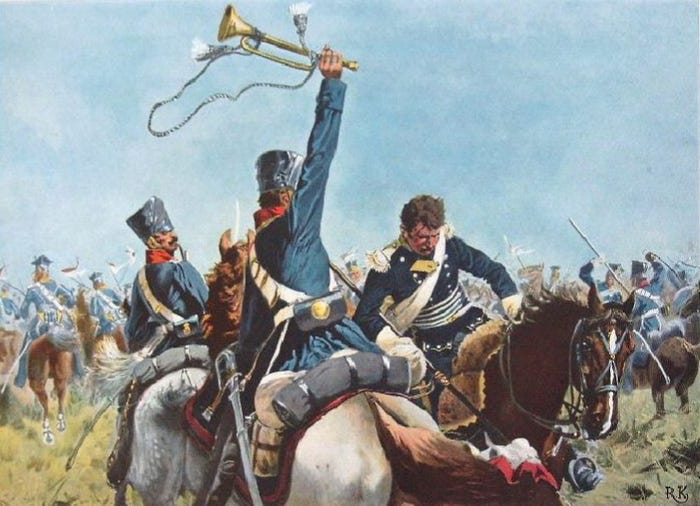
The painting at the top of the piece depicts a scene from the Battle of Möckern (5 April 1813) in which Gottlieb ‘Crazy’ von Platen, a Prussian general famous for leading cavalry charges while smoking his pipe, watches his bugler fight a French lancer.
Clemens Spohn ‘Die Kunst des Befehlens’ (‘The Art of Command’) Jahrbücher für die Deutsche Armee und Marine (Annuals for the German Army and Navy) (October 1907) pages 337-340 (Hathi Trust)
‘The Art of Command’ (unpublished typescript prepared by the British War Office, 1907) (Military Learning Library)
Prussia (War Ministry) Felddienst Ordnung (Field Service Regulations) (Berlin: E.S. Mittler, 1900)
Prussia (War Ministry) Exerzier Reglement für die Infanterie (Infantry Training Regulations) (Berlin: E.S. Mittler, 1906)
Readers can find a copy of the Bavarian printing of the Infantry Training Regulations on the Internet Archive.
Paragraphs 417–420 of the Infantry Training Regulations describe the ‘delaying engagement’ (Hinhaltendes Gefecht), a type of action fought in order to ‘win time’. In the years between 1919 and 1935, the ‘delaying engagement’ would play a central part in the tactical repertoire of the German Army.