


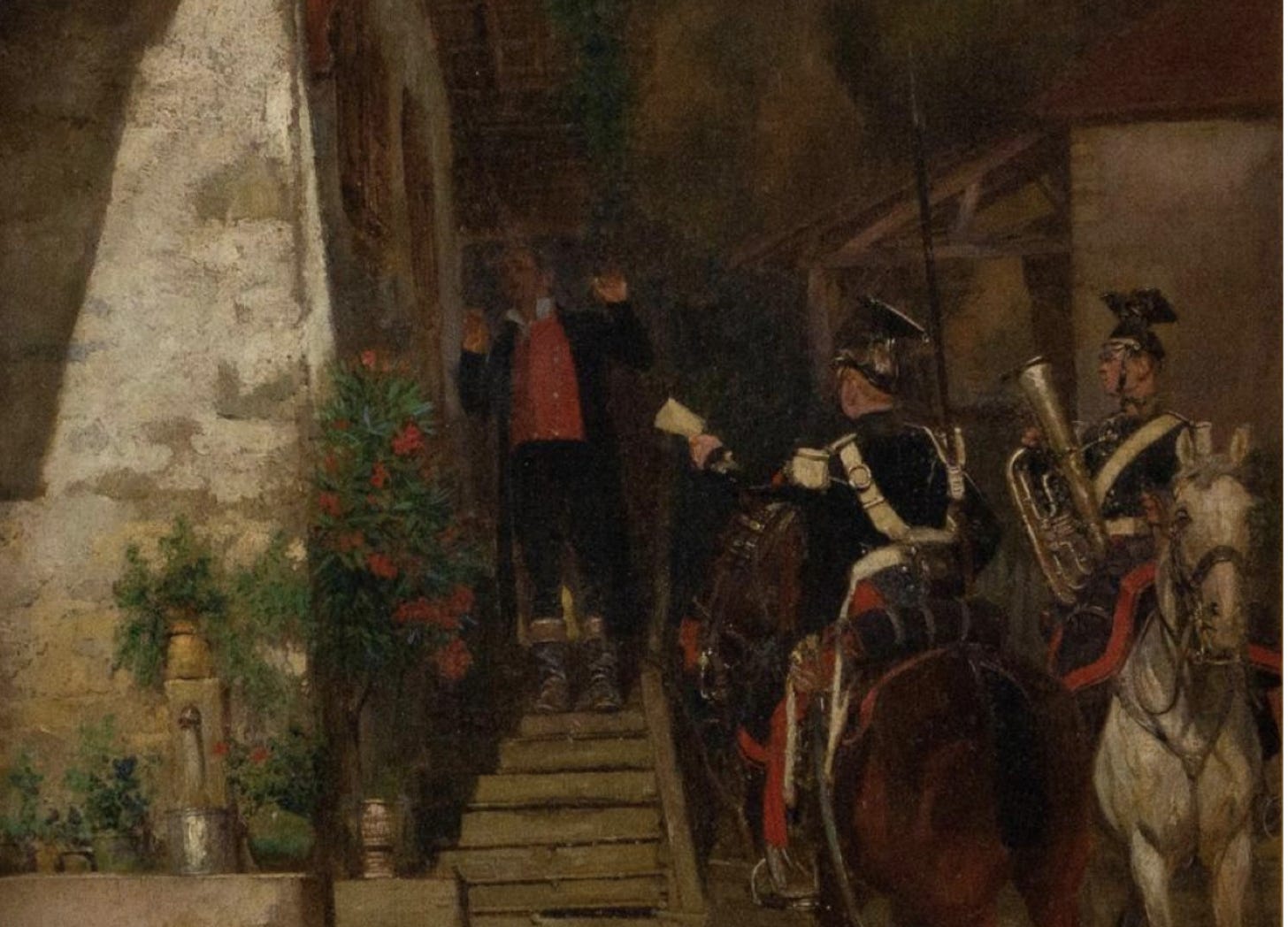
Édouard Detaille Lancers Visiting a HouseIf Victorian cavalrymen celebrated Opposite Day, dragoons of the nineteenth century would have marked the holiday by LARPing as lancers. After all, where dragoons retained (or at the very least, pretended to retain) the ability to fight on foot, lancers spent more time in the saddle than Gene Autry. To be more concrete, where all dragoons (save officers, senior non-coms, and musicians) carried long arms of some sort, most lancers made do with a pistol or two.
In each squadron of lancers, a puny proportion of the troopers traded their spears for carbines. This custom preserved sentries standing guard over the bivouacs of such squadrons from saying ‘stop, or I’ll poke’. It also provided formed bodies of lancers on active service with a means, however modest it might have been, of breaking unwelcome contact.
The lancers of European armies often, and, indeed, usually, wore an idiosyncratic headdress, one that might be described as the product of a wild weekend that a scholar’s mortarboard spent in the company of a Pickelhaube. Known, from the Polish word for ‘cap’, as a czapka, this served to remind nineteenth-century people of the great debt that the lancers of Victorian Europe owed to the Polish picadors who had served in the armies of the Napoleon.

In its language of origin, czapka started with a chushing sound. Thus, when transposed into German, it often appeared as Tschapka. However, where its kissing cousin czako found new homes in the military lexicons of French (le shako), Danish (chakoten), Swedish (tschakån or schakån), Spanish (el chacó), Italian (lo sciaccò) and English (the shako), as well as German (der Tschako), czapka proved less malleable. Thus, most European lancers found themselves choosing between a reasonable facsimile of the original pronunciation of czapka or replacing the word with a domestic substitute. (In the lancer regiments of the British Army, this seems to have been ‘lance cap’.)
In addition to naturalizing the traditional headdress of the Polish lancer, German-speaking armies adopted the Polish name (ułan) for soldiers of that sort. Thus, in the course of the first few decades of the nineteenth century, the armies of Austria, Prussia, Bavaria, Saxony, Hanover, and Württemberg provided themselves with czapka-wearing lance-bearing regiments of Ulanen.
During the Franco-Prussian War, French journalists of the less than careful kind (none of whom, I am sure, ever subscribed to The Tactical Notebook) adopted the practice of describing all German horsemen, regardless of weaponry carried or headdress worn, as ‘uhlans’. Soon thereafter, their English-speaking colleagues followed suite. Thus, as early as 1888, Eben Swift, of the 5th US Cavalry, could use ‘uhlan’ as short-hand for the entirety of the cavalry of the freshly-formed German Empire.
In 1890 or so, the armies of the German Empire began to issue lances to horse soldiers of all kinds, thereby breaking the monopoly on such weapons previously enjoyed by Ulanen. As might be expected, this measure, which occurred at a time when photographs began to fill the pages of popular periodicals, reinforced the tendency of folks who lived west of the Rhine to apply the title of ‘uhlan’ to all of the Kaiser’s Kavalleristen.
To be continued …
Sources
George B. McClellan European Cavalry (Philadephia: J.B. Lippencott, 1861) (Internet Archive) (Hathi Trust)
Eben Swift ‘Cossack or Uhlan’ The Public Service Review (July 1888) (Hathi Trust)
Related Reading

