


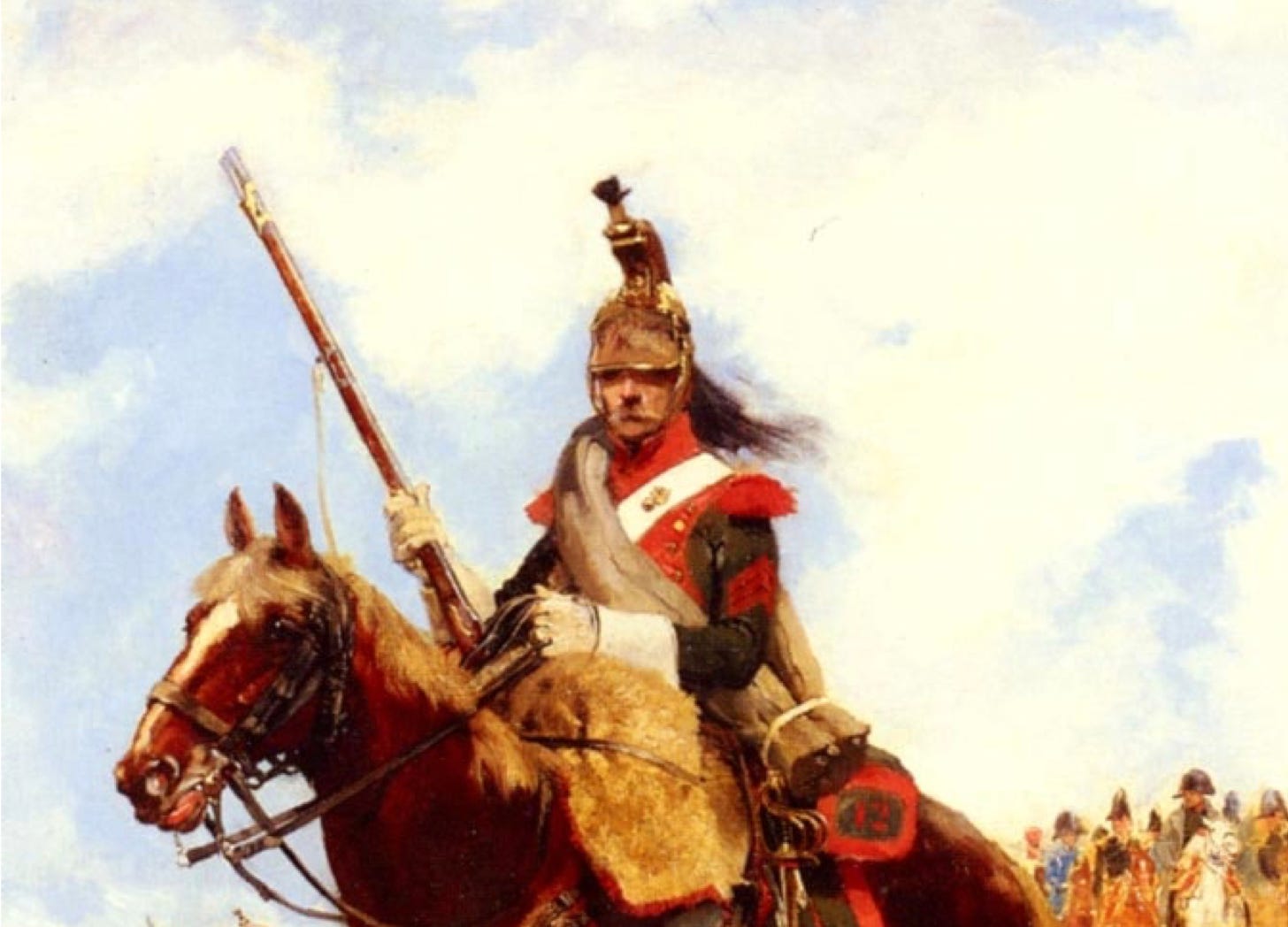
Dragoons throughout the world shared one obvious commonality. However tall they might be, and whatever the size of the horses they rode, they all carried long arms of some sort. In a few instances, these smoke poles resembled those carried by foot soldiers of the day. (The differences that separated the dragoon models of such shoulder arms from their their pedestrian counterparts usually took the form of the hardware used to attach slings and bayonets.) In most cases, however, they took the form of carbines. (Sometimes known as ‘musketoons’, these sported barrels with less in the way of length than those of full-sized muskets or rifles.)
Speaking of rifles …
The tour of European armies that provides this piece with its heart and soul, that carried out by George B. McClellan in 1855 and 1856, took place at a time when the infantrymen of European armies had begun to trade (and, in some instances, had finished trading) their smooth-bore muskets for weapons with rifled barrels. Thus, to no one’s surprise (least of all his own), Captain McClellan noticed that many of the dragoons he encountered in the course of his journeys found themselves in the midst of the same transition.
When visiting Prussian garrisons, McClellan learned that, of the hundred and thirty dragons of each squadron who carried shoulder arms (that is, men who were neither sergeants nor trumpeters nor officers), fifty carried rifled carbines and eighty abbreviated muskets of the smooth-bore persuasion. (During the season of McClellan’s tour of Prussia, the ordnance authorities of that kingdom adopted a short-barreled variant of the famous Dreyse needle gun that had been modified to meet the particular desires of dragoons.)
The custom of giving a shoulder-arm of some sort to each dragon who rode in the ranks owed much to memories of the seventeenth century, when soldiers armed with long barreled pieces called ‘dragons’ rode to the places where they planned to fight on foot. Thus, as late at 1856, McClellan, who had recently accepted a transfer to the freshly-formed 1st Cavalry Regiment of the regular US Army, could imagine a geographical division of labor between American dragoons and ‘cavalry’ of a more specialized sort.
It is a question at least worthy of consideration, whether it would not be advantageous in the United States service to make real dragoons of the regiments now nominally so, employing them always in those portions of our territory where the Indians frequent the plains but retire to the mountains when hard pressed; at the same time making the so-called cavalry regiments mere regiments of light cavalry, to act only on the plains, and not to be expected to fight on foot.
To be continued …
Source
George B. McClellan European Cavalry (Philadephia: J.B. Lippencott, 1861) (Internet Archive) (Hathi Trust) (The quotation comes from page 116.)
Related Reading


This reminds me of the Hobelars of the Middle Ages and the (actual) Dragoon Regiments of the New Model Army, at least in their initial organizations. Mobility is always a crucial element of warfare as you cannot fight with troops that are not there.