

Double-Able Divisions
The Expansibility of J-Series Units

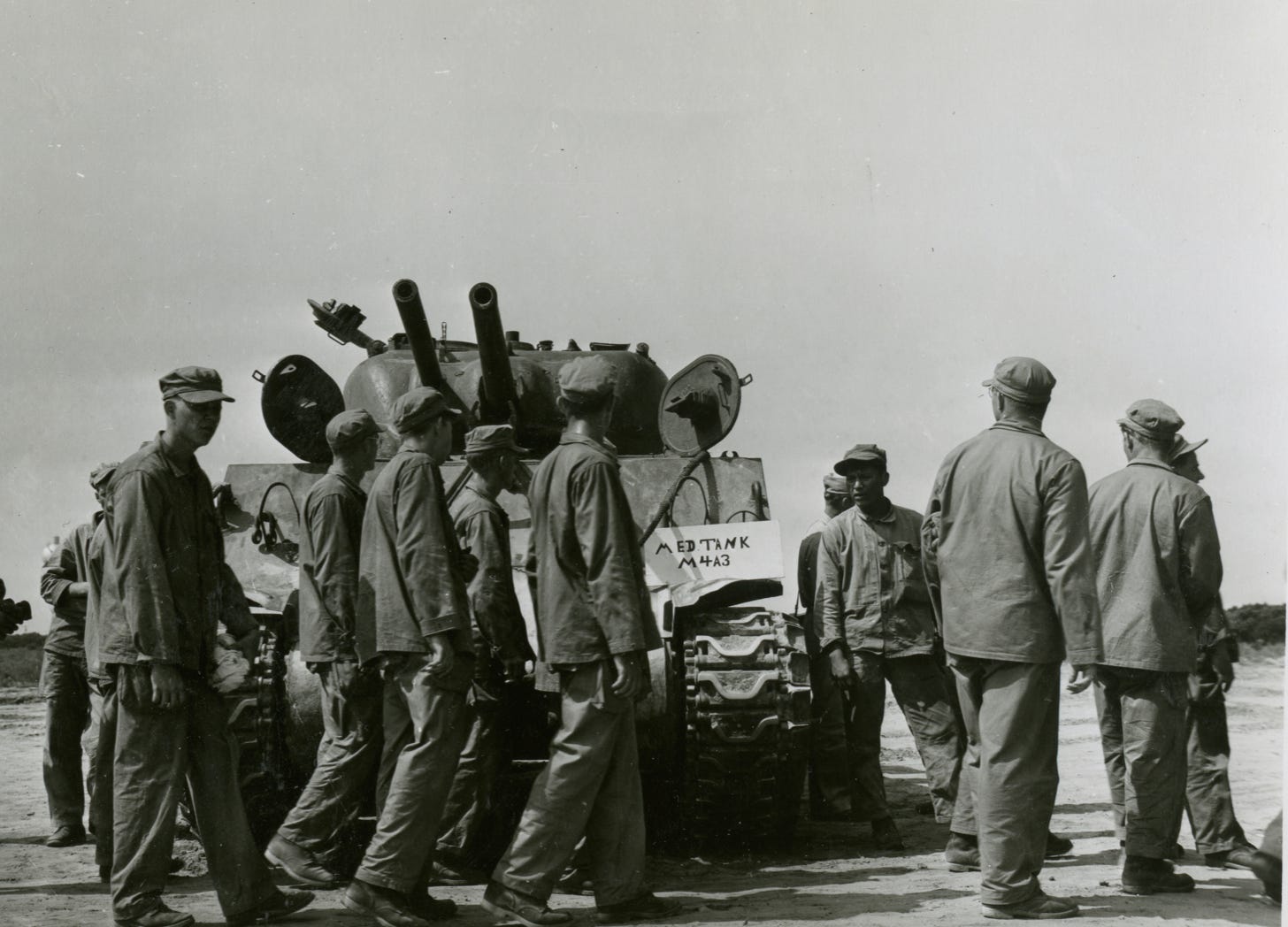
Between 28 November 1945 and 1 April 1946, the US Marine Corps deactivated four of the six divisions that had served during the Second World War, thereby reducing to two the number of formations of that kind. The two Marine divisions that remained, moreover, quickly became mere shadows of the formations that had fought in the Pacific in the very recent past.
The adoption, in May of 1947, of the J-Series tables of organization, which called for Marine divisions much smaller than those of the Second World War, reflected this reality. At the same time, the authors of these establishments made provision for the both rapid expansion of the component units of these two formations and the quick creation of two additional Marine divisions.
The practice of making each infantry battalion the heir to the name, traditions, and battle honors of a wartime regiment set the stage for the three-fold expansion of such battalions in the event of a mobilization for a major conflict. That is, each of the three rifle companies of the peacetime battalion would provide a framework for the creation of a mobilized battalion. Each of the new battalions, in turn, would provide the basic building blocks for a full-strength Marine infantry regiment.
The component companies of each of the binary tank battalions would expand in much the same way, thereby creating the means for building four three-company units, each of which would serve as the armored component of one of the four fully mobilized Marine divisions.
A comparable process would provide each of the triangular tank battalions with a platoon of flamethrower tanks. However, rather than tripling itself, each of the ‘Zippo’ platoons would only have to expand by a factor of two.
Something similar would happen to the six batteries of each of the J-Series artillery regiments. If each of these multiplied itself by three, each of the mobilized artillery regiments would get three full-strength battalions. If, however, each battery quadrupled itself, each such regiment (and thus, each of the mobilized divisions) would enjoy the services of four artillery battalions. (As one of these would be armed with 155mm howitzers, guidance issued with the J-Series tables of organization called for a third of the peacetime batteries to devote a portion of their training time to the care, feeding, and employment of such weapons.)

Sources
A Chronology of the US Marine Corps, Volume III (1947-1964) (Washington, DC: US Marine Corps, 1971) page 4 (USMC)
‘The New FMF’ The Marine Corps Gazette (May 1947) pages 10-14 (Internet Archive)
For Further Reading


This also presupposes that your opponent will grant you the time and other resources needed to man, equip and train these new units.
Sounds very much akin to the old Expansible Army concept, which did not work well if I recall correctly. Experienced leaders do not grow on trees, nor can you warehouse them in case of future need 🙄