

Buck Rogers' Marines
Marine rocket batteries 1944-1953

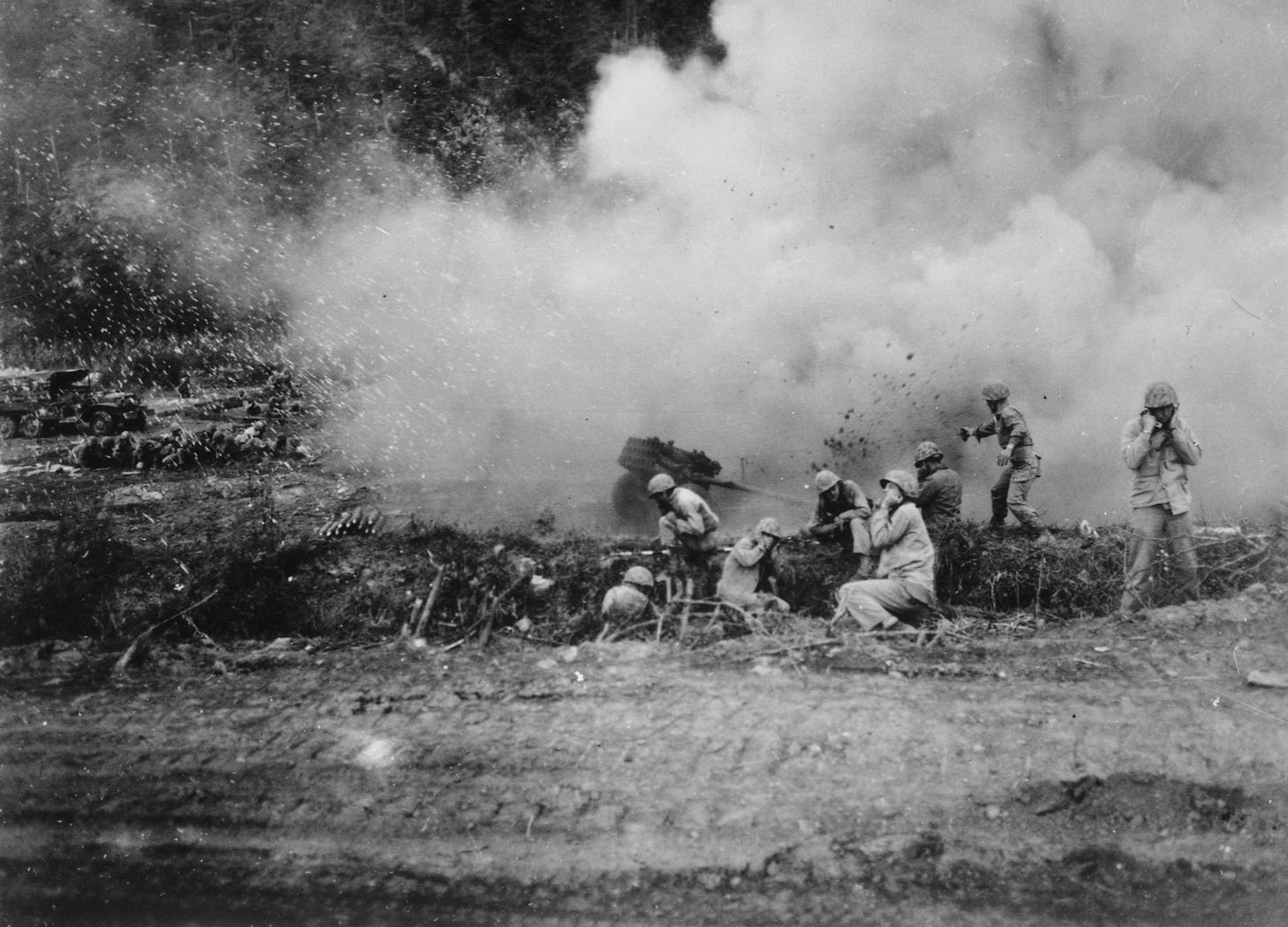
During the last eighteen months of the Second World War, the Marine Corps deployed several provisional rocket detachments, each of which rated fifty-four Marines and a dozen truck-mounted multiple rocket launchers.
In the battles for Tinian, Iwo Jima, and Okinawa, units of this sort delivered large numbers of 4.5-inch rockets, each of which carried 6.5 pounds (3 kilograms) of high explosive. Thanks to this payload, the explosion created by a single rocket, and the fragmentation effect that followed, compared favorably to that achieved by a 105mm howitzer shell of the day.
Unfortunately, the 4.5-inch rockets suffered from limited range. Thus, the ‘Buck Rogers men’ who delivered them could only reach targets within 1,200 yards (1,100 meters) of their trucks. To make matters worse, the near simultaneous ignition of hundreds of rocket motors in small places produced a great deal of dust and flash, smoke and sound.
In order to avoid the counter-fire attracted by such a signature, the rocket trucks often practiced the terrestrial version of the technique that torpedo-boat sailors of the First World War had called ‘shoot and scoot’. That is, within seconds of expending its last rocket, the crew using this technique would jump onto its truck, pull out of its old firing position, and begin moving to a new location.
In December of 1945, The Marine Corps Gazette published a piece that, after celebrating the achievements of the provisional rocket batteries and pointing out the shortcomings of their equipment, argued for the adoption of a multiple rocket launcher recently developed by the US Army. Light enough to be towed by a jeep, the T66 could fire its 4.5-inch rockets as far as 5,200 yards (4,800 meters). The new rockets, moreover, could be fitted with a variety of fuzes that the Army had developed for use with shells fired by artillery pieces.
This proposal found favor with Headquarters, US Marine Corps, which authorized the formation of a ‘rocket battery’ in each of the artillery regiments of the regular establishment. Unfortunately, in the years between the end of the Second World War and the start of the Korean War, authorization did not necessarily result in the provision of resources. Thus, in October of 1946, the freshly-formed rocket battery of the 10th Marines, which had just set up housekeeping at Camp Lejeune, North Carolina, enjoyed the services of one captain, a single sergeant major, and a solitary corporal.
Sources
Information about the provisional rocket detachments of 1944 and 1945 comes from Andrew F. Mazzara Marine Corps Artillery Rockets: Back Through The Future (Quantico: Marine Corps Command and Staff College, 1987) (Global Security.org)
Both film clips come from the US National Archives, the first directly and the second via YouTube. (Portions of the second movie also appear in a YouTube video hosted by The History Guy.)
Issues of the Marine Corps Gazette published in the years between 1916 and 1961 can be found on the Internet Archive.
The tale of the meager muster roll of the rocket battery of the 10th Marines can be found on page 86 of the official history of that regiment: David N. Buckner A Brief History of the 10th Marines (Washington, DC: Government Printing Office, 1981) (Marine Corps University)
For Further Reading


Sounds promising, A Captain, A Sgt. Major and a Corporal. From small acorns mighty oaks grow…It would seem we are still trying to find our way with rockets, where and how to deploy them and what kind. One would think in the last 79 years we would have come to some conclusions. Improvise, adapt over come. Shoot and scoot. Well it’s an executable plan anyway. Beats being stranded on the first island chain ringing China….