

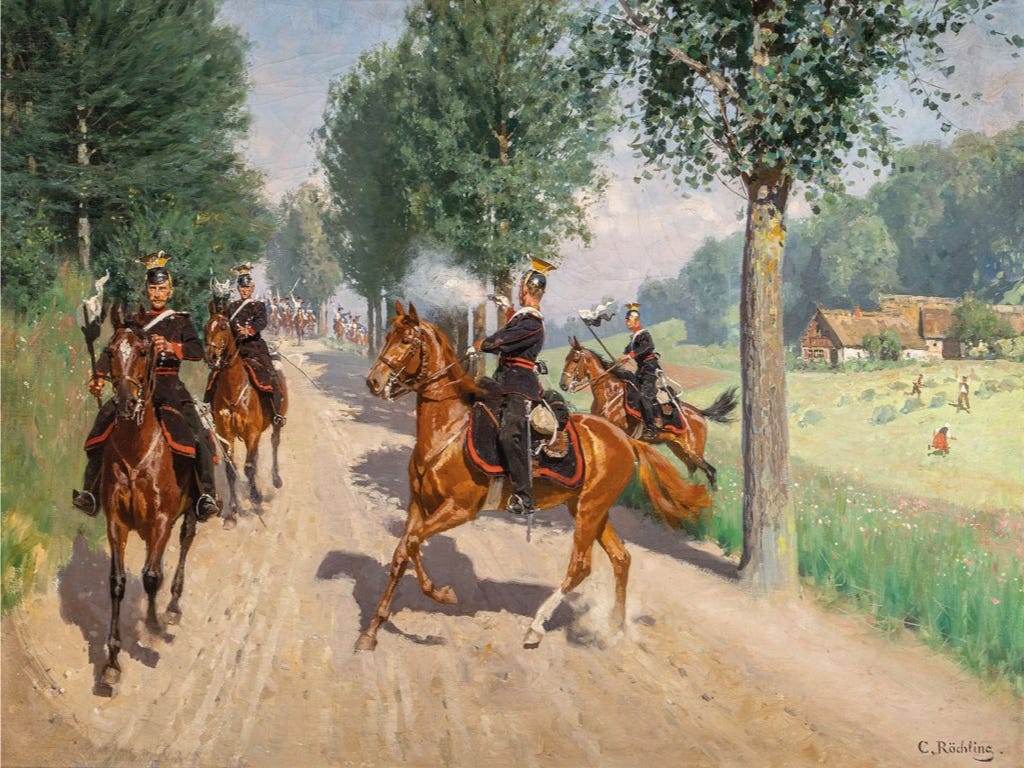
Napoleon may or may not have said that one hundred years would see Europe dominated by Cossack or Uhlan. At all events a contest between Slav and Teuton has been long foretold and carefully prepared. We believe that the decision when it comes will depend upon the relative values of the types of national cavalry employed.
Eighteen years ago when the Uhlan was picketing his horse in the Gardens of Versailles it did not look as if he would soon lose his prestige, and later when the Cossack failed of dazzling results in the Balkan campaign [of the Russo-Turkish War of 1877-1878] it did not look as if there need be doubt as to the issue of a struggle between Uhlan and Cossack, on the sandy plains between the Vistula and the Oder. But the Russians have learned much in the last two years, while the Prussians and Austrians have been at a stand-still in many matters-particularly in all [things] pertaining to cavalry.
German cavalry is the pride of the race; officered entirely from the nobility, even the sons of the great Chancellor [Otto von Bismarck] fought in its ranks as privates. Filled with the romance and traditions of a glorious history, it need not be doubted that it has all the confidence of those hard-headed nobles who so freely gave their lives for an idea at Crécy and Morgarten.
At Crécy (26 August 1346) and Morgarten (15 November 1315), armies composed of commoners on foot defeated forces made up of well-born knights on horseback.
Germans point to great results and say that by such should their methods be judged, but they ignore the fact that they have only encountered inferior representatives of the same cavalry school with themselves. The Cossack shocks the sentimental idea of cavalry. The glitter and the tinsel that comes from old days of joust and tourney are not in his line. He wears not a button or a bright thing about him, and he rides his little plug of a horse holding his knees almost as high as his chin.
His seat resembles that of a monkey in a circus race. The haute école and the manége he regards as mere cavalry quackery, the reposte and point he takes to be obsolete practices of a discarded weapon. He is ungainly and ugly. But he may be relied on to apply the homely maxim of an American cavalryman, and he will be sure to ‘git the most men thar first’; and in a scrimmage he will be a bad man to meet.
The German military system seems now, as in the days of Frederick, to consist of a single prodigious warrior with a crowd of gallant gentlemen, his blind followers, in a plane immeasurably beneath him. It will be remembered that Frederick [the Great, who died in 1786] was only dead twenty years when [on 14 October 1806, the battles of] Jena and Auerstadt were fought.
Military men wonder if the creations of the mighty [Helmuth von] Moltke [the Elder] may not be as rudely tested in the next war as were those of Frederick in 1806. The Russians have been hard at work gathering together all that was useful in German methods; but under the influence of younger and more progressive men they have not been bounded by German experience alone; they have culled from many fields of improvement in the art of war.
The Russians have been attentive students of our experience. The Germans have despised the struggles of our undisciplined militia. General [William T.] Sherman says in his recent article in The Century Illustrated that he found Russian officers well versed in our campaigns, while the Germans in self-sufficient confidence rested content with their laurels.
In Russia I found the army officers specially well informed about American affairs. … In Germany the army officers seemed so well satisfied with themselves, by reason of their then recent victories over the French, that they gave little heed to our affairs on this side of the Atlantic.
The Germans ignored the use of field entrenchments and they entered the [Franco-Prussian] War of 1870-1871 with incorrect battle tactics for infantry, and they will practice in the next war the errors of one hundred years in the use of cavalry. The Russians on the contrary have freely used field entrenchments, and [Russian general Mikhail] Skobelev drew the inspiration of his masterly use of successive lines of skirmishers from American battles.
The Russians have now Americanized their cavalry. No German by merit alone can rise. A Russian soldier may reach the highest command; Skobelev’s grandfather fought in the ranks in the Napoleonic wars and he was himself a lieutenant-general at the age of 32. [General Mikhail] Loris-Melikov [of Armenian origin] is an Asiatic. [Maksud] Alikhanov [-Avarsky], from a cashiered subaltern disgraced to the ranks, has fought himself into the positions of general officer and governor of Merv [in Turkmenistan].
Within a few hours of the declaration of war, the cavalry, which is maintained on a war-footing, will be sent across the frontier to harass the enemy, to delay his mobilization and concentration, to burn, pillage and destroy. This action by the horsemen of both armies will at once result in one or more great cavalry battles. A decisive defeat of either side will be defeat of the entire cavalry of a nation, and disaster at such a time cannot be subsequently remedied within the limits of a modern war.
The field army of the beaten cavalry will conduct its concentration and first movements, up to the time of actual contact with the enemy, with hesitation and delay. During the great battles which are to bring about the final decision the victorious cavalry will be able to act in the rear of the advance army. The tactical advantages of an independent body of horse with defensive as well as offensive powers, acting as a turning force in a battle, would undoubtedly be great.
If the field army of the superior cavalry is greatly overmatched by its adversary, the result will probably be no worse than a drawn battle.
A collision between German and Russian cavalry would test the two radically different ideas of the arms that are now held over the world. Although it has been customary to speak of all German cavalry as ‘Uhlans’ on account of their success in [the] Prussian wars [of 1864, 1866, and 1870-1871], these cavalry, as well as those of Austria, are composed of lancers, hussars, cuirassiers, and dragoons. The Russian cavalry, with the exception of a few fancy regiments, of the Guard, may be said to have been completely transformed into dragoons since 1882.
The Germans preserve the traditions of the beau sabreur, and affect the head-long charge and the use of cold steel. If they have conceded something to the fire-weapon in allowing some carbines and revolvers to be carried, it has been under a certain amount of protest. They do not propose to use these weapons on horse-back, ‘except as a signal’. They feel, however, that sometimes it maybe necessary to dismount to fight on foot, but for this our German cavalier always feels bound to apologize.
The Russians, on the contrary, have discarded cold steel for hot lead. They are armed principally with the carbines and revolvers, which they use well on foot and on horseback. They are the first European natives to acknowledge that cavalry can fight on foot without losing the distinctive attributes of cavalry. They will apply to the fullest extent the cavalry lessons taught by [Philip] Sheridan and [Nathan Bedford] Forrest in this country, and will be the first to give to Europe the idea of a cavalry army moving with celerity, crossing rivers and mountains without a base of supplies, attacking infantry, cavalry, breastworks or gun-boats, wherever opportunity occurs.
The world maybe prepared for a new surprise when the light horsemen of Russia joins battle with the ponderous horsemen of middle Europe. The Russians can immediately dispose of nearly a quarter of a million of horsemen, outnumbering the cavalry of Germany and Austria combined, by nearly a hundred thousand.
In making a steady soldier and brilliant trooper out of the Cossack, you have a great advantage in his national aptitude, for he is a born horseman, and he has long been accustomed to the use of arms. His term of service is six years with the colors. In other European cavalry his service is three years with the colors. Now, it is well known by those who have tried both methods that the fire-weapon can be more easily learned than the arme blanche by recruits without previous training, so the superiority of the Cossack, adding natural advantages to double this training, becomes apparent.
These descendants of the [Don] Cossacks of [Hetman Matvey Ivanovich Count] Platoff are no longer irregular horse; for some years they have been brigaded with the regular cavalry; they are drilled and armed in the best style; they have a horse artillery of their own and a [supply] train organization that cannot be surpassed; they have telegraph and pioneer attachments, and special scout service. The reports of their practice rides show that in endurance and in celerity of movement they can hardly be equalled in this country, and they surpass the Germans.
Their arrangements for crossing rivers are no more than equalled by the Indians on our plains. But the boldest innovation of the Russian cavalry, and the one from which they will derive the greatest results, is their teaching their troopers to rely upon the revolver in mounted combat. By this the enormous tendency towards changing cavalry into dismounted infantry is checked; and the two distinct rôles of cavalry under modern conditions become clearly defined-namely, its offensive mounted action with revolvers, and its defensive dismounted action with carbines. Whether a campaign next spring would be too soon for a proper appreciation of the value of their innovations remains to be seen.
Russia before now has found safety in the valor of her Cossacks. In 1812, the Cossacks of Hetman Platoff were out-numbered by the cavalry of [French marshal Joachim] Murat.
Imagine two hundred thousand of such soldiers as Nez Percé Joseph and White Bird, and Ollicut [Ollokot], Joseph’s brother, led across mountains and through rivers, for fifteen hundred miles, baffling ten times their number in 1877; drill them in modern tactics; give them the confidence of a powerful nation, arms of the latest model, artillery of their own, and educate the chiefs in every phase of the modern trade of war, and you will form some idea of the cavalry that now awaits the word of the Czar along the western border of Russia.
Sources
Eben Swift ‘Cossack or Uhlan’ The Public Service Review (July 1888) (Hathi Trust)
William T. Sherman ‘The Grand Strategy of the War of the Rebellion’ The Century Illustrated (February 1888) pages 597-598 (Hathi Trust)
Related Reading


A thrilling vision, but the Russian cavalry in the first world war did not strike the mighty blows predicted here. I wonder why not? I’m not asking that sarcastically. Did this author completely fail to understand the Russian capabilities? Was he imagining this?