


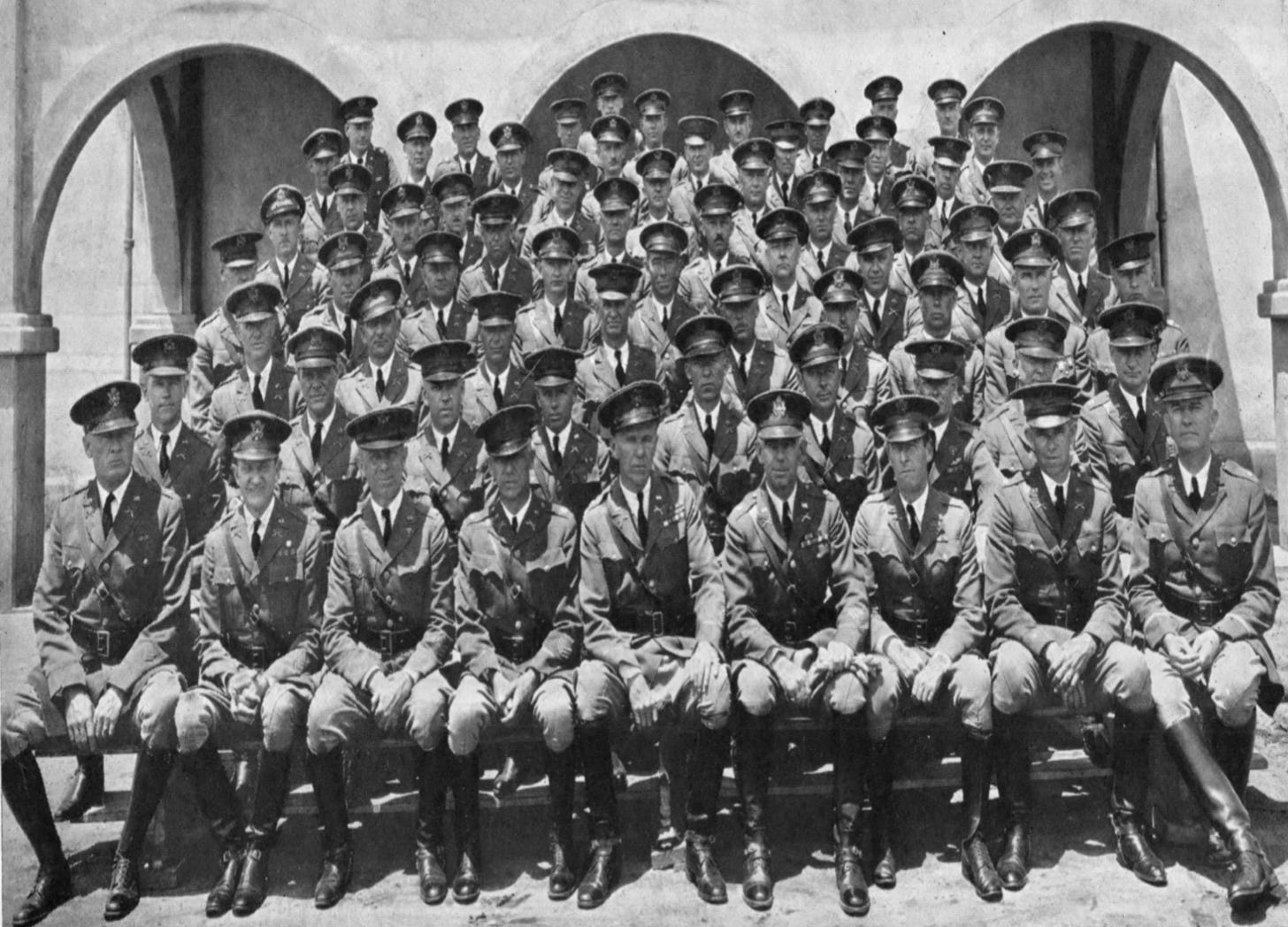
Of the eight articles published in the first issue of the Infantry School Mailing List, only one, the transcript of a lecture given by German exchange officer Adolf von Schell, bore the name of its author. Thus, a century or so after the volume rolled of the press, we cannot be sure who wrote any of them, let alone the set of sixteen short ‘Infantry Problems’ serialized in the summer of 2026 in The Tactical Notebook. That said, some peculiarities of the problems allow us to distinguish between, if not name, several different authors.
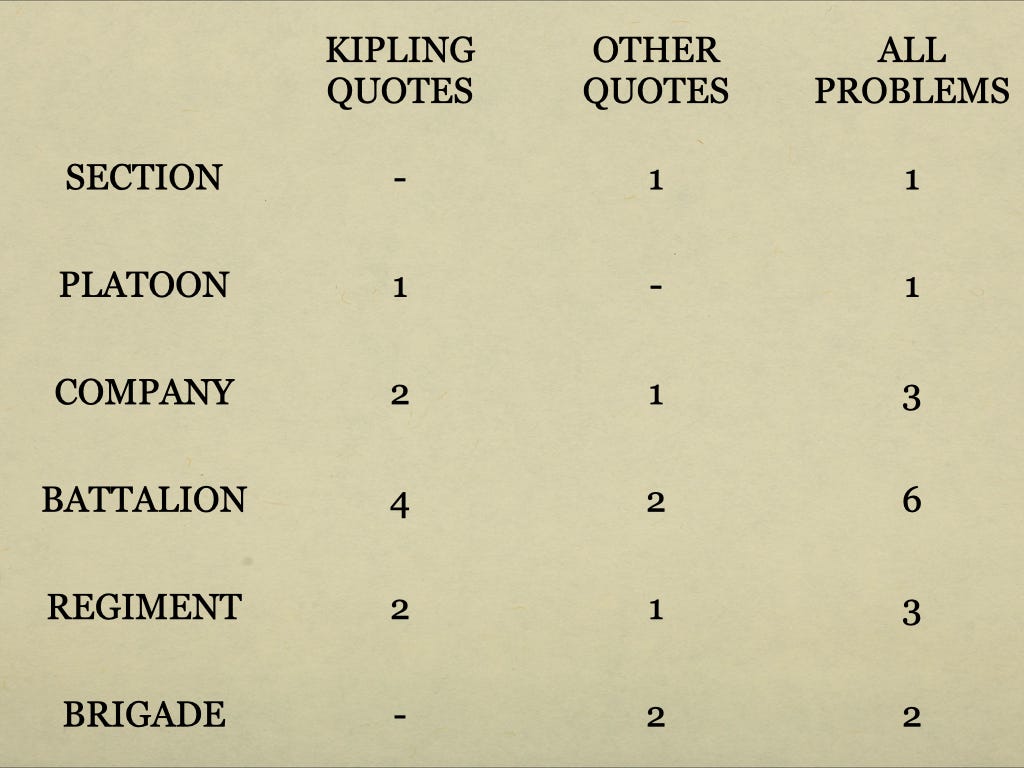
Each of the problems began with a short quotation. Of these, nine came from poems penned by Rudyard Kipling and six from the works of individual authors, each of whom made a single appearance. Of the nine quotations from Kipling, moreover, eight came from explicitly martial ditties and four made mention of artillery pieces. (The exception to this rule belongs to a pair of lines from The Song of the Banjo, a rhyme which, while set in a military milieu, deals chiefly with the music made by the eponymous instrument.)
With this in mind, I went looking for an officer who combined a strong connection to the Infantry School with a fondness for the rhymes of Mr. Kipling. Marvelous to say, the first biography I pulled off of the shelf told me that the subject of the story, Edwin Forrest Harding, who spent six years (1927 through 1933) at the Infantry School, gave ample evidence of ferocious fondness for, and occasional imitation of, the oeuvre of the Bard of Bombay.
Armed with this intersection, I took a closer look at the Kipling-crowned problems. All nine of them, I discovered, contained what, faute de mieux, might be called ‘secondary scenarios’. That is, they asked students to provide solutions for two variants of the same basic problem. (In four cases, moreover, the difference between the two parts of these two-fisted conundra lay in the background of the unit in question, that is, whether or not it enjoyed the advantages of thorough training and experience of active service.)
Speaking of units … A plurality of the problems that began with quotations from Kipling placed players in the role of battalion commanders. Of the rest, all but one of the exercises might well be described as ‘battalion adjacent’. Kipling-free games, however, asked participants to imagine themselves in command of a wider variety of units.
Sources
‘Infantry Problems’ Infantry School Mailing List (Fort Benning: US Army Infantry School, 1931) Volume 1 (1930-1931) pages 27-66 (Internet Archive)
Leslie Anders Gentle Knight: The Life and Times of Major General Edwin Forrest Harding (Kent, Ohio: Kent State University Press, 1985)
The poems quoted can be found on the Poetry Lover’s Page and the website of the Kipling Society.
The photo of the faculty of the Infantry School comes from the yearbook of that institution (The Doughboy) for 1931. (Donovan Library)
(Alas, and, indeed, alack, the website for the Donovan Library has gone into occlusion. I will post a link as soon as it returns to the Land of the Living.)
Related Reading


I think you found the thread - it's definitely the Kipling quotes that tell the tale.
Bruce! I love the detective dedication!