

The Personality Factor in War
From the Infantry School Mailing List of 1936

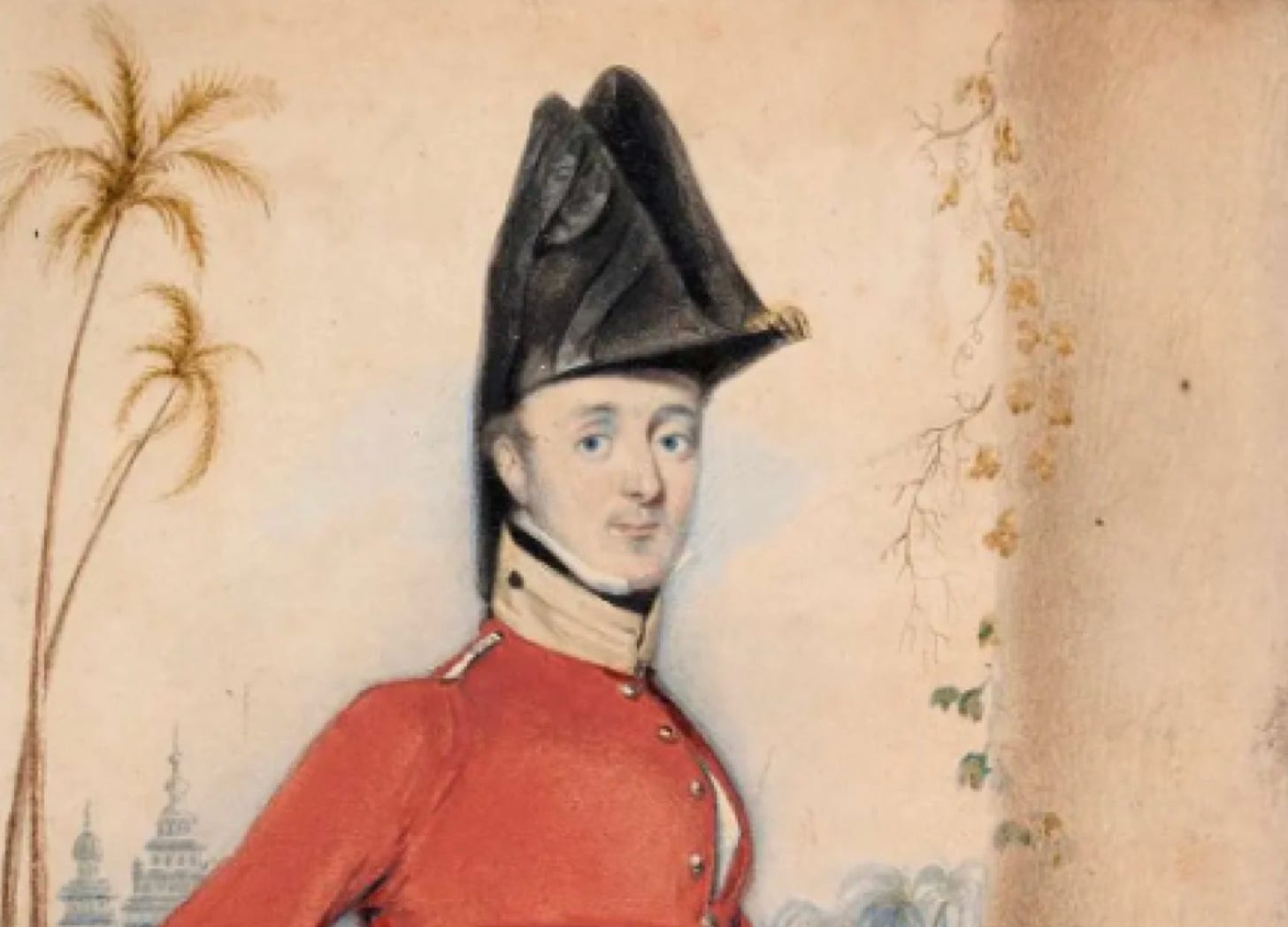
,_later_1st_Duke_of_Wellington,_when_in_India_1797-1804_P3839.jpg)
I am posting this anonymous essay, not merely because of its inherent value to students of war and warfare, but also because of the light it sheds on the design and direction of fictional decision games.
A leader so intimately acquainted with the character of his opponent as to be able to predict with certainty what he will do under any given circumstances may set aside with impunity every established rule of war.
Henderson
All tactical instruction has a definite mechanistic background. Notwithstanding the lessons of history that show us conclusively how victory does not always go to the side with the heaviest battalions, nor to the side which has initially the tactically superior dispositions, school problems are invariably decided on this basis. There are, in reality, factors more important than numerical strength or even superior dispositions. Training, discipline, morale, personality of commanders, national morale, and the like, exert a profound, and generally a decisive, influence on all battles. All such items, however, are deliberately left out of map problems on the ground that it is impossible to assume a value for intangibles.
This leads the student, though he may be little aware of being led, to the conclusion that war is entirely an affair of invariable and easily measurable factors, that an army is only a machine, and that a commander has only to know the right levers to shift in order to secure victory. It is never driven home to him, for instance, that battalions are not solid blocks but unstable organizations liable to disintegrate under certain conditions, and that commanders are not simple robots, all responding alike to a given stimulus, but men of complex temperaments each of whom has his individual — even unique — reaction. Nevertheless, there is only one thing of which the student can be sure: He will never encounter General A, the intellectual automaton of the map problem, on any battlefield.
Furthermore, in the study of military history this neglect of the non-physical elements of war has far too often concentrated all attention upon its physical aspects. Victory, in consequence, is usually ascribed to some maneuver that can be plotted clearly, whereas it is more likely to be due to an intangible factor such as the personality of the commander. The maneuver that one commander pushes through to a brilliant success, tried by another, may lead only to a miserable failure. What if the troops lack confidence in their commander—or the commander lacks resolution to push his attack home? Burnside might have conceived some of Lee’s plans but if he had tried them he would in all probability have failed. He lacked at least one of Lee’s personal qualities — intelligence — which in essence made Lee’s schemes of maneuver possible.
Does it profit us to neglect such a factor of war as that? And of these personal qualities intelligence is only one, and, though readily recognized, perhaps not the most important. We may debate how true it is that “In war all things are simple but the simple is difficult,” as Clausewitz said. Why not flatly admit that it takes no intellectual giant to comprehend or devise a scheme of battle but it takes a giant of some sort to execute. And then, going further, try to ascertain what qualities are responsible for the successful execution. In short, place the emphasis on the difficult execution, not the simple plan.
A maneuver, whether simple or difficult, is actually but the extension of the personality of one man—the commander. To consider it only as a simple pattern for the application of physical force in a geometric direction is totally false. Yet this is our viewpoint, gained at great sweat over maps and overlays. The pattern of battle is all, and the man nothing. Our training, our tactics, and our study of military history bring us, unless we are indeed of tough mind and open, to that distorted stage at which we grind out a mechanical solution, apply it to mechanical units, and get a mechanical result. That may seem desirable in this day of mechanical warfare but no, it will never be desirable until we get mechanical men and even then it will take brains to push the buttons.[
Yet it is also true that in military history to evaluate factors outside the physical realm is exceedingly difficult and accordingly, it is not unnatural for us to thus concentrate on the easily tabulated and plainly charted details of campaign and battle. Often, indeed, the obstacles to estimating even the effect of a commander’s personality alone, may appear insurmountable. In the first place the estimate of an historic personality is the boiled-down decision of posterity, which has had a chance to see both sides of the man and his problem and has very likely arrived at a full estimate, however accurate or inaccurate. Certainly it is not always accurate. Prejudice, national pride, and other emotional factors too often conspire to give us a picture of a personality far different from the truth. Hannibal, whose accomplishments are known to us only through his enemies, was very likely a man quite different from the Hannibal of our histories. The fact that his character dominates the Second Punic War, and that even his bitterest enemies could not diminish his stature, is testimony, of course, to the transcendent genius of the man. We can say that much but we cannot say we know Hannibal or his personal technique of action.
Washington as painted in most history books is far different from the person he actually was, or appeared to be, to his contemporaries. We have trimmed off the humanity of the man to obtain by our pruning a stiff legendary hero devoid of the slightest informality or fault. Robert E. Lee has been going through the same process. Figures thus trimmed to fit our story books are valueless in estimating the personality factor in war. They are untrue. The man who as a child builds up a folk-lore concept of an historical character will, as a man, find it difficult—for some men it is impossible—to consider this character in any other guise. The impressions of youth cannot be discarded like an old coat. They are more in the nature of a scar, which only an operation will remove, and even then leave its cicatrice.
To sum up our first difficulty in determining the values to give the non-physical factors of war: History may give us the correct picture of a personality, or it may give us a distorted picture and we ourselves are all too liable to gaze at either picture with eyes dimmed by emotion born of childhood schooling. But there are further difficulties, not the least of which is that we do not even know precisely what personal qualities in a commander are essential and we have no clear terminology to describe those qualities if we knew them, no scales to weigh them, no method of measuring them. Not an auspicious start to the study of the influence of personalities on battle.
But the end is not yet. Of every battle studied we know the answer—who won. And being only human, this fact warps our judgment. Like the child who looks in the back of his arithmetic to find the answer, and then tries to juggle the figures of his problem until he gets the same result, we unconsciously juggle our available facts and sequences of events to show how a battle took the form it did. The pressure to do so is great. We are under the necessity of showing causation, or else we must admit that war is a game of chance and battle but a toss of the dice. This admission we cannot make, for it would destroy the whole fabric of military education and make impossible a military science or art.
But since we omit or slur the intangible psychological factors, such as the influence of a commander’s personality, we throw away factors in our equation which, according to one authority, are three times as important as the physical facts. The result is a battle picture constructed of physical data alone. And in order to show how inexorably these data produced victory we are reduced to some very ridiculous rationalizing.
Thus we arrive again at the main point. To show how effects flow from certain causes in war we must include what heretofore have been regarded as intangibles. Let anyone who doubts this study the battle of Cannae. On the basis of that battle, only a master of dialectics could prepare a case for dominance of the physical factor in war, only a sophist would present such a case, and only a simpleton would be convinced by the arguments.
A bland disregard of the non-physical factors of war leads to some delightful pieces of rationalization. Napoleon’s marshals in Spain had poor success against Wellington. Hence, it is argued, they were poor commanders away from Napoleon. Yet in the same breath Wellington is given great credit for defeating them. This, itself, is droll, but it is only incidental. The point is that a thorough analysis of the campaigns in the Peninsula, attributing a fair weight to the mental attitude of the Spanish people, might well reach the conclusion that it was not Wellington who defeated the French so much as the fanatic hostile peasantry egged on by the clergy.
Eliminate this factor or, better, reverse conditions. Imagine Wellington operating against Massena in the revolutionary Ireland of 1916–1920. Then the shoe would be on the other foot, and old, one-eyed Massena might have justified the remark that Wellington was only a Sepoy general. Yet here we tread on dangerous ground for we are likely to arouse the passions of admirers of Wellington. So hard is it to look at great personalities objectively.
Indeed, perhaps the greatest single item that prevents true appreciation of the personality factor in war is our acceptance of the historical verdict. With the historical estimate of a particular general before us, we are unable to understand why his opponent did not take advantage of certain weaknesses in his character or on the other hand, we wonder why another general should be so foolhardy as to try something risky in the face of a master of maneuver. We forget that generals fighting a war do not have the verdict of history to help them. They must find out for themselves, and in this process often get burned—or just as often gain a victory.
Thus, in studying the personality of a commander and how he plays his opponent, we are often safer in taking the contemporary opinion of his opponent than the historical opinion. Not because the contemporary opinion is more accurate, but because it is far more likely to be the opinion that was held by the general we are studying and the opinion that motivated his actions. Robert E. Lee thought highly of McClellan, as did hosts of people in the North. History does not reach the same conclusion. Lee may have been correct and the documentary historians wrong but in any event it was not the historians’ estimate of McClellan that Lee held.
Again summing up, with fair assurance we can at least say this: To obtain a proper appreciation of a commander’s character and ability we must first place ourselves in that commander’s shoes; we must be certain that we have no prejudices, national or otherwise, concerning him—no hero worship; we must be wary of accepting historical judgments as to the worth, or the worthlessness, of his opponent; we must be sure that our evidence concerning him and the battle is substantially correct; we must feel the impact of contemporary knowledge and events as a participant—a man of the day—not a cold-blooded dissector of documents—a scholar; and above all we must not know how the battle will turn out, for to do so will certainly warp our judgment. As humans we cannot help believing that the victor was right, and then steadily rationalizing to prove his actions and our conception of them correct.
True, it is simple to build up a map problem and then state what the proper action should be. But the cynical student often refuses to be convinced that the solution is sound or that any commander would act that way. It takes the crash of actual battle, the impact of armed masses, and the decision of the God of Battles to convince him that a maneuver or a decision was correct.
But how can we do all that? Perhaps we cannot but in the next chapter we shall have a try at it. And you, if you care to, can match your wits against a personality and see a real one in action.
Notes and Sources
‘The Personality Factor In War’ Infantry School Mailing List Volume 12 (July 1936 ) pages 1-7 (Internet Archive)
The Internet Archive preserves scans of microfilmed copies of all thirty volumes of the Infantry School Mailing List. However, it catalogs them under the heading of the Infantry School Quarterly, which succeeded the Mailing List in 1947. (Internet Archive)
The Hathi Trust provides links to scanned-from-paper copies of some, but far from all, issues of the Infantry School Mailing List (Hathi Trust)
The quotation at the head of the article comes from G.F.R. (George Francis Robert) Henderson Stonewall Jackson and the American Civil War (London: Longmans, 1898) Volume I page 62 (Hathi Trust)
In addition to this, Colonel Henderson seems to have provided the anonymous author of ‘The Personality Factor in War’ with the starting points for his thoughts about Robert E. Lee, George B. McClellan, André Masséna, and the Duke of Wellington. Thus, readers interested in the roots of the ideas expressed in the essay may want to compare it Henderson’s many writings on the American Civil War and his Some Notes on Wellington (Dublin: Dollard, 1897) (Hathi Trust)