

The Direction Group
'Forest-Fighting and Reconnaissance Training in Finland' (Part I)

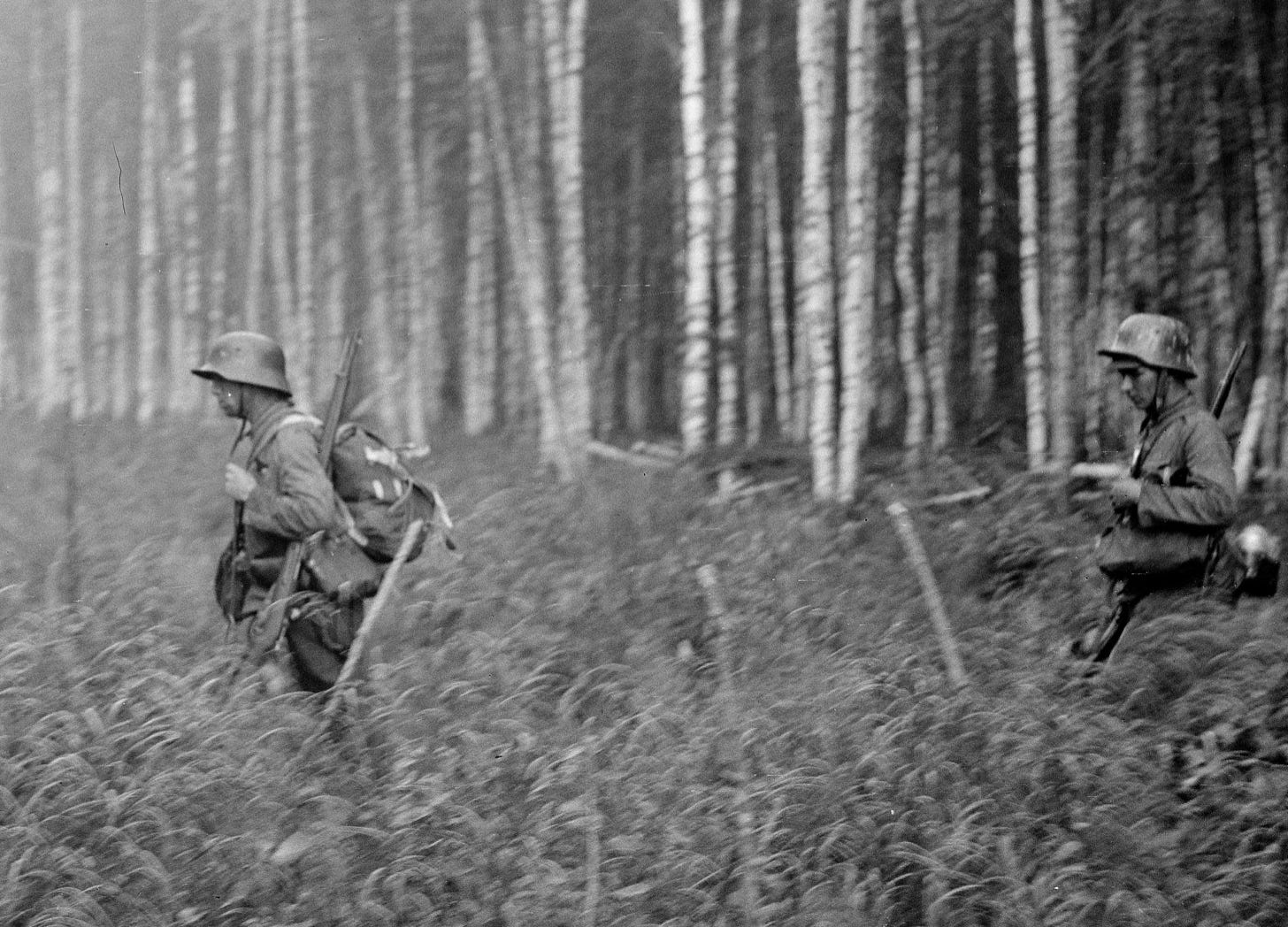

Forward
The Finn regards the forest as an ally. He knows how to exploit every feature of woodland conditions to his advantage. Training exercises have demonstrated the value of Finnish forest fighting methods for operations in the wooded regions of the East and North, as well as for combat against irregular forces.
Of these, the direction group merits particular attention.
The Direction Group
The Purpose of the Direction Group
The direction group simultaneously, which might be described as a ‘maid of all work’ for the column, serves as a means of providing security, orientation, pathbreaking, route marking, and liaison.
[Note: German soldiers had long used the expression ‘maid of all work’ (Mädchen für Alles) to describe the multifaceted role played by combat engineers (Pioniere).]
In the forest-familiar Finnish forces, any squad can perform this role. Thanks, however, to our lack of prior training in this field, each [German] company should train of squad of chosen ‘forest runners’ (Waldläufer) as a direction group. Thanks to the work of this squad, the overall leader can be sure that his unit will reach its objective in a secure and reliable fashion, without running about, the loss of cohesion, or unnecessary shouting (which betrays the presence of the unit). The direction group guides a unit through the thick forest quietly and calmly. It also relieves the overall leader of the unit of the work of navigation, thereby allowing him to fully focus his attention on the combat mission.
Roles within the Direction Group
The leader of the direction group prepares a march table, in which he records each segment of a route laid out by the unit leader. This table informs the orders he gives to the direction group.
The map-and-time man draws routes on the map, measures the distances involved, and tracks progress along those routes. This record of distances covered allows him to determine the group’s exact location. He makes a note of any discrepancies between terrain and map. At the same time, he keeps track of time.
The compass man receives the march bearings from the direction group leader and is responsible for maintaining strict adherence to them. He communicates correct headings to scouts.
The first pace-counter counts paces (Schritte). The second pace-counter converts paces into meters. (Sixty to sixty-three paces equals a hundred meters.) The pace counters tell the distance group leader when the group has covered a set distance.
The pathbreaker uses his hacking knife (Haumesser) to clear away larger branches. He removes other obstacles, thereby making it easier for men behind him to follow in his wake..
The marker uses strips of paper, bent branches, or tufts of moss to mark the route.
The flag man carries a clearly visible flag or cloth marker, thereby helping other squads follow in the path laid out (by the direction group).
Two scouts walk ahead of the direction group, remaining within sight (of other elements of the squad). They provide protection against surprise. The compass man provides bearings that help the scouts maintain direction.
Keep reading with a 7-day free trial
Subscribe to The Tactical Notebook to keep reading this post and get 7 days of free access to the full post archives.