

The Applicatory Method
A view from Fort Leavenworth
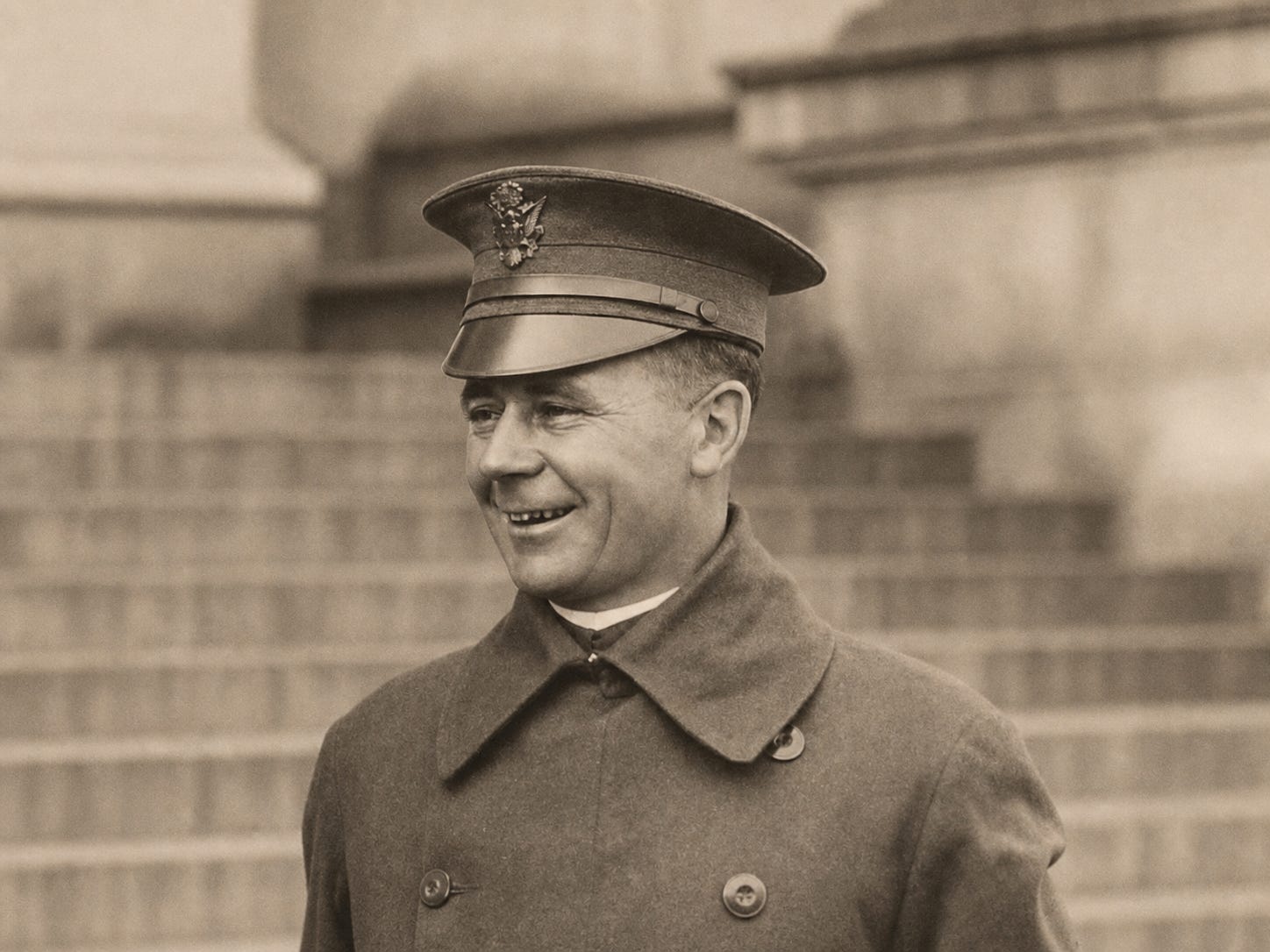
In September of 1921, Bernard Lentz matriculated at the US Army School of the Line. While attending that school for field grade officers, he wrote the libretto for At Kickapoo, a musical satire lampooning that institution that included the following barb: ‘Reading an approved solution is like playing bridge with your wife. Everything that you did was wrong’.
At some point in the same year, Major Lentz penned a longer, more serious critique of the teaching methods he experienced at Fort Leavenworth. It in appeared in the issue of the Infantry Journal for June of 1922, the month of his graduation.
The Applicatory Method
By Major Bernard Lentz, Infantry, D.O.L.
The underlying idea in the applicatory method is ‘learning by doing’. This method when correctly applied brings results because it is in harmony with the well-known principle in educational psychology which tells us that if one would be educated he must take part in the process. It is teaching in which the student participates.
The applicatory method is a method of instruction. It is admittedly the best means of instruction that has yet been devised. But we must use it as a method of instruction and not as something else, or it fails to function correctly.
Since this form of instruction is so widely used in the Army, a discussion as to its use and misuse should be of interest to all readers of the Infantry Journal.
I am of the opinion that the applicatory method is at times misused in our army, especially in some of our schools for officers. As long as we bear in mind that we are dealing with a method of instruction, we cannot go wrong very far. Its misuse is generally brought about by the attempts to have this process for imparting knowledge serve also as a measure of educational attainment. As will be brought out later, a method of instruction and a measure of educational attainment—a yardstick so to speak—differ fundamentally. When we try to make the applicatory method serve both as a method of instruction and as a measure of attainment, ability or anything else, it loses much of its effectiveness as a means for imparting knowledge because the emphasis is shifted to the measure feature, i.e., to the marks which the student gets, and the instructional feature becomes of secondary importance.
Before we can measure anything accurately we must have a standard—a basis—which is scientifically prepared. In everyday life we have many such scientifically prepared standards. For example: When you drive your machine to the filling station to have the gasoline tank refilled you tell the man the number of gallons you want. He fills the tank forthwith. He understands you perfectly. Why? Because you talk a common language; you express yourself in terms of a well-known unit of measurement. To use a slang phrase, ‘The man gets you’. The same thing happens when you are buying coal for your furnace, wood for your fireplace, or sugar for your table. There is nothing indefinite about any of these transactions because you are talking in units which are the universal standards of measurement.
It is comparatively simple to construct a scientific standard of measurement when we are concerned with an exact science such as algebra or arithmetic, but it is not so easy when it comes to art. It is art—military art—with which we are largely concerned in our officers’ schools. When we undertake to use the applicatory method to measure the comparative attainments of students in military art we are apt to go far astray because there is lacking a scientific standard.
It may be argued that an approved solution is the scientific standard on which the measuring or marking is based. The measuring or marking may be based on an approved solution, but such approved solution is not a scientific standard because, as we shall see later, it is not scientifically prepared and also because every problem in military art is unquestionably susceptible to several sound solutions. If we say that an approved solution is not the standard we go still farther astray, for then, to use a homely illustration, we measure one solution in terms of the ‘gallon’, a second in terms of the ‘pound’, and a third in terms of the ‘yard’. It should be clear that we cannot determine comparative ability unless we have a common standard of measurement.
These attempts to determine comparative ability when we are dealing with an art reminds me of the Philippine hombre’s method of giving the distance from one place to another. He was wont to say, ‘dos cigarros’, or ‘quatro cigarillos’, meaning that he would smoke two cigars or four cigarettes in going from the first place to the second. This measure of distance was accurate enough for his purpose but not for the lieutenant who, with his detachment, might be after a band of Pulajanes or Moros. Just so, the applicatory method with its attendant approved solution may be sufficiently accurate for the marker but not for the one being marked, especially if the success or failure of the latter’s future career in the Army may depend on the marks that are given.
Lest there still remain some doubt on this point, let us continue the discussion a little farther. The scientist, when he wants to find out how far a bullet will travel in air, assuming a certain propelling force, does not perform his experiment in vacuo. But this is precisely what happens in the preparation of an approved solution. Such solution is made up under conditions entirely different from those which obtain when the student solves the problem. There are no restrictions as to time, use of texts, etc., whereas the student is limited in all of these. The instructor preparing the approved solution finds himself in the delightful situation in which we used to find ourselves as boys with an arithmetic that had all the answers in the back. We looked at the answer first and then worked the problem backwards.
I do not advocate the plan which follows, but it is conceivable that approved solutions could be employed in a more or less scientific manner as standards for marking solutions in military art, if we were to proceed something like this: Place a certain number of instructors (the more the better) in the room with the students and have them prepare the approved solutions under the same restrictions as to time, texts, etc., as the student whose work is to be graded and then use the instructor’s solutions as standards of measurement. In this way we would still be far from accurate, but at least we would be approaching the subject from a quasi-scientific standpoint. I repeat, I do not advocate such a method. Additional reasons follow.
So far, I have attempted to make one main point—that the use of the applicatory method as an educational yardstick, though it may be partially applied, is inaccurate. It does not measure what we are after. For this reason alone it should be discarded.
But there are many other reasons why the applicatory method should not be used in the manner discussed. Some of these are the following:
The instructor spends endless hours as a marker, and so the fact that a school is intended for instructional purposes is often lost sight of. The instructor becomes a cog in a marking machine and, as such, he naturally cannot have that broad, tolerant conception of true education which is so essential if in the Army we would keep abreast of the best educational practice. There is always the tendency to look at military art as an exact science, for it facilitates marking.
Whenever a problem on which the student is to be graded comes along, the whole educational system is upset. The student’s objective becomes marks. Under the threat of a low mark the student accepts poll-parrot fashion almost anything that he thinks will bring him a high mark. Whether or not the student honestly believes in the correctness of the points under consideration is another question. Every correct principle is capable of having its accuracy demonstrated. It should be the big job of the instructor to lead his students into believing in the correctness of stated principles and not force the student into such belief. It should be assumed that the student has a right to take the attitude of being ‘from Missouri’, and it should be the welcome task of the instructor to ‘show him’, for that is the underlying idea in modern education. The first course develops leaders; the second followers.
What we are after in the Army is leaders.
Mr. Harrington Emerson, in his volume on Twelve Principles of Efficiency, enumerates as one the following: ‘Strenuousness and efficiency are not only not the same but are antagonistic’.
The use of the applicatory method as a yardstick creates such strenuousness. The wild search for old problems, the feverish running around to instructors for possible points on prospective problems and many other forms of aimless strenuousness, so destructive to real education, are all familiar to those who have watched the procedure.
On January 11, 1908, in a letter to the Secretary of War, President [Theodore] Roosevelt wrote as follows: ‘We need soldiers, not mere students, or rather we need students only so far as study helps towards soldiership’.
Does the use of the applicatory method as an educational yardstick square with Colonel Roosevelt’s ideas as quoted above? I submit that it does not. The use of the applicatory method in the manner indicated is purposely shrouded in secrecy, for the more the student is kept in the dark, the more efficiently, from standpoints other than the student’s, the applicatory method is working. Figuratively speaking, I see no reason why we should impede the student with all kinds of wire entanglements, trous de loup or chevaux de frise when our objective is the greatest educational progress in the time available and when we remember that the education given at a school is intended for practical use in the service.
The question will be asked: If the use of the applicatory method as a yardstick is discontinued, what is to take its place?
This suggests the story of the Kentuckian from the blue grass region who called on a doctor to be treated for red nose. ‘Doctuh’, the Kentuckian said, ‘What shall I take, Suh, to remove the redness of mah nose?’
‘Take nothing — especially between meals’, the doctor answered.
Unless we insist that some form of mental hazing is necessary, which I do not believe is the case, we don’t need anything to take its place, providing we take it for granted that personnel branches and Class B boards are proper and competent agencies for looking after the comparative ability of officers as revealed by complete records of service. Proper cooperation and coordination demand that schools should be educational institutions, pure and simple.
The above discussion does not intend to imply that students who solve problems by the applicatory method should not have their solutions corrected, nor that approved solutions are not important. The solutions should by all means be gone over and commented upon. Any student in the right frame of mind will welcome anything that points out to him wherein he is wrong or how a thing could have been done better. And this is where an approved solution has its great value. It guides the student in mastering established principles and so forms an essential step in the correct use of the applicatory method. A man is not dull if he makes mistakes, but only when he repeats the same mistake. This is a psychological principle that should be borne in mind in this connection.
Now let us consider some ways of using the applicatory method as a means of instruction. It is correctly used in the map maneuver where the student is called upon to say what he will do under an assumed situation. Its proper use is also shown in the solution of a map problem. It is only when the map problem is made to function as a means of measuring comparative attainment that the misapplication of the method comes in force.
I believe the applicatory method should in large part displace the conference and the lecture. Any process of learning demands that the student do some real thinking about the subject at hand. The instructor’s problem is how to get the student to think. To give a student forty or fifty pages to study, even when the text is put in the form of problems with solutions and discussions added, does not necessarily mean that the student will really expend mental energy on the subject. Most of the time it does not. The man who prepared the text has done most of the thinking that is going to be done on the particular problem. The student spends several hours reading over the text, and then the instructor may go over it again in a conference or a lecture.
A good use of the applicatory method would, to my mind, be as follows:
Let us assume that the subject is advance guard. Let the student be supplied with a sheet that enumerates in a concise way all the principles involved in the solution of advance guard problems. It would in many cases be desirable to start off with a short lecture by the instructor who would elaborate on the principles. Then let the student be given a problem to solve. For the first one, the student might be told what principles are intended to be illustrated in the problem in order (and this is good educational practice) that he may be led gradually from the simple to the complex. The student solves the problem. This makes him think and that, as has been said before, is what the instructor wants. When the problem has been solved, a discussion, which may appropriately have as its line of departure an approved solution, follows immediately.
The student who has not violated the principles probably had a good grasp of the subject to start with and can be dismissed from the mind of the instructor. The one who has violated the principles profits by the mistakes he has made. From the psychological standpoint, the student who has made mistakes in the application of the principles (unless he is a dullard) will have the principles more firmly impressed on his mind than the one who didn’t make the mistakes in the first place. By utilizing some of the time often taken up in conferences and lectures, such a problem may be followed up by a second and a third on the same subject, and by that time the student, having done some real thinking and having profited by the discussion (led by the instructor), has acquired a working knowledge of the subject.
In approaching the subject in this way, the student has saved numerous hours of simulated study of reams of texts and apparent listening to hours of conferences and lectures, and instead he has gone straight to the point by doing some real, hard thinking.
The point to remember here is that we must get the student to think. When we succeed in this we are using the applicatory method correctly as a method of instruction.

The subject under discussion would not be complete without a word concerning methods and means of measuring men. Let us see what some well-known people have to say on the subject.
Mr. Ellis Parker Butler in a recent article published in the Outlook, wrote as follows:
A college education or any other education is valueless unless its owner knows how to use it. We are not helped by what we know but by what we know how to use. Who’s Who is not filled with college graduates; it is filled with men and women who know how.
Here is what John H. Bartlett, president of the Civil Service Commission, has to say on the subject of picking men and women for Civil Service.
The Government needs to take more into consideration the plus qualities of men and women, moral and character attributes which go to make up the intangible thing known as personality. In the rugged battle of life the race is not to the man who can conjugate amo. The prize goes to the man who has that intangible something known as personality, and personality is made up of ability, strength and appearance.
Does not the essence of the aforesaid quotations apply in the Army in a marked degree? I believe it does.
Men may be compared with automobiles—two, four or six cylinders. We wouldn’t say that an automobile is a fine machine if we simply test one cylinder and find that it ‘hits’ all right. Yet that is what we do when we test a man by the marks he makes in a school.
To get at the real value of a man we must examine all his cylinders, and in the Army the only way this can be done with any measure of success is to base our estimate on the man’s entire record of service.
We cannot close our eyes to the fact that there is abroad in the Army a widespread feeling that there is something wrong with the schools that use the applicatory method as a means for measuring an officer’s ability. Students are often reluctant to come to these schools, and instructors are frequently kept at the schools when they would rather be elsewhere. Many graduates, when occasion offers, roundly and bitterly denounce the school methods. I believe the crux of the whole matter lies in the misuse of the applicatory method when it is made a means for measuring comparative ability.
The best interests of the service demand the elimination of this incorrect and inaccurate use of the applicatory method and a more extensive use along correct lines. Let all the time of students and instructors be devoted to education of the kind that, as Roosevelt said, ‘helps towards soldiership’, and let other agencies, already functioning in the Army, decide an officer’s value to the service.
When we do this, officers will welcome a detail to a school either as students or as instructors, and there will be developed in these schools a broadness of ideas which so eminently fits in with the modern idea of education as the unfolding and the perfecting of the human mind.
Source
Bernhard Lentz ‘The Applicatory Method’ The Infantry Journal (June 1922) pages 604-609 (Hathi Trust)
Bernhard Lentz (and others) A Program of Entertainment Given by the Line Class at Fort Leavenworth, Feb. 21 1922 (Combined Arms Research Library)
In fall of 1978, this writer attended the Infantry Officers Course at Camp Barrett, MCB Quantico. On day one, 36 of us newly minted 0302’s gathered in a classroom at TBS and Major Bo Dishman who had just replaced then Major Oliver North, let us in on a secret, there were no school solutions for the next 6 weeks. Everything would be practical application, yep some reading and writing, but we would learn by doing and so it went. That very first afternoon we trucked out to a place somewhere close to TBS and were given a problem, rifle platoon in the defense. I was gob smacked, what do I do now? I turned around and looked at an older LDO Captain, firmly ensconced on a small three legged field stool one leg crossed over the other smoking a pipe. He caught my look and said…”Don’t look at me Lieutenant it’s your problem now…” We early IOC graduates got the privilege of getting to the fleet, with a new mind set. The fleet was waiting. Today, it is fair to say, IOC is one of most defining and well run and challenging schools in the US military, if anyone has the opportunity to meet a young 0302 today, they are something else. So the Corps must be doing something right.
This all said, we have dozens and dozens of senior and flag grade officers, that are nothing more than milk fed veal…all the same, all the same school solutions and answers, and most of the answers are wrong because any lessons learned in the last 80 years are put in the top left hand drawer of the Secretary of War’s desk, never to see the light of day until the mistakes of the past fights have been repeated. We see them up in front of Congress babbling numbers and concepts, the senior senators hungover and falling asleep, waiting for the lunch break and a nice amber colored liquid drink with their BLT sandwich (crusts cut off of course) in the senate dinning room. Who cares? Well, if we can train some of the finest young infantry officers (and the Corps is not alone) then maybe the senior officers and the the watch dogs could try to pay attention long enough to not repeat the same mistakes over, and over and over again. Like precision daylight bombing in a limited nature that will render the enemy useless…whether in mud huts, or deep caves, the resistance is the same…then came boots on the ground, and “you go to war with the army you have…” “Don’t look at me Lieutenant, its your problem now…”
Great essay. Yet here we are almost 115 years later with the same problems confronting us. The Quantico Renaissance was surely a great thing, but is professional military education still pro forma or pro patria?