

Storm Troop Training (June 1917)
Diary of a Stosstrupp Leader (Part 23)

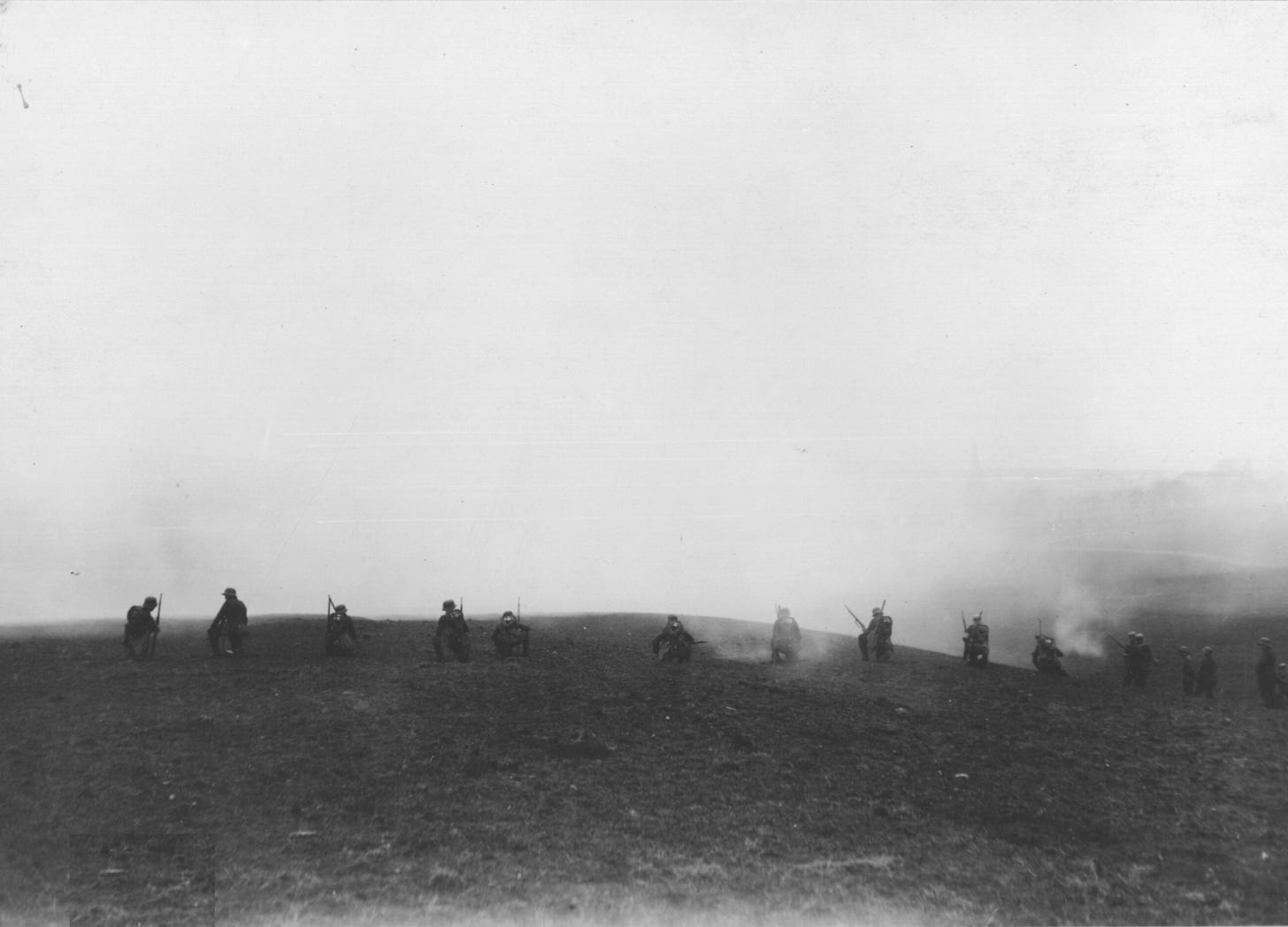
This post continues the translation of the diary of a German soldier who fought in the First World War. Readers can find links to other posts in this series in the following guide.

1 June 1917
Russian machine guns did a great deal of firing
2 June 1917
The weather was very warm. In the evening, our interpreter, Private Ganglow, spoke with some Russians. The Russians said that they were done with the war, and that it was only the French field gun crews and machine gunners who continued to fire. ‘Once you get rid of your Wilhelm,’ the Russians said, ‘we can make peace. Nicholas Nikolaevich (Grand Duke Nicholas Romanov, commander-in-chief of the Russian Army) has been arrested.’
We treated them (the Russians) to a mandolin concert. They responded with hearty applause. We agreed to refrain from shooting for a day.
3 June 1917 (Sunday)
I reported to the regimental commander, Lieutenant Colonel Breyding. He awarded me the Iron Cross, Second Class and told me that, if he was ordered to conduct a trench raid, he wanted me to lead the raiding party. To this end, I would be seconded to Assault Battalion 11 in Kovel for some training.
After reporting, Captain Kittel, of 1/97, invited me to eat with him. Everything was very nice.
Alas, my well-deserved home leave has been delayed.
4 June 1917
At ten pm I attended an iron-cross party in the company headquarters of Sector B I a. Spengler, Röser, Hinnenthal, and I were the guests of honor. The party lasted until two in the morning. We drank red wine and sekt (German sparkling wine)
1 through 5 June 1917
All day, and especially at night, we exchanged artillery and machine gun fire with the Russians.
6 June 1917
At three in the morning, a lot of artillery and trench mortar fire fell.
8 June 1917
I prepared for my trip to Kovel.
9 June 1917
At four in the morning, Geiger and Anton and I traveled from the trenches to the combat trains. At seven, we began, along with one sergeant and two men, the journey to Radcyn. Anton Karaus, my orderly, returned to the company. He was, alas, poorly suited to the life of a storm trooper (Sturmtruppler).
I continued with the sergeant and Geiger. We arrived in Kovel at four in the afternoon. I reported to the commandant of the town. I was assigned quarters with Lieutenant von Guben in a private house at 10 Kaiserstrasse.
Note
The use of the term Sturmtruppler, which I had never seen before, took me by surprise. So, I went looking for other appearances. Apart from Jedi-adjacent references, the only three instances I found - one in the history of an Austrian infantry regiment and two in tales of Austro-Hungarian daring-do in an illustrated serial - suggest that use of the term was largely confined to subjects of the Hapsburg Empire. (Digital Study Room of the Czech Ministry of Defense)
10 June 1917
I stood no watches.
11 June 1917
I stood duty from seven fifteen until eleven.
I ate my breakfast, lunch, and dinner in the officers’ mess and spent my evenings in either the Austrian officers’ mess or the Hotel Bristol.
12 June 1917
I stood duty from seven until half past nine. It was very hot. I spent the evening in the theatre, (where I saw a comedy called) Pension Schöller.
13 June 1917
I stood several hours of duty in the morning. By nine am, it was already too hot. I spent the evening at the cinema.
14 June 1917
As I did on most mornings in those days, I walked for an hour to the sandy training grounds. There, I was trained as the leader of a Sturmtrupp. I threw hand grenades, blew up obstacles, ran obstacle courses, and learned all the things that a storm trooper (Sturmtruppler) needed to know.
16 June 1917
I stood duty from six thirty to eight fifteen and, at night, from seven thirty until three. It was very hot. I was invited to the officers’ mess of the assault battalion.
17 June 1917 (Sunday)
I ran into Kern in the Officers’ Home.
To be continued …
Sources
The text comes from Alwin Lydding Meine Kriegstagbuch (My War Diary), an unpublished manuscript that I found at the Bundesarchiv (German Federal Archive) (Folder N 382/1).
Related Reading


.