

Solutions to Short Problem 7
From the 'Infantry School Mailing List'

The first volume of the Infantry School Mailing List, which rolled off the press in 1931, offered readers a set of sixteen short tactical problems. On 30 June 2026, The Tactical Notebook published the seventh of these.

This article provides both of the author’s solution published with the problem. So, if you would like to play your way through the series, please engage the exercise before reading this post.
PUBLISHED SOLUTION TO PROBLEM NO. 7
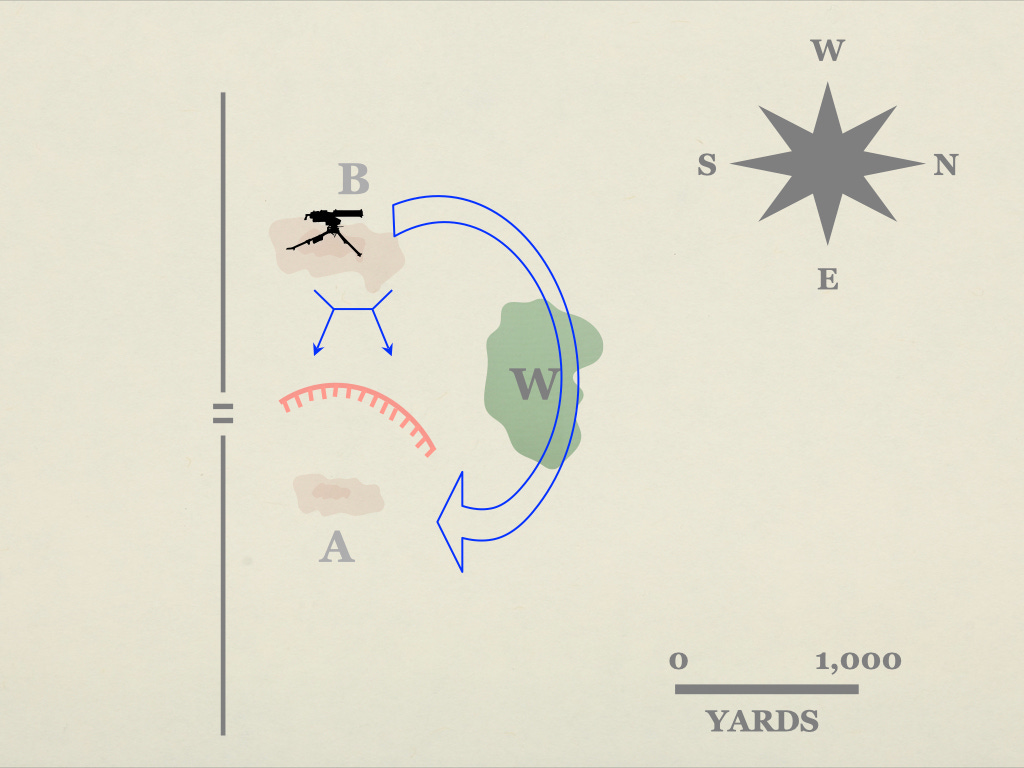
In the first case the battalion will fix the enemy in position by machine gun fire from B while rifle units advance in column of companies through woods W to strike the enemy in flank.
It seems that the enemy in this case can be fixed, that is, kept fully occupied and prevented from shifting troops to a more threatened locality, by machine gun fire alone. The decisive attack can thus be made stronger. The requisite conditions for fixing by fire alone are good observation for the adjustment of fire and lack of good avenues of withdrawal for the enemy being subjected to fire.
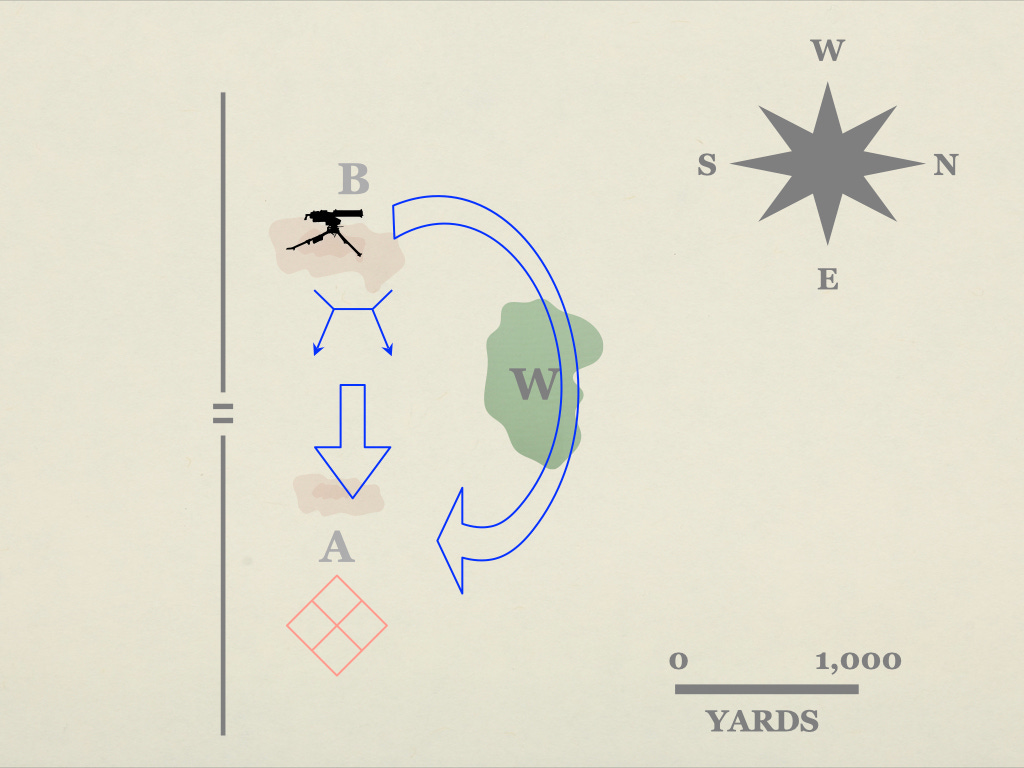
In the second case the enemy on hill A cannot be fixed by automatic fire alone, since he is at liberty to shift the bulk of his troops behind A to meet the decisive maneuver. Therefore in addition to machine gun fire from B, he must be fixed by the advance of one rifle company from B toward A, while the rest of the battalion executes the maneuver through W.
For the enemy to be fixed in this case, he must be forced to employ more troops initially to insure security from the direction of B.
SOLUTIONS DISCUSSED AT MEETINGS OF THE DECISION GAME CLUB
In describing his solutions to the two versions of Problem Number 6, the author of the exercise made no mention of a reserve. His solution to the second version, moreover, assigned tasks of other sorts to all of the component companies of the battalion, thereby leaving no unit in a position to serve as a reserve. Nonetheless, most of those who offered solutions at meetings of the Case Method Club held back a portion of the battalion (usually a rifle company, but, in one instance, a pair of machine gun platoons) to respond to crises, exploit opportunities, and protect the open flank of both the battalion and the larger friendly force.
Like the solutions provided by the author, most courses of action offered during the Zoomdezvous made use of the woods (at W) to conceal the movement of an enveloping force. This raised the possibility that enemy forces might be hiding in the woods. Thus, before sending a company (or two, or three) into the woods, some participants conducted reconnaissance patrols, which ranged in size from a handful of scouts to a complete company.
A few participants combined an envelopment through the woods with an attack against the other flank of the enemy position. This led to mention of the role played by the boundary along the south edge of the battalion position.
Most participants employed their machine gun company as a ‘grand battery’ of sixteen pieces. A few, however, detached a pair of machine gun platoons, whether for attachment to rifle companies or (in one instance) to create a reserve. This lead to fruitful discussions about the pros and cons of employing companies as whole units (and thus the costs and benefits of forming of task forces.)
Sources
‘Infantry Problems’ Infantry School Mailing List (Fort Benning: US Army Infantry School, 1931) Volume 1 (1930-1931) page 41 (Internet Archive)
The Internet Archive preserves scans of microfilmed copies of all thirty volumes of the Infantry School Mailing List. However, it catalogs them under the heading of the Infantry School Quarterly, which succeeded the Mailing List in 1947. (Internet Archive)
The Hathi Trust provides links to scanned-from-paper copies of some, but far from all, issues of the Infantry School Mailing List (Hathi Trust)
The quotation from Kipling appeared in the original version of the problem. The complete poem can be found on the website of the Kipling Society.
Related Reading

