Please note: In an attempt to remove a duplicate of the first version of this post, I deleted both copies. Thus, with apologies to those who receive duplicates, I am publishing this post for a third time.
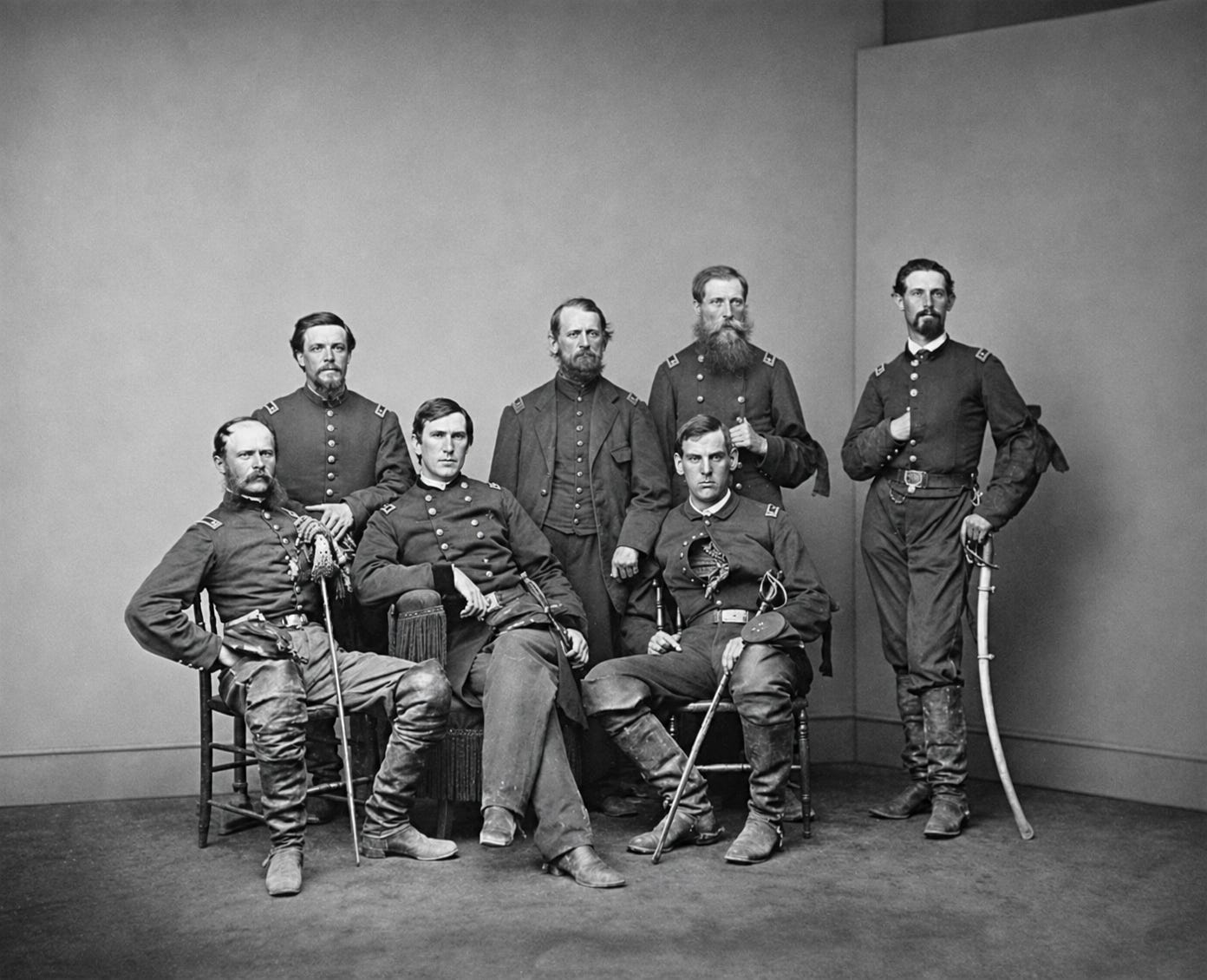
In like manner as to the staff. The more intimately it comes into contact with the troops, the more useful and valuable it becomes. The almost entire separation of the staff from the line, as now practiced by us, and hitherto by the French, has proved mischievous, and the great retinues of staff-officers with which some of our earlier generals began the war were simply ridiculous. I don’t believe in a chief of staff at all, and any general commanding an army, corps, or division, that has a staff-officer who professes to know more than his chief, is to be pitied.
Each regiment should have a competent adjutant, quartermaster, and commissary, with two or three medical officers. Each brigade commander should have the same staff, with the addition of a couple of young aides-de-camp, habitually selected from the subalterns of the brigade, who should be good riders, and intelligent enough to give and explain the orders of their general.
The same staff will answer for a division. The general in command of a separate army, and of a corps d’armée, should have the same professional assistance, with two or more good engineers, and his adjutant-general should exercise all the functions usually ascribed to a chief of staff, viz., he should possess the ability to comprehend the scope of operations, and to make verbally and in writing all the orders and details necessary to carry into effect the views of his general, as well as to keep the returns and records of events for the information of the next higher authority, and for history.
A bulky staff implies a division of responsibility, slowness of action, and indecision, whereas a small staff implies activity and concentration of purpose. The smallness of General Grant’s staff throughout the civil war forms the best model for future imitation.
So of tents, officers’ furniture, etc., etc. In real war these should all be discarded, and an army is efficient for action and motion exactly in the inverse ratio of its impedimenta. Tents should be omitted altogether, save one to a regiment for an office, and a few for the division hospital. Officers should be content with a tent fly, improvising poles and shelter out of bushes. The tente d’abri, or shelter-tent, carried by the soldier himself, is all-sufficient. Officers should never seek for houses, but share the condition of their men.

A recent message (July 18, 1874) made to the French Assembly by Marshal MacMahon, President of the French Republic, submits a projet de loi [proposed act of Parliament], with a report prepared by a board of French generals on ‘army administration,’ which is full of information, and is as applicable to us as to the French. I quote from its very beginning:
The misfortunes of the campaign of 1870 have demonstrated the inferiority of our system.... Two separate organizations existed with parallel functions - the general more occupied in giving direction to his troops than in providing for their material wants, which he regarded as the special province of the staff, and the intendant (staff) often working at random, taking on his shoulders a crushing burden of functions and duties, exhausting himself with useless efforts, and aiming to accomplish an insufficient service, to the disappointment of everybody.
‘This separation of the administration and command, this coexistence of two wills, each independent of the other, which paralyzed both and annulled the dualism,’ was condemned. It was decided by the board that this error should be ‘proscribed’ in the new military system. The report then goes on at great length discussing the provisions of the ‘new law,’ which is described to be a radical change from the old one on the same subject.
While conceding to the Minister of War in Paris the general control and supervision of the entire military establishment primarily, especially of the annual estimates or budget, and the great depots of supply, it distributes to the commanders of the corps d’armée in time of peace, and to all army commanders generally in time of war, the absolute command of the money, provisions, and stores, with the necessary staff-officers to receive, issue, and account for them. I quote further:
The object of this law is to confer on the commander of troops whatever liberty of action the case demands. He has the power even to go beyond the regulations, in circumstances of urgency and pressing necessity. The extraordinary measures he may take on these occasions may require their execution without delay. The staff-officer has but one duty before obeying, and that is to submit his observations to the general, and to ask his orders in writing. With this formality his responsibility ceases, and the responsibility for the extraordinary act falls solely on the general who gives the order. The officers and agents charged with supplies are placed under the orders of the general in command of the troops, that is, they are obliged both in war and peace to obey, with the single qualification above named, of first making their observations and securing the written order of the general.
With us, to-day, the law and regulations are that, no matter what may be the emergency, the commanding general in Texas, New Mexico, and the remote frontiers, cannot draw from the arsenals a pistol-cartridge, or any sort of ordnance-stores, without first procuring an order of the Secretary of War in Washington. The commanding general - though entrusted with the lives of his soldiers and with the safety of a frontier in a condition of chronic war - cannot touch or be trusted with ordnance-stores or property, and that is declared to be the law!
Every officer of the old army remembers how, in 1861, we were hampered with the old blue army-regulations, which tied our hands, and that to do any thing positive and necessary we had to tear it all to pieces - cut the red-tape, as it was called - a dangerous thing for an army to do, for it was calculated to bring the law and authority into contempt; but war was upon us, and overwhelming necessity overrides all law.
This French report is well worth the study of our army-officers, of all grades and classes, and I will only refer again, casually, to another part, wherein it discusses the subject of military correspondence: whether the staff-officer should correspond directly with his chief in Paris, submitting to his general copies, or whether he should be required to carry on his correspondence through his general, so that the latter could promptly forward the communication, endorsed with his own remarks and opinions. The latter is declared by the board to be the only safe rule, because ‘the general should never be ignorant of any thing that is transpiring that concerns his command.’
In this country, as in France, Congress controls the great questions of war and peace, makes all laws for the creation and government of armies, and votes the necessary supplies, leaving to the President to execute and apply these laws, especially the harder task of limiting the expenditure of public money to the amount of the annual appropriations. The executive power is further subdivided into the seven great departments, and to the Secretary of War is confided the general care of the military establishment, and his powers are further subdivided into ten distinct and separate bureaus. The chiefs of these bureaus are under the immediate orders of the Secretary of War, who, through them, in fact commands the army from ‘his office,’ but cannot do so ‘in the field’ - an absurdity in military if not civil law.
The subordinates of these staff-corps and departments are selected and chosen from the army itself, or fresh from West Point, and too commonly construe themselves into the elite, as made of better clay than the common soldier. Thus they separate themselves more and more from their comrades of the line, and in process of time realize the condition of that old officer of artillery who thought the army would be a delightful place for a gentleman if it were not for the d—d soldier; or, better still, the conclusion of the young lord in ‘Henry IV.,’ who told Harry Percy (Hotspur) that ‘but for these vile guns he would himself have been a soldier.’
This is all wrong; utterly at variance with our democratic form of government and of universal experience; and now that the French, from whom we had copied the system, have utterly ‘proscribed’ it, I hope that our Congress will follow suit. I admit, in its fullest force, the strength of the maxim that the civil law should be superior to the military in time of peace; that the army should be at all times subject to the direct control of Congress; and I assert that, from the formation of our Government to the present day, the Regular Army has set the highest example of obedience to law and authority; but, for the very reason that our army is comparatively so very small, I hold that it should be the best possible, organized and governed on true military principles, and that in time of peace we should preserve the ‘habits and usages of war,’ so that, when war does come, we may not again be compelled to suffer the disgrace, confusion, and disorder of 1861.
The commanding officers of divisions, departments, and posts, should have the amplest powers, not only to command their troops, but all the stores designed for their use, and the officers of the staff necessary to administer them, within the area of their command; and then with fairness they could be held to the most perfect responsibility. The President and Secretary of War can command the army quite as well through these generals as through the subordinate staff-officers. Of course, the Secretary would, as now, distribute the funds according to the appropriation bills, and reserve to himself the absolute control and supervision of the larger arsenals and depots of supply. The error lies in the law, or in the judicial interpretation thereof, and no code of army regulations can be made that meets the case, until Congress, like the French Corps Législatif (Parliament), utterly annihilates and ‘proscribes’ the old law and the system which has grown up under it.
It is related of Napoleon that his last words were, ‘Tête-d’armée!’ [head of the army]. Doubtless, as the shadow of death obscured his memory, the last thought that remained for speech was of some event when he was directing an important ‘head of column.’ I believe that every general who has handled armies in battle must recall from his own experience the intensity of thought on some similar occasion, when by a single command he had given the finishing stroke to some complicated action; but to me recurs another thought that is worthy of record, and may encourage others who are to follow us in our profession.
I never saw the rear of an army engaged in battle but I feared that some calamity had happened at the front - the apparent confusion, broken wagons, crippled horses, men lying about dead and maimed, parties hastening to and fro in seeming disorder, and a general apprehension of something dreadful about to ensue; all these signs, however, lessened as I neared the front, and there the contrast was complete - perfect order, men and horses full of confidence, and it was not unusual for general hilarity, laughing, and cheering.
Although cannon might be firing, the musketry clattering, and the enemy’s shot hitting close, there reigned a general feeling of strength and security that bore a marked contrast to the bloody signs that had drifted rapidly to the rear; therefore, for comfort and safety, I surely would rather be at the front than the rear line of battle. So also on the march, the head of a column moves on steadily, while the rear is alternately halting and then rushing forward to close up the gap; and all sorts of rumors, especially the worst, float back to the rear. Old troops invariably deem it a special privilege to be in the front - to be at the ‘head of column’ - because experience has taught them that it is the easiest and most comfortable place, and danger only adds zest and stimulus to this fact.
The hardest task in war is to lie in support of some position or battery, under fire without the privilege of returning it; or to guard some train left in the rear, within hearing but out of danger; or to provide for the wounded and dead of some corps which is too busy ahead to care for its own.
To be at the head of a strong column of troops, in the execution of some task that requires brain, is the highest pleasure of war - a grim one and terrible, but which leaves on the mind and memory the strongest mark; to detect the weak point of an enemy’s line; to break through with vehemence and thus lead to victory; or to discover some key-point and hold it with tenacity; or to do some other distinct act which is afterward recognized as the real cause of success. These all become matters that are never forgotten. Other great difficulties, experienced by every general, are to measure truly the thousand-and-one reports that come to him in the midst of conflict; to preserve a clear and well-defined purpose at every instant of time, and to cause all efforts to converge to that end. To do these things he must know perfectly the strength and quality of each part of his own army, as well as that of his opponent, and must be where he can personally see and observe with his own eyes, and judge with his own mind.
No man can properly command an army from the rear, he must be ‘at its front;’ and when a detachment is made, the commander thereof should be informed of the object to be accomplished, and left as free as possible to execute it in his own way; and when an army is divided up into several parts, the superior should always attend that one which he regards as most important. Some men think that modern armies may be so regulated that a general can sit in an office and play on his several columns as on the keys of a piano; this is a fearful mistake. The directing mind must be at the very head of the army - must be seen there, and the effect of his mind and personal energy must be felt by every officer and man present with it, to secure the best results. Every attempt to make war easy and safe will result in humiliation and disaster.
Sources and Notes
Apart from items printed in italic letters, the text of this post comes from: William Tecumseh Sherman Memoirs of William T. Sherman (New York: D. Appleton, 1875) Volume II, Chapter XIV (Internet Archive)
Librivox offers, free of charge, an audio version of the aforementioned chapter. The viva voce version of the paragraphs reprinted in this post can be found in the recording marked ‘Military Lessons of the War - Section 3’. (The Tactical Notebook salutes Librivox reader David Wells for the high quality of this program and thanks him for his support of this remarkable service.)
The proposal submitted by President MacMahon divided the general staffs of the army of the Third Republic into three parts: the 1èr Bureau (administration and logistics), the 2ème Bureau (intelligence), and the 3ème Bureau (operations). In 1917, on the eve of the adoption of this arrangement by the American Expeditionary Forces, the French authorities separated the functions of administration and logistics, thereby creating the 4ème Bureau.
Related Reading


Clearly General Sherman did not think much of Berthier, Gneisenau, Marcy or Rawlings! He is, naturally, completely correct about the early staffs of the US Civil War and the danger of staffs being disconnected from the rest of the Army, which we keep seeing that to this day. However, how does a staff stay synchronized with the commander, and itself, if there is no one directing it? Or did the Adjutant do that in his view?
I also appreciate his references to Frederic Bastiat, but not to Patrice de MacMahon (“I shall remove from my promotion list any officer whose name I have seen on the cover of a book.”).
Too bad Congress did not listen to him about the reorganization of the War Department! The bureau system he describes only became worse until Elihu Root showed up!
“bring the law and authority into contempt; “ as war was upon them. Interesting. Presently authority is respected but that will pass with elections, the law is so contemptible now as to be beyond salvation.