

Ranks
The Baltic Landeswehr

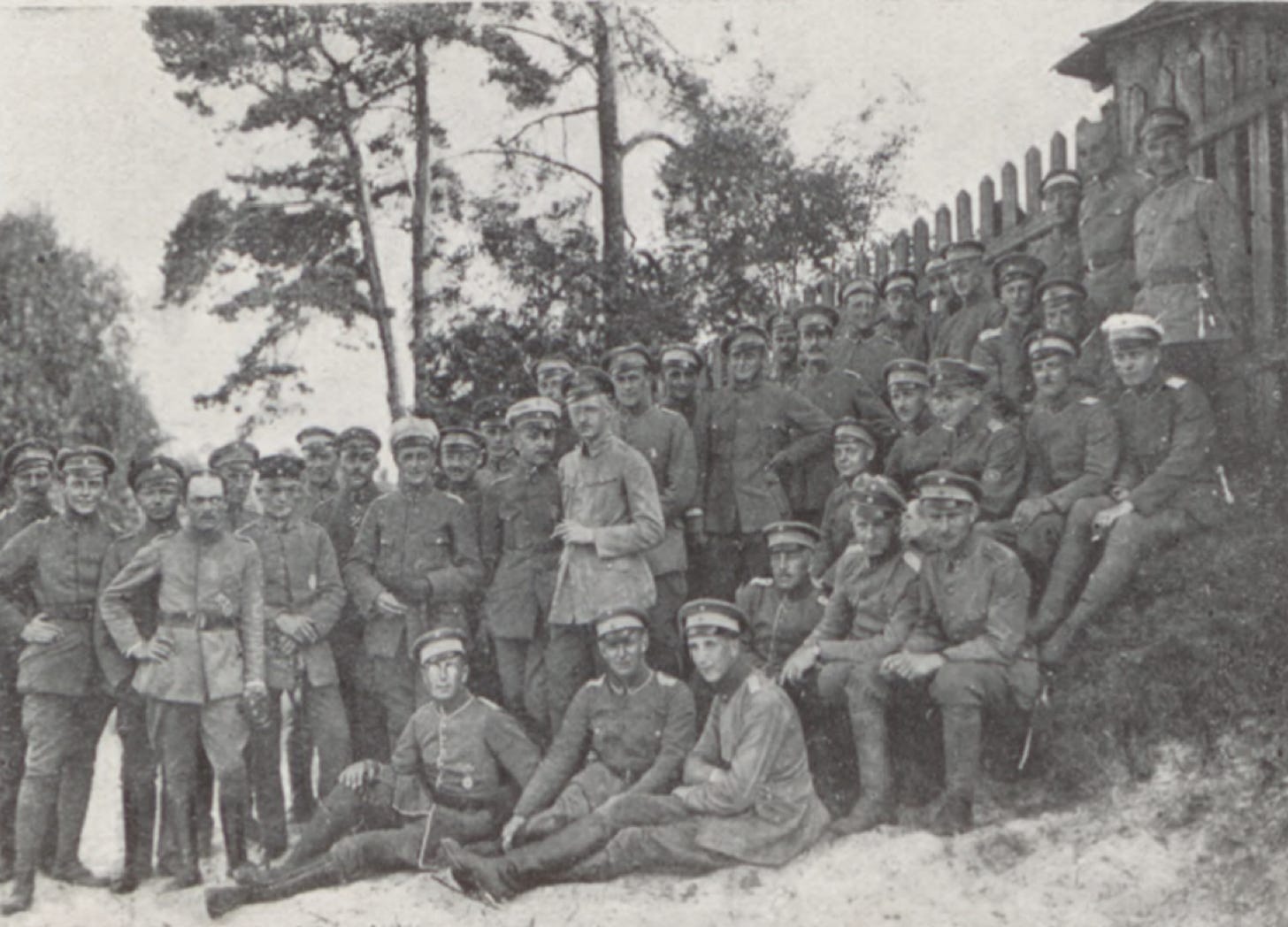
Upon joining the Baltic Landeswehr, a man became a ‘volunteer’ (Freiwillige).
If he distinguished himself in the field, a Freiwillige might be promoted to the rank of Wappner. Borrowed from tales of the Middle Ages, where it meant ‘squire’, this word would later be used to describe a statue that held the coat of arms (Wappen) of a city.
Late in February of 1919, each Wappner of the Landeswehr traded that title for the rank of Gefreiter. While less appealing to folks who recite Medieval poetry, the latter designation (which I often translate as ‘lance corporal’) would have been fully familiar to all of those who had served in the armies of the Russian and German Empires.
A squad leader usually wore the rank of ‘field master’ (Feldmeister). This, like Wappner, seems to have been peculiar to the Landeswehr.
A platoon leader might bear the title of ‘senior field master’ (Oberfeldmeister). If, however, he enjoyed the status of a commissioned officer, he was known either as a ‘cornet’ (Kornett) or an ‘ensign’ (Fähnrich).
While not as old-timey as Wappner, Kornett was a term for ‘junior officer of cavalry’ that, while widely used in the seventeenth and eighteenth centuries, had since fallen out of use in most European armies. Those who had served in one of the German armies, however, would have recognized a Fähnrich as someone who had met most, but not all, of the qualifications for the rank of ‘second lieutenant’ (Leutnant).
In keeping with the horsey quality of the name of that kind of unit, the commander of a Schwadron rated the rank of ‘captain of cavalry’ (Rittmeister). Some of the Schwadron commanders, however, continued to be known by the ranks they had earned in the service of an empire, whether ‘lieutenant’ (Leutnant), ‘first lieutenant’ (Oberleutnant), or ‘captain’ (Hauptmann).
In much the same way, while the default rank for the commanding officer of a battalion (such as the Stosstruppe), was ‘commander’ (Kommandeur), many who held that position preferred the ranks they had worn during the World War. (In most cases, this was Major.)
Note
Based entirely upon the sources listed, this description differs somewhat from the one found on page 63 of Toomas Boltowsky and Nigel Thomas in their Armies of the Baltic Wars of Independence (Oxford: Osprey, 2019). In particular, while I distinguish between the ranks accorded by the Landeswehr and those carried over from other armies, Lieutenant Colonel Boltowsky and Dr. Thomas merge all ranks into a single hierarchy.
Sources
Abteilungsbefehle Nr.1 - 109, Nr.1 - 115 der Stoßtruppe der Baltischen Landeswehr (Orders-1-115 of the Assault Unit of the Baltic Territorial Force) (Bundesarchiv R 8025/6) (Bundesarchiv)
Baltische Landeswehrverein (Baltic Territorial Force Society) Die Baltische Landeswehr im Befreiungskampf gegen den Bolschewismus : ein Gedenkbuch (The Baltic Territorial Force in the Liberation Struggle against Bolshevism: A Memorial) (Riga: G. Löffler, 1929) (Kujawsko-Pomorska Digital Library)
The picture at the top of this page comes from Die Baltische Landeswehr …
For Further Reading


While Wappner is a very interesting sounding rank, being a Rittmeister (Riding Master) is even more so (and undoubtedly better paying).
What were the qualifications for moving from Fahnrich* to commission? An interesting question indirectly raised.
*Cadet
“Fähnrich as someone who had met most, but not all, of the qualifications for the rank of ‘second lieutenant’ (Leutnant)”