

Rain
Diary of a Stosstrupp Leader (Part 10)

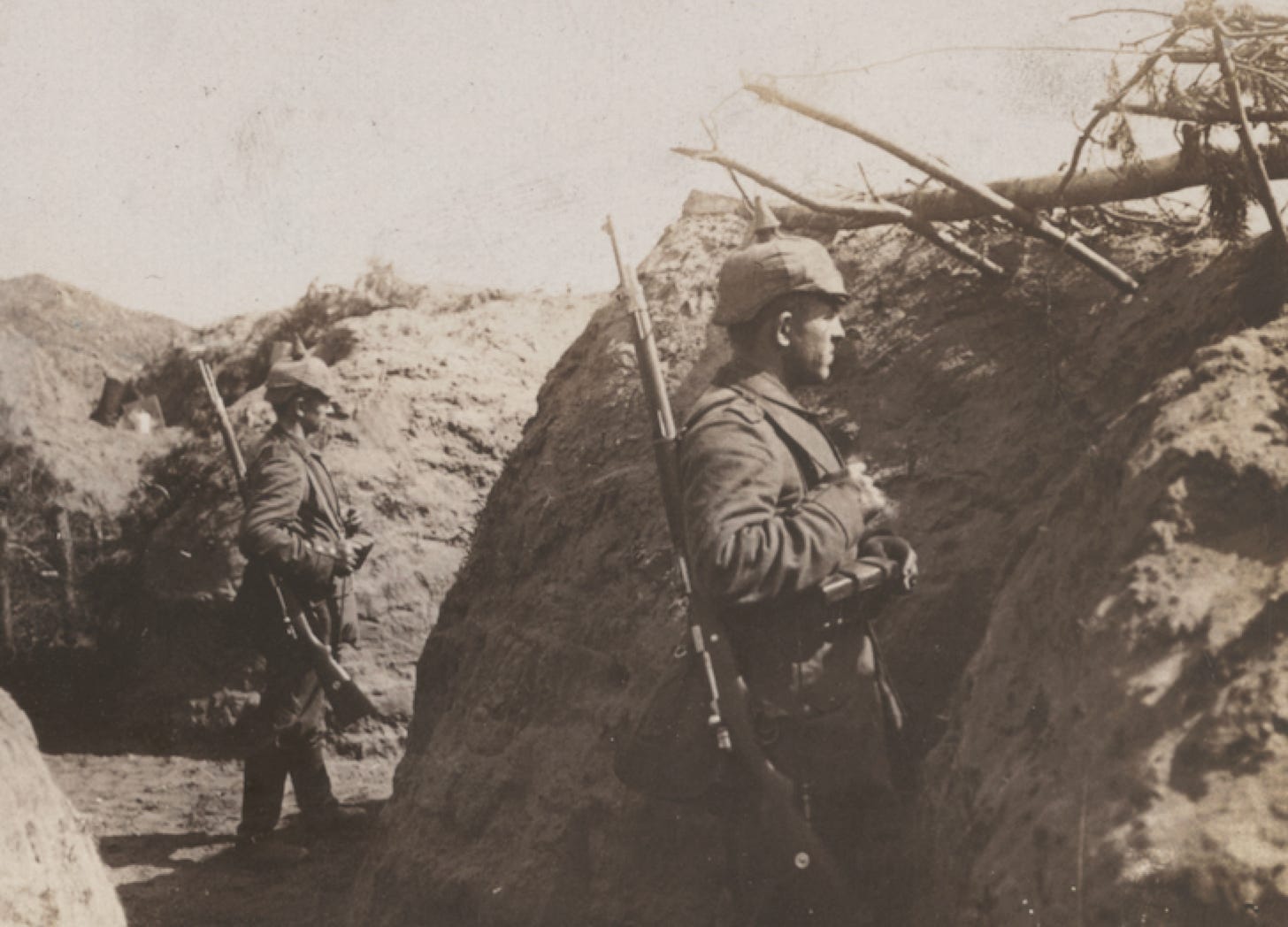
This post continues the translation of the diary of a German soldier who fought in the First World War. Readers can find links to other posts in this series in the following guide.

19 November 1916
Winter arrived. It was very cold. At night, we were relieved by the 8th Company.
My batman (Putzer) Loske and I moved into in a small platoon commander’s shelter in the Forest of Zarucka. Inside, all was cozy. Outside, nothing was cozy.
21 November 1916
I reported to the battalion headquarters to receive my pay as an ensign (Fähnrich). I received twenty-six marks and fifty-five pfennigs. Of this, five marks came from prize money (Beutegeld).
I went to the camp to spend the night with my 3rd Platoon.
Later that night, my platoon and I went forward, for (our superiors) had received a report of the appearance of two companies of Russians, with machine guns. Frightful mud. We spent yet another night of our well-deserved rest period in a wet and muddy fighting trench.
23 November 1916
In the morning and afternoon, I supervised two platoons charged with widening the communications trench that led to sector B II b.
26 November 1916
We took care of our gear, cleaned our rifles, and underwent an inspection in marching order. In the evening, we relieved the 2nd Company (2./97th Infantry) in sector B II c. The sector turned our to be very long (more than one kilometer wide). The enemy seemed to be eight hundred kilometers away, in places even further. The position was well-wired and well secured with forward listening posts.
At dawn and dusk, the times of greatest danger, we all occupied the fighting trenches. Otherwise, half of us spent the night in the trenches (while others were able to rest.)
In every platoon, two sergeants (Unteroffiziere) stood duty (during the hours of darkness). One supervised the men on watch in the trenches and the other the listening posts. Also, in every platoon, the platoon commander or his deputy watched over the sentries in the trenches and the men in the listening posts.
During the day, a pair of sentries stood watch in every platoon sector, one platoon commander served as the duty officer for the company.
I stood this duty from seven to eleven in the morning and from three to six in the afternoon.
25 November 1916
Duty from eight to ten in the morning, seven to eleven in the evening, and three to six in the wee hours of the following morning.
25 November 1916 (Sunday)
I marched the Protestant men to a church service in the cemetery for fallen German soldiers. While the enemy artillery rarely fired, the Russian riflemen did a great deal of shooting. A Russian sniper made us very uncomfortable.
I spent the day in a chalk trench (a forward strong point on the right flank) in the vicinity of a trench gun, where a man standing on the walkway for riflemen had a hole shot through his cap. In the distance, we could see, through binoculars, a single Russian sharpshooter.
28 November 1916
I stood duty from midnight until two in the morning, from seven to eleven, and from three to six. This is a long time for a junior leader (Portepeeträger) to shoulder responsibility for the security of such a large sector. In snow, rain, and frost, five hours was a long time to stand in a trench, especially in wet clothing and boots, and after having eaten a third of a plate of soup from the field kitchen (with bits of wheat, groats, or oats in it), bread, and marmalade.
Too much standing guard and too little sleep wore out the men. It reduced their fighting power (Kampfkraft).
All hands stood to in the trenches from four to seven in the morning and from three thirty to seven in the afternoon, a total of six and a half hours. From seven in the evening until four in the morning, half of the men found themselves on duty. (During these nine hours, each man spent four-and-a-half hours guarding the trench and four-and-half hours in a listening post.) In addition to this, each man lost about four hours each day to such things as standing watch in the trenches, delivering food, or on working parties. Thus, in each twenty-four hours, there remained but six-and-a-half hours for such things as sleeping, eating, and writing letters.
Service in listening posts, close to enemy obstacles and Russian sentries, proved especially demanding. In his lonely hole, the soldier strained his ears and his eyes to the limit, paying attention to every possible sound so that, in the event of a surprise attack, he might warn his company. In winter, the unrelenting, health-sapping damp and long periods of darkness made this duty even more difficult.
to be continued …
Source
The text comes from Alwin Lydding Meine Kriegstagbuch (My War Diary), unpublished manuscript, Bundesarchiv (German Federal Archive) N 382/1
For Further Reading

Few people ever said “World War I, sure wish I could’ve been there for that!”
When it’s not outright hellish, it’s always squalid and miserable.
Rain is always miserable for the infantryman. The account of the "cozy" Platoon Commander's shelter is an experience any infantryman can relate to. There are few things better than finding a "cozy" respite from the wet and cold, even for just a little while!