

Promotion
Diary of a Stosstrupp Leader (Part 19)

This post continues the translation of the diary of a German soldier who fought in the First World War. Readers can find links to other posts in this series in the following guide.

1 March 1917
The Russian ‘tin-can bombs’ (fired from trench mortars) bothered us more and more every day.
I gave a package containing my boots to Gefreiter Junker, who was going on leave.
I stood duty from eight to ten in the morning and from nine thirty to one thirty at night.
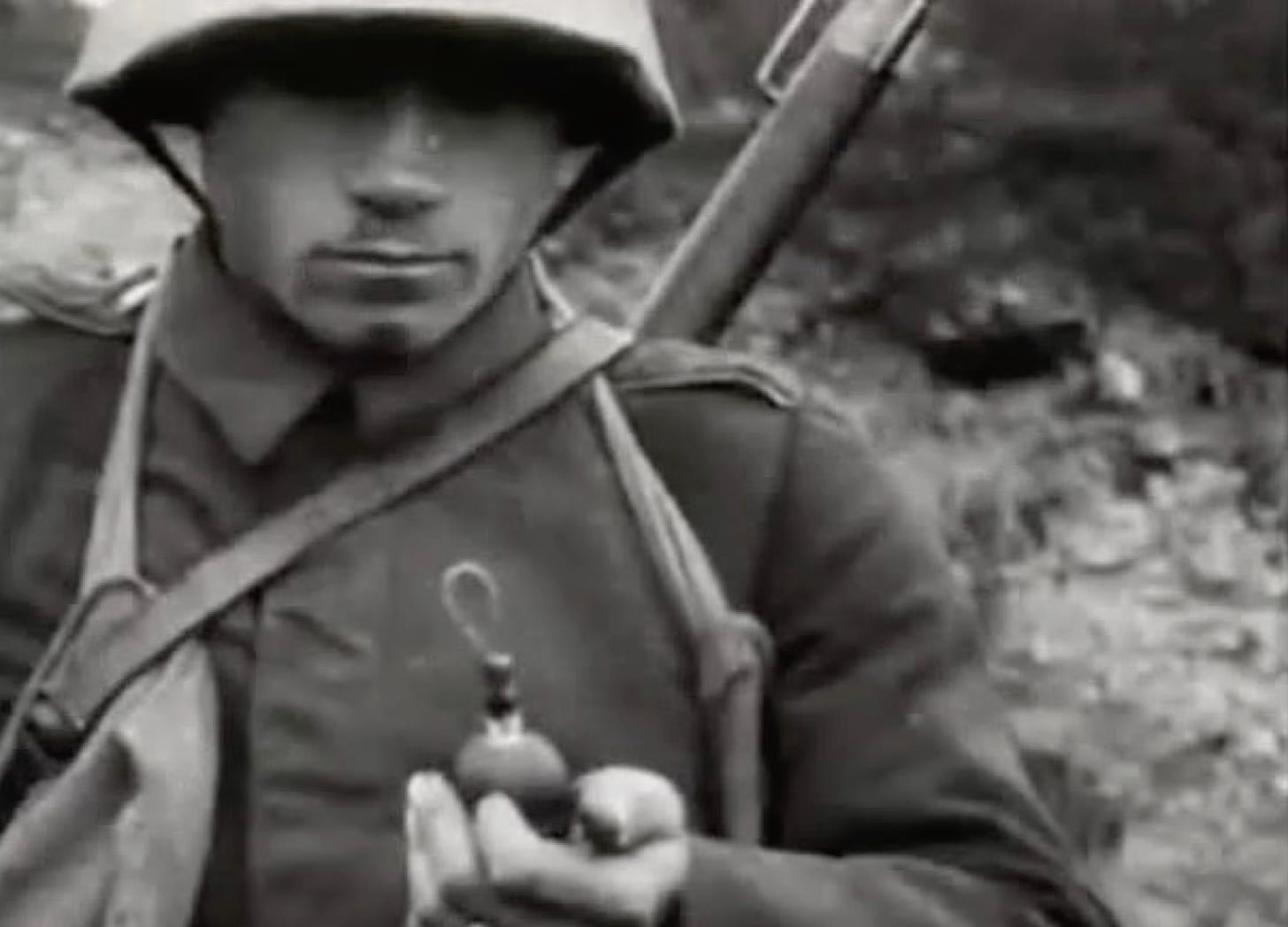
While defending against a Russian patrol, Private Schmidt was wounded by the premature detonation of one of our own egg grenades. He lost a lot of a blood. Fragments struck him in the side, the thigh, and the back of his head. I bound his wounds.
Lieutenant Rudloff was seconded to an Austrian unit.
Lieutenant Kastelleiner took command of the company.
Winter and I drank a glass of wine with him.
He is a great scaredy-cat (Angsthase). We called him ‘Big Bear’ and his orderly (bâtman) ‘Little Bear’.
Russian trench mortars (both light and heavy) fired often around the clock, but especially at night.
Our enemy uses illumination rounds with two long-lasting parachute flares.
2 March 1917
Private Zimmer got shot in the toe.
4 March 1917 (Sunday)
Today, the regimental commander, Lieutenant Colonel Breyding, visited my sector.
5 March 1917
At night, the moon shone clearly. It was very cold. I stood two watches, one of two hours and one of four.
6 March 1917
The Russians fired machine guns and trench mortars against our daytime sentry posts of the ‘Sentry Heights’ (Postenhöhe).
All indicators suggested an imminent attack.
Looking through tripod-mounted binoculars, I could see the Russians cutting lanes in their own barbed wire.
Three squads took up positions on the Sentry Heights.
I joined the 1st Squad (ten rifles) in the listening post holes on the far right (of this position).
We occupied this position until seven in the evening. After that, we resumed our usual nighttime routine.
Once again, we waited in vain for the Russkies to attack.
I was disappointed that they didn’t come. Perhaps the men in the trenches refused to move.
There was a noticeable calm over there.
7 March 1917
Quiet reigned during the day.
8 March 1917
Lots of snow fell into, and was blown into, the trenches. The weather was frightful, with a big snowstorm. In the evening, the 1st Platoon was, at last, relieved by the 8th Company, and so went into the camp in the woods.
9 March 1917
We underwent delousing and a gas chamber test.
10 March 1917
From seven to eleven in the morning, and again, from five to ten in the evening, I took an eleven-man detail to the trenches to shovel snow.
11 March 1917 (Sunday)
We rested.
I visited Hartmann in his position and took two photos.
I was paid 21 Marks.
12 March 1917
In the morning, (my snow-shoveling crew) cleaned the trench to the left of the company line.
In the evening, the staff of II/97 (the battalion in which I served) invited Lieutenant Winter and me to dinner.
Captain Meissner, our battalion commander, gave a speech congratulating me on my promotion (to the rank of second lieutenant, which was dated) on 9 March 1917.
To be continued …
Sources
The text comes from Alwin Lydding Meine Kriegstagbuch (My War Diary), an unpublished manuscript that I found at the Bundesarchiv (German Federal Archive) (Folder N 382/1).
The video comes from a training film from 1918 called Infantry Close Combat (Infanterie Nähkampf). To can find both the clip that was used and the film as a whole on YouTube.