

Odd Squads
Of the Cold War

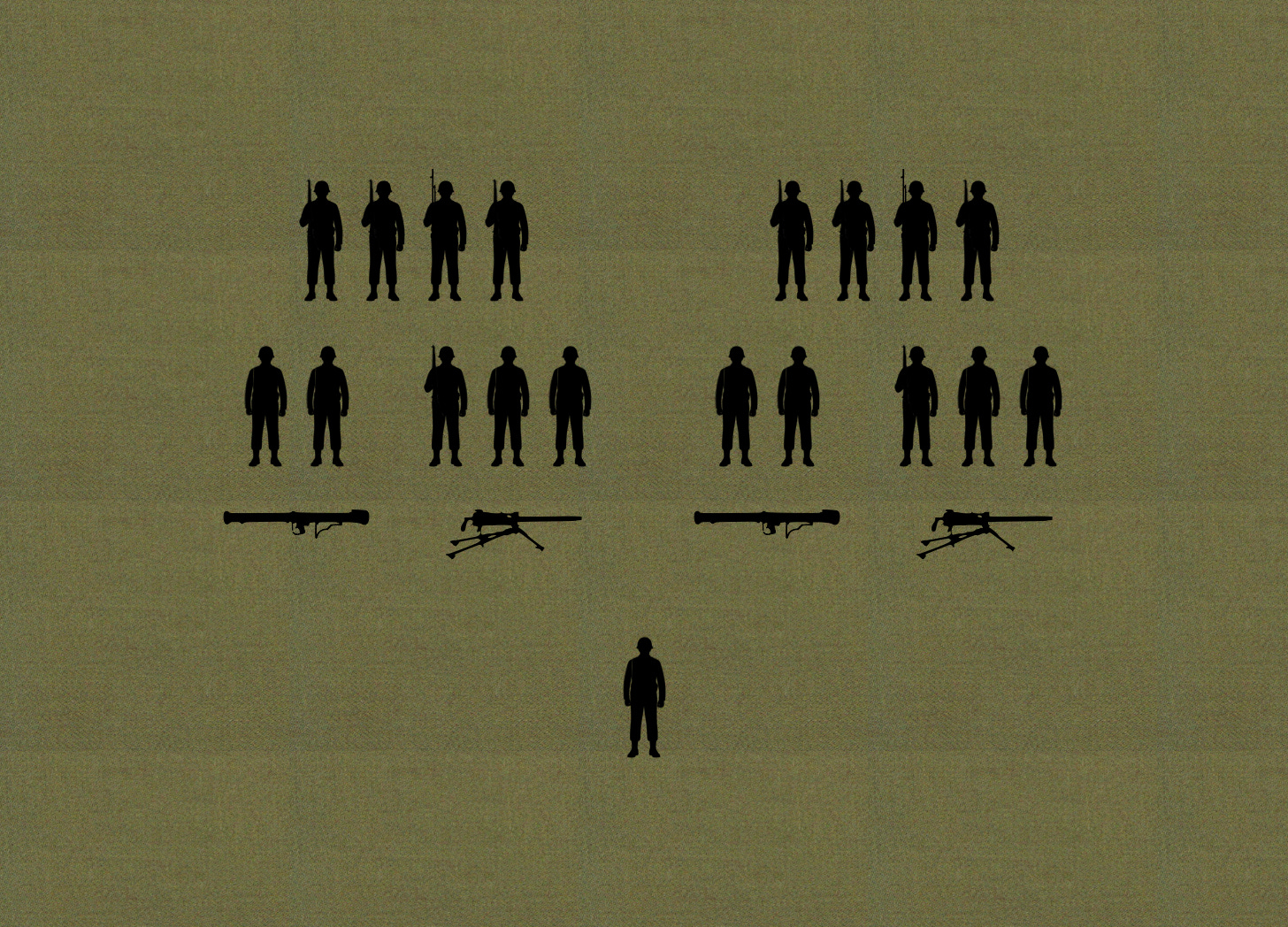
As a rule, squads belong to platoons, platoons to companies, and so on. Every once in a while, however, an organizational architect will provide a relatively large organization with an element that gives a commander the ability to deal with squad- or platoon-sized problems without depriving one of his subordinates of a substantial portion of his combat power.
In 1957, for example, the US Marine Corps experimented an infantry regiment that, with a view towards service on a nuclear battlefield, had been optimized for dispersed operations. That is, the three battalions of each regiment would, under normal circumstances, expect to operate at greater distances from the regimental command post than had previously been the case.
With this pattern of employment in mind, the architects of this regiment provided it with a ‘command post security platoon’. Led by a technical sergeant, this platoon consisted of two four-man fire teams (like the ones found in rifle squads), two three-man light machine gun teams (each armed with an air-cooled .30 caliber Browning), and two two-man rocket-launcher teams (each of which carried a 3.5-inch ‘Super Bazooka’.)
In the 1970s, Franz-Uhle Wettler designed light infantry units for service in the woods and towns of West Germany that supplied the commanders of both companies and battalions with comparable organizations. In particular, he proposed that each rifle company rate a Verfügungsgruppe (‘disposition squad’) and each infantry battalion get a Verfügungszug (‘disposition platoon’). Organized, armed, and trained like an ordinary rifle squad, the first of these served, under the direction of the first sergeant (Hauptfeldwebel), in the headquarters of a rifle company. In much the same way, the second, which would have been hard to distinguish from an ordinary rifle platoon, worked directly for the battalion commander.
Sources
John J. Sayen Battalion: An Organizational Study of United States Infantry (unpublished manuscript) Appendix 8.23
Franz Uhle-Wettler Gefechtsfeld Mitteleuropa , Gefahr der Übertechnisierung von Streitkräften (Munich: Bernard & Graefe, 1980)
You can find both the aforementioned appendix and a translation of the latter work at the Military Learning Library.
Related Reading


Curious that the Marine Corps chose to call a 19 Marine unit a platoon, when it is clearly Section sized. Could they have done that so it would rate a Technical Sergeant instead of a Staff Sergeant or do I have my early Cold War rank terminology mixed up?