

Meet the Mule
Military Mules of the US Army

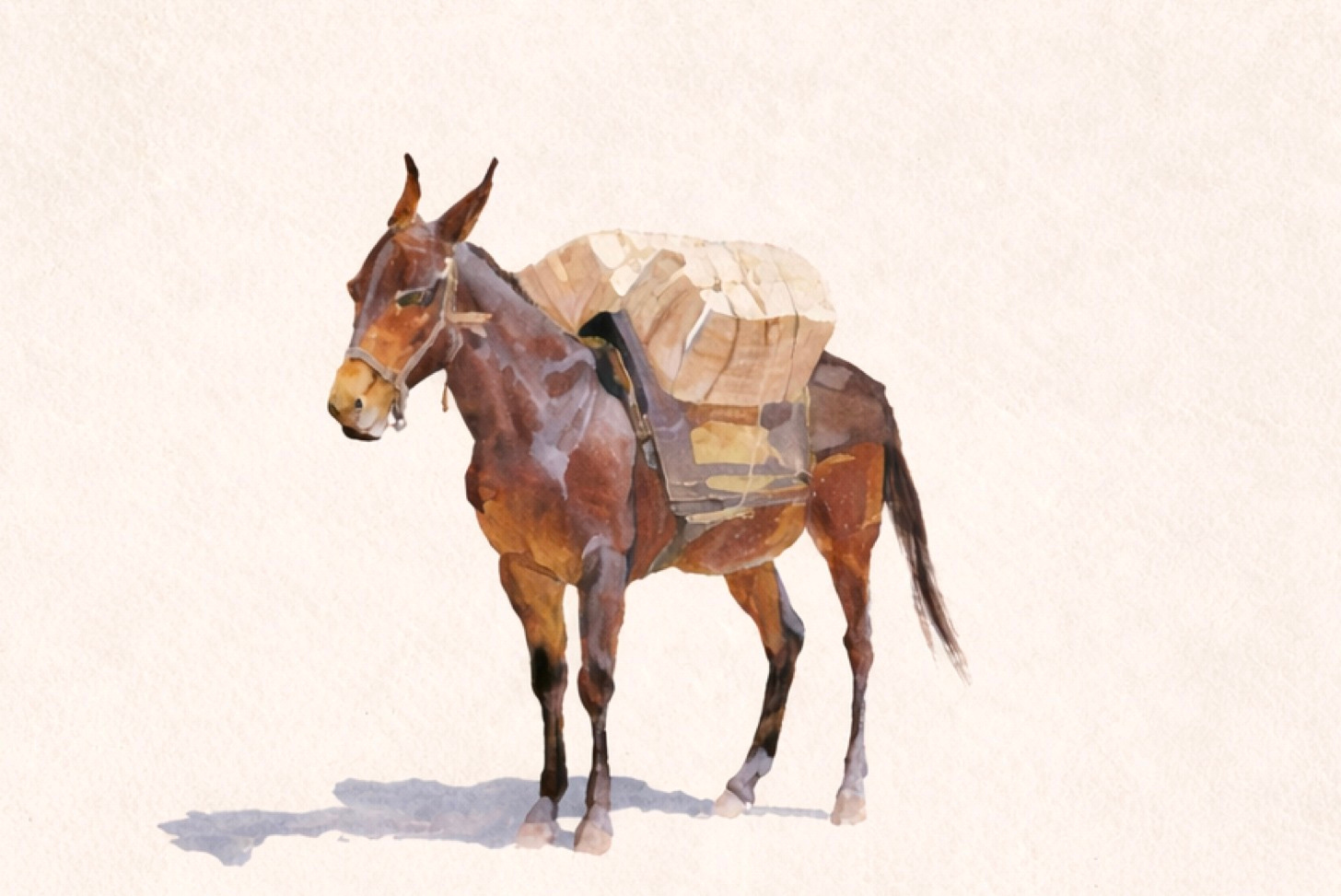
Marches and Loads
Section 81. Under ordinary conditions, the pack mule carrying a load of 250 pounds will travel from 20 to 25 miles per day, and maintain a rate of speed of 4 1/2 to 5 miles per hour.
With occasional days of rest he may be expected to perform this amount of work steadily; and this, too, without the aid of grain or hay.
It must be remembered, however, that except on extraordinary occasions pack mules should never be tied to a picket line, but should be herded as much as possible. In bivouac they should be taken to graze at night as well as day, packers being detailed as herd guard.
The ‘bell’ horse being hobbled or picketed in the vicinity, there is no danger of the mules stampeding, as they will not leave the ’bell’.
If allowed to graze, mules will always keep in average condition, and on nutritious grasses will stand a twelve months’ campaign and keep fat.
Section 82. Mountainous country. In rough and mountainous country, the pack mule will carry the same load (250 pounds), and travel from 10 to 15 miles per day. He should not, however, be forced when traveling up or down a mountain, unless the occasion is very urgent. Uphill work is hard on man and beast.
Section 83. Forced marches. In forced marches the pack animals should not be loaded in excess of 200 pounds.
If traveling with cavalry, the pack mule may not be able to spurt off at a 10-mile gait, but he will be pushing the horse before 30 miles are covered, and he has the horse at his mercy in a march of 75 to 100 miles in twenty-four hours.
The following instances, out of a great many, may be briefly mentioned:
In the campaign of 1881, under Colonel Buell, Fifteenth Infantry, against Chiefs Victoria and Nana, of the Warm Spring tribe of Apaches, a company of Indian scouts and one pack train made a march of 85 miles in twelve hours, loaded 200 pounds to the pack animal.
Later, in pursuing Indians of the same tribe, a company of Indian scouts and one pack train marched from old Fort Cummings to Fort Seldon, on the Rio Grande, about 60 miles, from sunrise to sunset ; then went by rail to Fort Craig, N. Mex., loaded 250 pounds to the mule; marched across the valley, some 30 miles, to the San Mateo Range; struck the trail of Chief Nana and party; and, without making an all-night camp, followed the hostiles into old Mexico, south of the Hatchet Mountains.
This was a running fight the entire way. A distance of about 300 miles was covered in about four days.
During the ‘Loco’ outbreak from San Carlos Agency, Arizona, in 1882, one company of scouts and one pack train, loaded 200 pounds to the mule, made a forced march of 280 miles in three days.
During the Garza campaign on the Rio Grande frontier, in Texas, in 1891 and 1892, a troop of the Third Cavalry and a part of one pack train marched 108 miles in sixteen hours; the mules were loaded 250 pounds to the mule.
In the same campaign another troop, with part of a pack train, marched 104 miles in a night and part of the following day.
In another instance, in the same campaign, a pack train made 90 miles in less than twenty-four hours, the animals carrying loads of 250 pounds. After such marches the mules were given twelve to twenty-four hours’ rest to regain their normal condition.
It should be remembered that pack animals should be kept in condition by constant exercise, for if fat such marches will quickly kill them.
Source
Henry W. Daly Manual of Pack Transportation (Washington: Government Printing Office, 1917) pages 144=145 (Internet Archive)
Related Reading

🎼 I'd rather be a soldier
With a mule and mountain gun
Than a knight of old with spurs of gold or Roman, Greek or Hun. 🎵
Wow! An honorable beast. Great post!!