

Bombs and Basements (May 1918)
Diary of a Stosstrupp Leader (Part 53)

This post continues the translation of the diary of a German soldier who fought in the First World War. Readers can find links to other installments in this series in the following guide.

19 May 1918
The number of enemy aircraft grew at a terrifying rate. I sometimes counted fifty to eighty planes a day engaged in combat in the skies above us.
Despite the enemy advantage in numbers, the German aviators shot down many planes.
20 May 1918
Life in our sector often proved hellish.
Another unit relieved us as battle battalion. After five days of putting up with shell holes, shell fire, and gas, we (looked forward to) a few days of rest.
(When we were in our rest area), planes dropped bombs on us and artillery fired upon us. Nonetheless, we were away from the gruesome field of corpses, and could sleep, eat, and, at times, even wash.
22 May 1918
An artillery shell scored a direct hit on the battle battalion headquarters we had recently left. It tore to pieces First Lieutenant Miller of the regimental staff of the 97th Infantry, who had taken the place of the battalion commander, who had fallen ill.
26 May 1918
At night, my battalion (I/97) moved into Marcelcave to relieve the Third Battalion (III/97) of its duty the ready battalion. We took up residence in the cellars of the shot-up houses.
27 May 1918
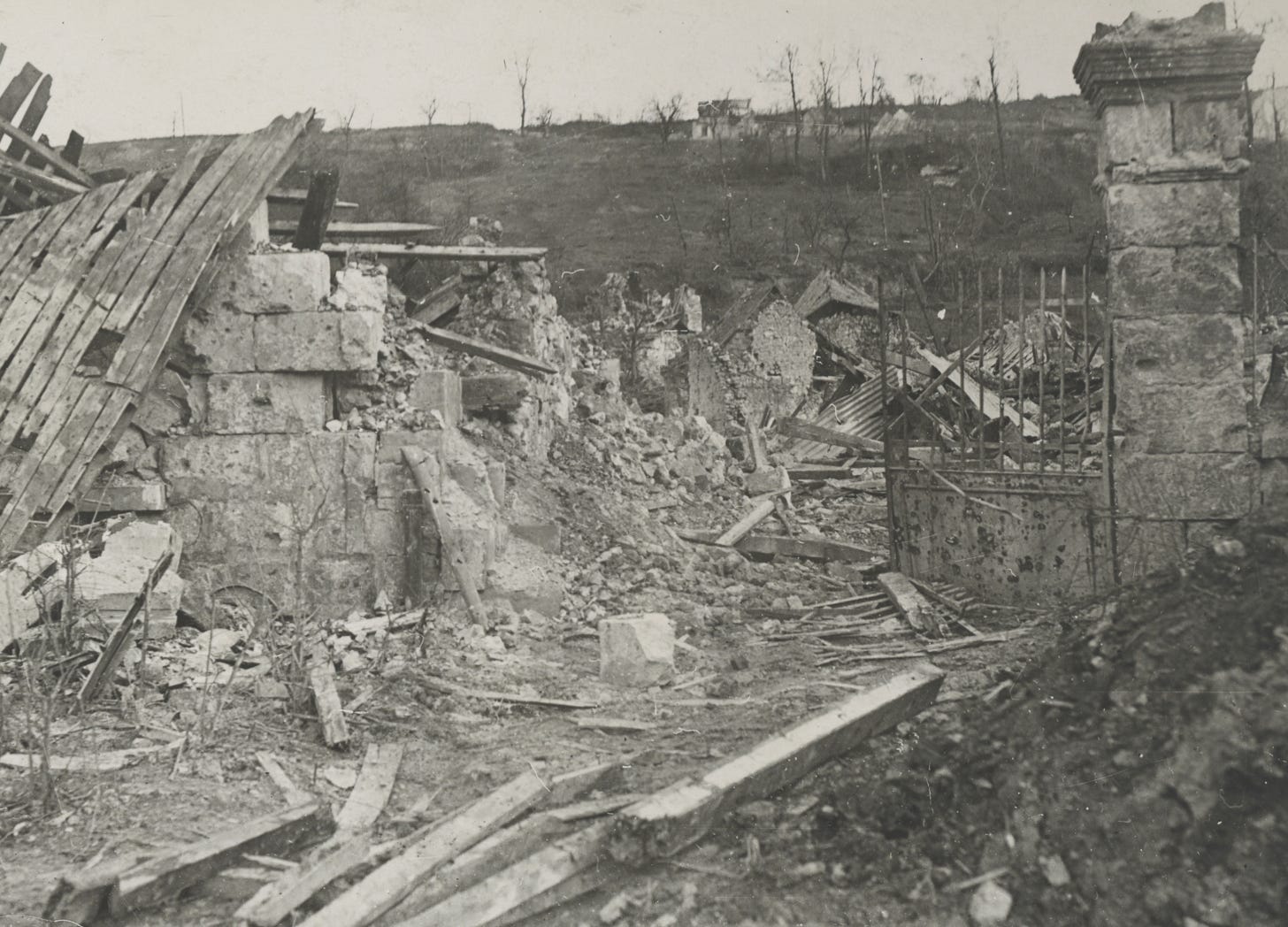
The enemy fired many concentrations of artillery fire against us. At eight or so, shell landed on top of the house next to ours. Many men were killed, badly wounded, or buried alive. Marcelcave had become nothing more than a pile of ruins and rubble.
31 May 1918
At night we marched into Hell to relieve the Third Battalion (III/97) from its service as battle battalion. We wondered if we would survive five days in such a place.
To be sure, some of us would survive, perhaps only the smallest part of our tiny band.
It seemed ludicrous to call our unit a ‘battalion’. It consisted of four groups of twenty-five men piece, and thus mustered fewer men than half of a full-strength company.
In the afternoon, the British used heavy gas shells to subject us to a surprise gas attack.
Gas filled all of our cellars.
to be continued …
Sources
The text comes from Alwin Lyding Meine Kriegstagbuch (My War Diary), an unpublished manuscript that I found at the Bundesarchiv (German Federal Archive) (Folder N 382/1).
Related Reading

What it feels like to lose a protracted war of attrition.
English people who only know about World War II through the tragic lens of war poets should at least be aware of this. The British Army was a juggernaut by the end of World War I. All the Germans who write about the British talk about the massive scale of the artillery attacks they endured.